
Competitive Pricing Analysis for SaaS Revenue
Compare subscription, usage, and hybrid SaaS pricing and use competitor intelligence to boost revenue while protecting margins.

SaaS pricing is a powerful growth lever, but most companies still rely on guesswork, leaving up to 40% of revenue untapped. In 2026, two major trends dominate:
- Hybrid Pricing Models: 77% of companies now combine subscriptions with usage-based fees, reflecting the rising costs of AI tools like LLM APIs.
- AI-Powered Pricing Tools: Real-time benchmarking helps businesses refine pricing tiers and make smarter decisions.
Key Takeaways:
-
Subscription-Based Pricing:
- Provides steady revenue and easier forecasting.
- Enables growth through tier upgrades and add-ons.
- Protects margins with strategic price adjustments.
-
Usage-Based Pricing:
- Links revenue directly to customer activity, ensuring scalability.
- Challenges include unpredictable revenue during low usage periods.
- Popular among AI and data-focused tools, with 61% adoption by 2026.
Trends to Watch:
- Hybrid Models: Combining subscription and usage-based elements ensures predictable income while capturing growth from heavy users.
- Competitor Analysis Tools: These tools identify pricing gaps and track market shifts, helping SaaS companies optimize their strategy.
Pricing decisions directly impact revenue growth, retention, and market positioning. By leveraging competitive intelligence and balancing pricing models, SaaS companies can stay ahead in a fast-evolving landscape.
1. Subscription-Based Pricing
Subscription pricing remains a cornerstone of SaaS revenue strategies heading into 2026, even as hybrid models gain traction. This approach involves customers paying a fixed monthly or annual fee, providing businesses with steady income and easier financial forecasting.
Revenue Predictability
One of the biggest advantages of subscription pricing is its ability to generate consistent, recurring revenue. Unlike one-time purchases or usage-based models, subscriptions offer clear insights into monthly recurring revenue (MRR) and annual recurring revenue (ARR). Companies that offer annual plans, often with discounts ranging from 15–20%, benefit from upfront cash flow and reduced churn rates.
Take DocuSign, for example. Between Q1 2022 and Q4 2023, the company transitioned from a usage-based "per-envelope" model to a tiered subscription system with plans like Personal, Standard, Business, and Enterprise. This shift not only grew revenue from $469 million to $675 million but also improved customer retention from 85% to 92%.
Expansion Opportunities
Subscription pricing also creates room for growth through a "land-and-expand" strategy. Businesses can attract customers with an affordable entry point and then increase revenue by offering additional seats, tier upgrades, or modular add-ons. The key is to tie pricing metrics - like active users, data volume, or contacts - to customer success.
A standout example is Slack. Using a freemium, per-seat subscription model, Slack hit $100 million in ARR within just 2.5 years - a record-breaking pace for SaaS companies at the time. For SaaS founders looking to replicate this growth, understanding market positioning is critical. Slack’s intra-company virality played a major role, as free users often converted to paid plans once they hit usage limits, driving further growth as teams expanded.
Protecting Margins
Another advantage of subscription pricing is its ability to safeguard profit margins. Even a modest 1% increase in pricing can lead to an 8–11% boost in operating profits. This model also allows companies to adjust pricing as their product’s value grows. For instance, GitLab eliminated its $4/user "Bronze" tier in 2021, which had become unprofitable due to hosting and support costs. Customers were shifted to the $19/user "Premium" tier, resulting in higher average revenue per user (ARPU).
Interestingly, nearly 80% of SaaS companies tweak their pricing at least once a year. By analyzing competitor pricing quarterly, businesses can avoid leaving 5–15% of ARR on the table. This steady revenue foundation is essential for experimenting with additional pricing models.
Relevance in 2026
While 77% of SaaS companies are leaning toward hybrid pricing models that combine subscriptions with usage-based charges, the subscription component remains a solid foundation. It provides customers with a clear way to compare tiers while enabling businesses to capture extra revenue through usage-based add-ons.
Zoom’s "Zoom One" bundle is a great example of this evolution. In fiscal year 2024, Zoom simplified its pricing by consolidating over 11 separate add-ons into streamlined subscription plans. This approach contributed to a 115% net dollar retention rate in its enterprise segment and a 27% year-over-year increase in customers spending more than $100,000. By structuring pricing this way, Zoom not only strengthened its revenue but also bolstered its competitive edge in an ever-changing market.
2. Usage-Based Pricing
Subscription pricing might offer consistent revenue, but usage-based pricing - also known as pay-as-you-go - provides flexibility and scalability to meet changing customer demands. With this model, customers are billed based on their actual usage, such as API calls, data processed, messages sent, or compute time. This approach is gaining momentum, with 61% of SaaS companies adopting usage-based or hybrid pricing models by 2026, compared to 49% in 2025.
Revenue Predictability
One challenge with pure usage-based pricing is the potential for revenue drops during periods of low usage. To counter this, many SaaS companies in 2026 are turning to hybrid pricing models. These combine a base subscription fee with usage-based charges, creating a "floor and ceiling" system. This ensures a predictable minimum revenue while still allowing for growth as customers scale their usage. Companies using hybrid models report median growth rates of 21%, the highest among pricing strategies.
Expansion Potential
Usage-based pricing allows revenue to grow automatically as customers increase their activity. Unlike seat-based models that depend on manual upselling, this approach ensures natural revenue expansion. Companies embracing this model often achieve Net Revenue Retention (NRR) rates between 130% and 160%, compared to 110% for seat-based models. For instance, Snowflake, which charges based on data processed and compute time, achieved an impressive 158% NRR, while Twilio's transactional model delivered 155% NRR.
"Usage-based pricing transforms customer success from a department into the core business model." - Tomasz Tunguz, Redpoint Ventures
This setup is particularly advantageous for startups, as it allows them to start small and scale revenue naturally as customer activity grows.
Margin Protection
In 2026, usage-based pricing is crucial for protecting margins, especially with fluctuating AI compute costs. By linking revenue directly to delivery costs, this model prevents heavy users from eroding margins through unlimited consumption. Currently, 38% of SaaS companies include usage-based elements to address variable AI compute expenses. To balance customer trust with margin protection, leading companies use strategies like real-time usage dashboards, automated alerts at key thresholds (50%, 80%, and 100%), and spending caps to limit monthly costs.
2026 Suitability
Usage-based pricing aligns well with the shifting market landscape. Gartner predicts that by 2026, 70% of businesses will favor usage-based pricing over per-seat models, driven by a growing reluctance to pay for inactive features, often referred to as "shelfware." This model also offers flexibility by allowing customers to scale down during slow periods and ramp up when demand increases.
"The future isn't pure usage-based pricing versus pure subscription - it's finding the right mix that aligns value for both customer and vendor while maintaining predictability." - Kyle Poyar, OpenView Partners
A variant of this model, credit-based pricing, has seen rapid growth, expanding by 126% year-over-year. Companies like OpenAI and Anthropic use token systems to simplify complex costs, offering customers budget certainty while maintaining flexibility.
For businesses considering a shift to usage-based pricing, selecting the right usage metric is critical. The metric should directly reflect the value customers receive - examples include "messages sent" for messaging platforms or "data processed" for analytics tools. Avoid overly technical metrics like "API calls", which can feel more like a penalty than a value exchange. When transitioning from subscription models, many companies first apply the new system to new customers and monitor the results for 3–6 months before introducing it to their existing user base. These strategies provide a roadmap for evaluating pricing options and understanding their potential impact.
Pros and Cons
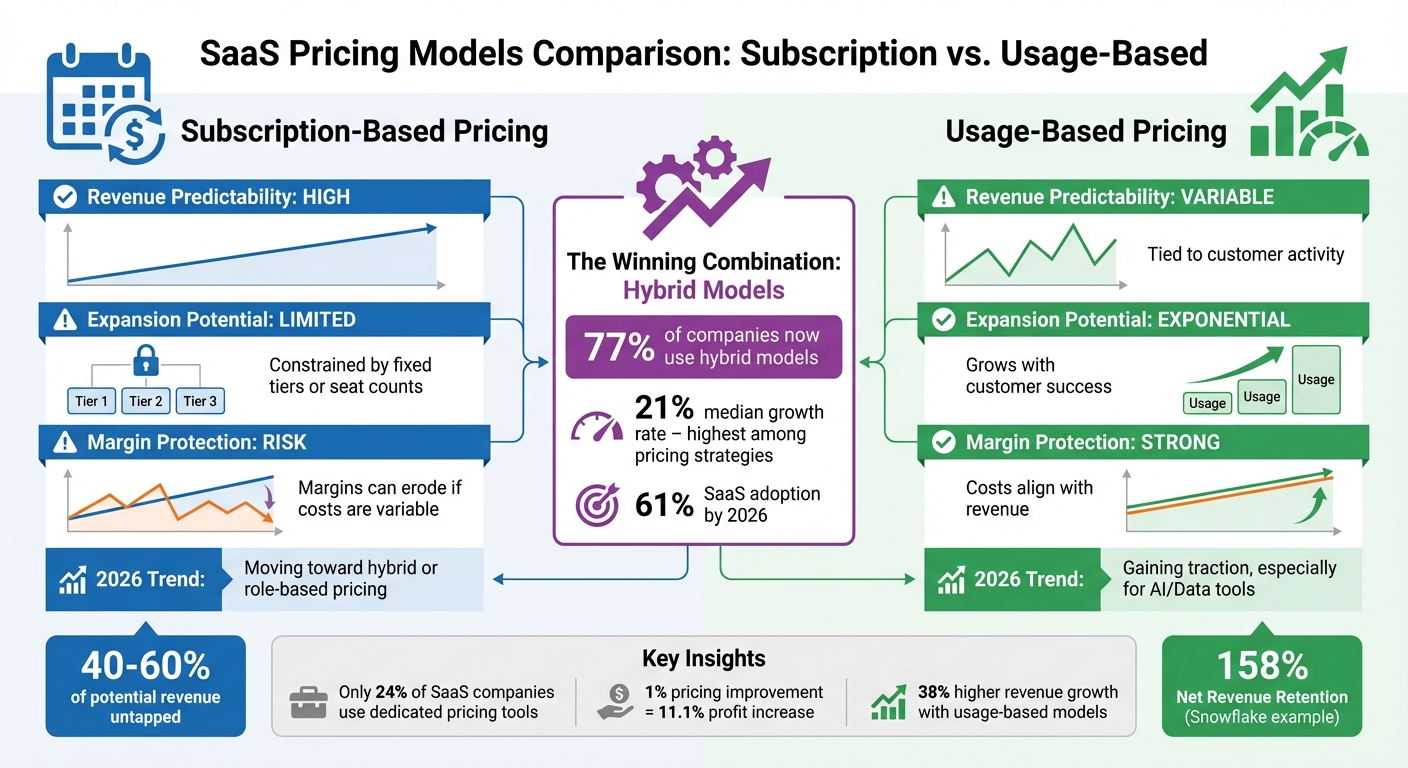
Subscription vs Usage-Based Pricing: SaaS Model Comparison 2026
Let’s dive into the advantages and challenges of subscription-based and usage-based pricing models, two popular strategies in the SaaS world. Each comes with its own set of trade-offs that can directly impact your business outcomes. Using a competitive analysis framework to understand these differences is key to picking the right model for your SaaS business in 2026.
Subscription-Based Pricing
One of the biggest perks of subscription-based pricing is the predictable cash flow it provides. With fixed contracts, you can confidently forecast revenue, making financial planning much easier. But this stability has its downsides. For instance, heavy users can eat into your margins if their resource usage exceeds what their subscription fee covers. On the flip side, low-usage customers might pay for features or seats they barely use, leading to "shelfware". Additionally, the model limits growth opportunities. Fixed tiers and manual upgrades often leave 40% to 60% of potential revenue untapped.
Usage-Based Pricing
Usage-based pricing flips the script by tying revenue directly to customer activity. This means your income grows as your customers grow, with companies like Snowflake boasting an impressive 158% Net Revenue Retention. It’s also great for protecting margins since costs scale alongside infrastructure expenses. However, the model isn’t without risks. Revenue can take a hit during seasonal slowdowns or months when customer usage drops. Despite this, many consider it “the most honest pricing” because it aligns costs with the actual value delivered to customers.
Comparing the Models
Here’s a quick look at how these two pricing strategies measure up across key business metrics:
| Feature | Subscription-Based | Usage-Based |
|---|---|---|
| Revenue Predictability | High; stable and linear progression | Variable; tied to customer activity |
| Expansion Potential | Limited by fixed tiers or seat counts | Exponential; grows with customer success |
| Margin Protection | Risk of eroded margins if costs are variable | Strong; costs align with revenue |
| 2026 Trend | Moving toward hybrid or role-based pricing | Gaining traction, especially for AI/Data tools |
The Rise of Hybrid Models
Hybrid pricing models are becoming a go-to solution, combining the best of both worlds. These models offer a base subscription for predictable revenue and usage-based overages to capture additional growth. Companies using this approach report median growth rates of 21%, outpacing other pricing strategies. This "floor and ceiling" approach ensures a steady revenue stream while allowing for scalable growth as customers expand. It’s no wonder so many SaaS companies are gravitating toward hybrid models to maximize their potential.
Using Competitor Analysis Tool for Pricing Intelligence
Making smart pricing decisions doesn’t have to be overly complicated. The Competitor Analysis Tool simplifies pricing intelligence for SaaS companies by transforming messy competitor website data into actionable insights - all in less than two minutes. Forget about the tedious process of manual data scraping; this tool does the heavy lifting for you.
One of its standout features is its ability to pinpoint pricing and growth gaps that traditional methods often miss. For example, it can identify untapped pricing tiers where competitors have left opportunities or flag steep price jumps - over 100% - between tiers. These jumps can create significant friction for customers considering upgrades. The tool also keeps an eye on changes in competitor messaging, such as updates to headlines or value propositions, which can signal a shift toward new target segments even before formal announcements are made. This kind of foresight is invaluable, as industry expert Jason Lemkin highlights:
"Most SaaS founders leave 20-40% of revenue on the table simply because they never study how their pricing compares to alternatives." - Jason Lemkin, Founder, SaaStr
Despite the importance of pricing strategy, only 24% of SaaS companies currently use dedicated pricing tools. Yet, even a 1% improvement in pricing can lead to an average profit increase of 11.1%. The Competitor Analysis Tool bridges this gap by benchmarking your pricing against emerging category trends, helping you fine-tune your sales funnel for better results.
Another key advantage is the tool’s ability to store a history of changes rather than just isolated snapshots. This allows you to track how competitor pricing evolves over time - whether it’s a simple test or part of a larger strategic move. This insight is especially critical, given that 72% of SaaS companies have adjusted their pricing in the past year. By continuously monitoring these shifts, you can protect your margins and seize growth opportunities. With this level of intelligence, you’ll be better equipped to refine your pricing strategy and stay ahead in the competitive SaaS landscape.
Conclusion
Choosing the right pricing model depends on your product type and how your customers use it. Subscription pricing offers consistent revenue and simplifies financial planning, making it a great fit for tools like workflow or productivity software, where usage tends to remain steady. On the other hand, usage-based pricing ties costs directly to the value customers receive, encouraging revenue growth - companies using this model have seen 38% higher revenue growth. That said, it comes with challenges like unpredictable billing cycles and the need for strong metering systems.
By 2025, 61% of SaaS companies adopted hybrid pricing, blending a stable subscription base with usage-based features. This approach allows businesses to benefit from heavy users while ensuring steady cash flow. As Andreessen Horowitz explains:
"Usage-based pricing usually works best for SaaS products used by other software (software-to-software), while subscription models are generally better for products used directly by people (software-to-human)".
Your pricing should align with your market position and growth objectives. Entering a competitive market? Pricing below rivals can help attract users - but it may also suggest lower quality. If your product is clearly differentiated, charging a premium can target higher-value customers. Remember, improving monetization delivers 4× greater returns compared to acquiring new customers, making pricing one of the most impactful levers for growth.
FAQs
How do I choose the right usage metric for usage-based pricing?
To choose the best usage metric for your product, look for one that reflects the value your customers gain, can be easily measured, and grows as usage increases. Begin by identifying how your product delivers value to customers, then narrow it down to 1–3 potential metrics, such as API calls, storage, or transactions. Assess each option based on its alignment with customer value, its predictability, and its ability to scale. Testing these metrics with your customers can provide valuable insights and help you settle on the most effective choice for your pricing model.
When should a SaaS switch from subscription to a hybrid pricing model?
When a subscription model stops aligning with the value customers derive from your product, it might be time to think about a hybrid pricing model. This often happens as your SaaS product evolves - whether through increased usage, growing operational costs, or new expenses tied to AI and automation. A hybrid pricing approach can help balance these factors by tying costs more closely to how customers use your product and the value it provides. This alignment not only captures revenue more effectively but also creates room for growth.
How can I benchmark my pricing without spending hours on manual research?
Streamlining pricing benchmarks is much easier with tools designed to automate competitor analysis for SaaS. Instead of manually visiting websites or updating endless spreadsheets, these tools handle the heavy lifting by analyzing pricing data for you. This not only saves time but also keeps you informed about market trends, enabling faster and more informed decisions. With these tools, staying competitive becomes far less labor-intensive.