
How To Find Competitor Referral Traffic Gaps
Find where competitors get referral visitors, assess traffic quality, and prioritize high-impact partner channels.

If your competitors are driving traffic from sources you're missing, you're leaving potential customers on the table. Referral traffic - visitors coming from links on external sites like blogs, directories, or partner websites - can be a cost-effective way to generate leads. This guide breaks down how to identify and leverage the referral sources your competitors are already benefiting from.
Key Points:
- What are referral traffic gaps? These are missed opportunities where competitors gain traffic from sources you're not utilizing.
- Why it matters: Referral traffic often converts 3–5x faster and delivers 16–25% higher lifetime value than other channels.
- How to analyze competitors: Use tools like Semrush, Similarweb, or Ahrefs to identify top referring domains and traffic patterns.
- Where to focus: Platforms like G2, Capterra, and niche blogs are common high-impact referral sources for SaaS companies.
- Metrics to track: Look at bounce rates, visit durations, and geographic distribution to evaluate the quality of traffic.
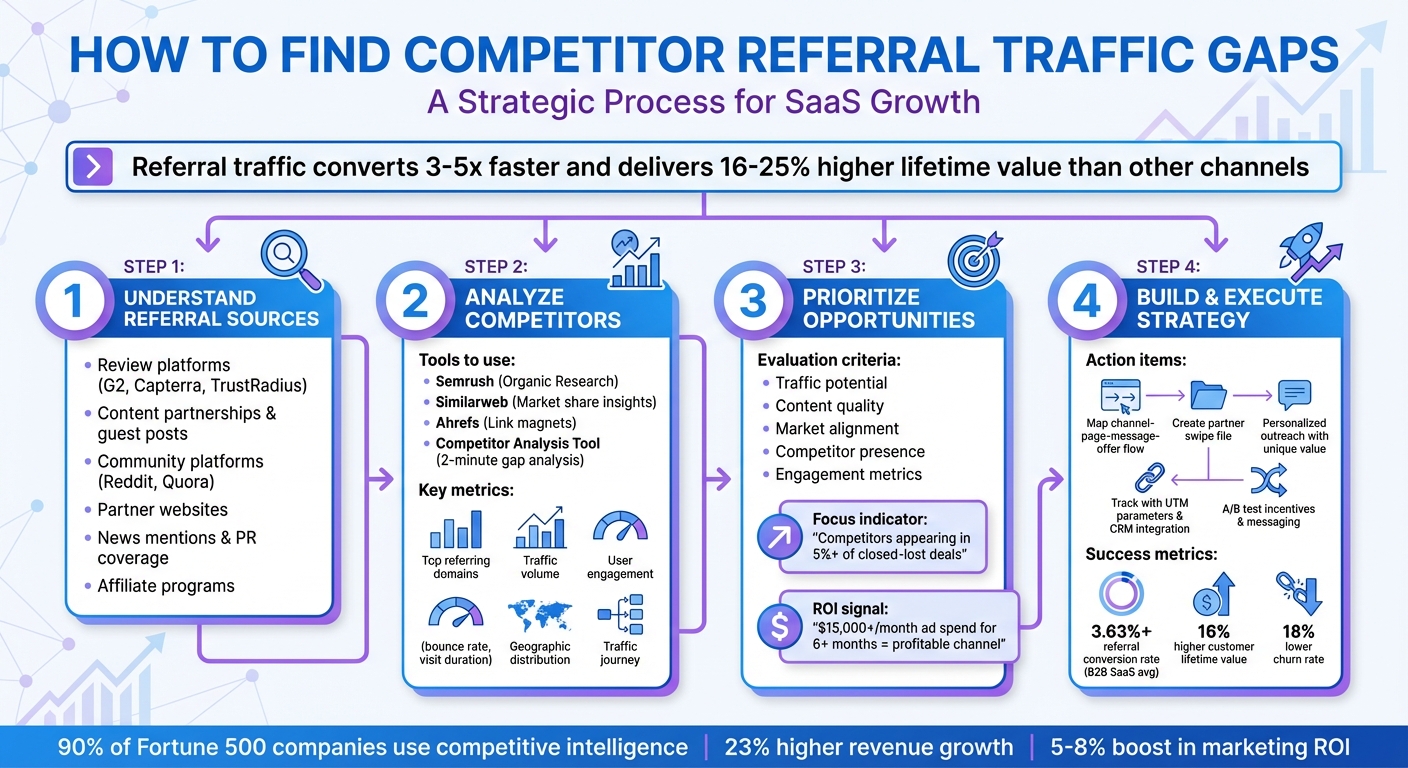
4-Step Process to Find and Leverage Competitor Referral Traffic Gaps
How to Find Competitors’ Best Traffic Sources in Similarweb Then Copy the Strategy
Understanding Competitor Referral Traffic Sources
Referral traffic comes from links on external websites, excluding paid ads or search engines. These visitors land on a site because another platform has effectively vouched for the content. Let’s dive into the main channels that drive this type of traffic.
Key Referral Traffic Channels
Competitors often rely on several key sources for referral traffic. For SaaS companies, platforms like G2, Capterra, and TrustRadius are particularly valuable. These sites aggregate user reviews and attract visitors who are actively researching and comparing solutions. If a competitor has a strong presence on these platforms - complete with numerous reviews - they’re likely capturing referral traffic you might be missing.
Another common strategy is leveraging content partnerships and guest posts. These collaborations not only establish authority but also drive targeted traffic. Community platforms such as Reddit, Quora, and niche forums offer additional opportunities for engagement. Here, competitors can interact with users, share insights, and include links to their solutions.
Partner websites are another powerful source. For example, a CRM tool that partners with an email marketing platform can create mutually beneficial referral opportunities. News mentions and PR coverage in respected industry publications provide high-authority backlinks, boosting credibility. Meanwhile, affiliate programs incentivize third-party creators to promote products, offering a scalable way to generate referrals.
These channels highlight how referral traffic stands apart from other acquisition methods.
Referral Traffic vs. Other Traffic Sources
Referral traffic brings unique advantages compared to other sources. Organic search relies heavily on SEO and keyword rankings, where competition for visibility can be fierce. Paid advertising delivers quick results but can become costly, and its impact fades once the budget is exhausted. Direct traffic, where users type in your URL, often indicates strong brand loyalty, while social traffic reflects active community engagement.
Referral traffic, on the other hand, is more cost-efficient. It’s earned through partnerships and quality content rather than paid campaigns. Links from third-party sites not only provide long-term value but also act as an endorsement, increasing the likelihood of conversions. Additionally, referral links enhance SEO by signaling trustworthiness to search engines.
In today’s AI-driven landscape, referral visibility is more important than ever. Tools like ChatGPT and Perplexity prioritize citing reliable sources, making it essential to establish a presence on high-quality referral platforms. This ensures your brand remains visible and recommended by AI-powered search agents.
How to Analyze Competitor Referral Traffic
Once you understand referral sources, the next step is to dive into competitor strategies. This involves leveraging tools and metrics to uncover patterns that reveal what’s driving success in your market.
Using Tools to Find Referral Sources
Certain analytics tools can give you a clear picture of your competitors' referral sources. For instance, Semrush offers an Organic Research feature that highlights websites competing for the same keywords and audience share. Their "Channel Mix" feature can help you put referral data into context.
Similarweb is another great option, providing insights into market share and geographic focus, which can clarify how referral channels are performing. If you're looking for "link magnets" - pages that attract significant referral traffic - Ahrefs is an effective choice.
For an even quicker approach, check out the Competitor Analysis Tool (https://competitorscan.io). This tool compares your website directly with a competitor’s, pinpointing visibility and demand gaps in under two minutes. It’s especially useful for SaaS teams that need actionable insights without diving deep into SEO.
"Traffic data reveals the 'what' - content and offers explain the 'why.'" - Shuai Guan, Co-founder/CEO, Thunderbit
Once you’ve gathered this data, the next step is to measure its impact using key metrics.
Key Metrics to Monitor
To evaluate the quality of referral traffic, focus on these essential metrics:
- Top referring domains: These are the external websites, blogs, or directories sending the most traffic to your competitors. They could be potential partners or PR opportunities for your business.
- Traffic volume: Look at the overall traffic and audience size from these referrals.
- User engagement: Metrics like bounce rate, pages per visit, and average visit duration can tell you how relevant the referred audience finds the content.
- Geographic distribution: Understanding which regions competitors are targeting can help you identify untapped markets.
- Traffic Journey: This metric tracks where users go after visiting a competitor’s site. If a significant number of users head to a specific third-party platform, consider pursuing partnerships or sponsored content opportunities there.
Spotting Trends Across Competitors
By analyzing multiple competitors at once, you can uncover broader trends in your industry. For example, Traffic Journey charts can show you which sites users visit before and after interacting with a competitor. This helps map out the larger network of referral sources.
Look for patterns in audience overlap to spot untapped opportunities. High overlap means you’re competing for the same visitors, while low overlap could point to referral channels you’ve yet to explore. If you notice a sudden spike in a competitor’s referral traffic, investigate further - it might be due to a new press mention, affiliate program, or guest post. Likewise, if a competitor has a lower bounce rate on their referral traffic, study their landing pages to see how they’re improving user engagement.
In 2025, Bella's Body Tips saw its monthly traffic triple (from 3,000 visitors) in just three months. How? By noticing that a competitor was getting a lot of referral traffic from health-focused YouTube influencers. By connecting with similar influencers and offering free resources, Bella’s Body Tips secured referral links and outranked the competitor on several keywords.
Looking ahead, keep an eye on AI-generated content. By 2026, tracking mentions in tools like ChatGPT and Perplexity could reveal new referral opportunities. It’s predicted that traffic from large language models (LLMs) will surpass traditional search by 2027. If competitors are frequently mentioned in AI-generated content but lack traditional referral links, they might already be optimizing for Generative Engine Optimization (GEO).
Finding and Prioritizing Referral Traffic Opportunities
Now that you've collected referral data from your competitors, it’s time to figure out which sources are worth pursuing. Let’s focus on identifying the most promising opportunities and how to prioritize them effectively.
Evaluating Referral Source Quality
Traffic numbers can be misleading if you don’t dig deeper. A referral source bringing in 10,000 visitors per month might seem great - until you realize most of those visitors leave immediately. Instead of just looking at traffic volume, pay attention to engagement metrics. Here are a few key indicators to focus on:
- Bounce Rate: A low bounce rate shows your messaging aligns with the audience's expectations.
- Average Visit Duration: Longer visits suggest genuine interest in your content or product.
- Pages per Visit: High numbers here indicate visitors are exploring your site in depth.
For SaaS businesses, some of the most effective referral sources include platforms like G2 and Capterra, niche blogs with loyal readers, and forums like Reddit or Quora where users actively search for solutions. Before reaching out, check for quality markers like original product screenshots, clear evidence of hands-on testing, regularly updated content, and active engagement in the comments section.
"Success in affiliate partner discovery isn't about finding the most partners - it's about finding the right ones."
– Nick Cotter, Founder & CEO, Growann
With these quality benchmarks in mind, let’s take a closer look at how competitors build their referral networks.
Reverse-Engineering Competitor Partnerships
Competitors don’t openly share their referral partnerships, but you can uncover them with a little detective work. Use search operators like:
site:domain.com "affiliate disclosure"intitle:review [competitor name] "affiliate"inurl:partner "powered by [competitor]"
These searches can reveal affiliate relationships or the platforms competitors use to manage their referral programs.
Another strategy? Subscribe to competitor affiliate or partner newsletters. This gives you direct insight into their communication style, promotional strategies, and incentives. You can also check tools like the Google Ads Transparency Center or the Meta Ad Library to spot co-marketing campaigns or sponsored partnerships. If you notice a sudden uptick in a competitor’s referral traffic, dig deeper - it could be tied to a new partnership, a viral moment on platforms like Reddit or Twitter, or even a major press mention.
For a quicker analysis, tools like the Competitor Analysis Tool (https://competitorscan.io) can compare your site to a competitor’s, highlighting gaps in visibility and demand in under two minutes.
Now that you’ve identified potential referral sources, it’s time to decide which ones to prioritize.
Prioritizing Referral Channels for Outreach
Once you’ve compiled a list of potential referral sources, create a scoring system to determine where to focus your efforts. Evaluate each source based on:
- Traffic Potential: Does the site attract a large audience?
- Content Quality: Is their content well-written, engaging, and relevant?
- Market Alignment: Does their audience overlap with your target market?
- Competitor Presence: Are your competitors already leveraging this source?
- Engagement Metrics: Are visitors from this source actively interacting with content?
Focus on competitors that show up in more than 5% of your "closed-lost" deals in your CRM. If they appear less often, they might not be worth a deep dive just yet.
Sustained ad spending is another strong indicator of a profitable channel. If a competitor spends $15,000 or more per month on a channel for six months or longer, it’s likely yielding a solid return on investment.
Here’s a quick breakdown of metrics to prioritize:
| Metric | What It Reveals | Priority Indicator |
|---|---|---|
| Total Visits | Popularity and reach | High volume = broad market appeal |
| Bounce Rate | Relevance of content and offers | Low rates = high-quality traffic |
| Sustained Ad Spend | Channel profitability | $15,000+/month over six months = ROI-positive |
| Traffic Sources | Growth strategy | Distinguishes between paid vs. organic/referral growth |
Before you reach out, spend a few weeks engaging with the target content on social media. This helps you build rapport and makes your outreach feel more collaborative rather than transactional.
"The best affiliate partners are often new to your space but growing quickly. Regular research helps you find them before your competitors do."
– Nick Cotter, Founder & CEO, Growann
Building a Referral Traffic Strategy for SaaS Growth
You've pinpointed the gaps and set your priorities. Now, it's time to transform those insights into a referral strategy that delivers measurable growth.
Turning Insights into Action
To address the gaps you've identified, it's crucial to turn insights into focused actions. Start by mapping out the channel, page, message, and offer flow for each successful referral source your competitors use. This helps you understand why certain partnerships work. For instance, if a competitor receives consistent traffic from a niche blog, analyze the landing page visitors are directed to, the headline they encounter, and the call-to-action that drives conversions. Keep a "swipe file" to document these patterns and use it to guide your own partnership materials.
Before reaching out to potential partners, subscribe to competitor partner newsletters to understand their communication style and the incentives they offer. When you're ready to approach potential partners, focus on mid-sized review sites and niche blogs, as these often yield higher engagement and better conversion rates.
Tailor your outreach to emphasize what makes you stand out. If the site already promotes your competitor, highlight your unique advantages - whether it's more competitive pricing, exclusive features, or robust partner resources such as detailed enablement materials. Use these insights to craft outreach strategies that are both genuine and personalized.
Outreach and Partnership Best Practices
Expand your swipe file by actively engaging with potential partners online before initiating outreach. Interact with them on social media, comment on their posts, and build a rapport over several weeks. This approach makes your eventual pitch feel more collaborative and less transactional.
When you do reach out, make each message personal. Reference specific content they've created, explain how your product meets a need for their audience, and offer resources that simplify their efforts. Implement clear tracking systems using unique referral codes and UTM parameters to show the tangible contributions of each partner. Integrating this data with your CRM (like HubSpot or Salesforce) can help you track revenue attribution and has been shown to improve conversion rates by 23%.
Focus on partners who actively use your product - they are four times more likely to generate successful referrals. Create topic clusters and "pillar pages" targeting high-intent keywords like "[Competitor] Alternatives" to attract users in the evaluation phase. Referral backlinks from organic traffic are particularly valuable, as they convert 8.5× better than outbound leads.
Once you've launched your outreach efforts, closely monitor performance to refine your approach.
Measuring Success and Refining Your Approach
Keep a close eye on metrics like participation rates, referral conversion rates, and cost per acquisition. In B2B SaaS, aim to exceed the 3.63% average referral conversion rate while working to improve Customer Lifetime Value (CLV) and reduce churn among referred customers.
Referred customers often deliver 16% higher lifetime value and are 18% less likely to churn compared to non-referred customers. Track how referral traffic influences key metrics like Monthly Recurring Revenue (MRR), Annual Recurring Revenue (ARR), and Net Revenue Retention (NRR).
Use A/B testing to fine-tune aspects like incentive structures, reward timing, and program visibility. Conduct segment analysis to identify which customer groups - based on tenure, usage patterns, or industry - are your most effective referrers, and then double down on those segments. Combine quantitative data with qualitative feedback by surveying referrers and interviewing referred customers. Companies that integrate both types of measurement are 2.3× more likely to successfully optimize their programs.
For B2B sales cycles, ensure attribution windows are long enough to account for extended decision-making periods. Set up automated alerts to track when competitors gain new high-value backlinks or release comparison pages, enabling you to respond quickly. Regularly evaluate the quality of leads from partners - if they're sending unqualified leads, provide coaching on your Ideal Customer Profile to improve conversions and lower churn.
Conclusion
Closing referral traffic gaps isn’t just about outpacing competitors - it’s about driving measurable growth for your SaaS business. By identifying where your competitors are attracting high-quality referral traffic, you can tap into those same audiences, forge valuable partnerships, and capture proven market share. Here’s a compelling stat: companies with robust competitive intelligence programs experience 23% higher revenue growth and 18% better profit margins. Plus, marketers who use competitor analytics see a 5% to 8% boost in marketing ROI.
The problem? Manually toggling between tabs, copying data into spreadsheets, and trying to piece together scattered metrics can be overwhelming. That’s where tools like Competitor Analysis Tool (https://competitorscan.io) come in. In less than two minutes, this tool compares your site with a competitor’s, revealing demand, messaging, and visibility gaps - no SEO expertise required. It even delivers actionable recommendations to help you identify high-impact referral channels fast.
Industry leaders back this approach:
"Competitor analysis website traffic is your shortcut to smarter decisions and faster growth." - Shuai Guan, Co-founder/CEO, Thunderbit
It’s no surprise that 90% of Fortune 500 companies already use competitive intelligence to guide their strategies. With sellers facing direct competition in 68% of deals, addressing referral traffic gaps isn’t optional - it’s a must. And here’s the upside: most teams rate their competitive readiness at just 3.8 out of 10. This means there’s a huge chance for SaaS companies ready to take action.
Start by analyzing the top three to five competitors in your space. Identify their strongest referral sources, and reverse-engineer their strategies. Turn these insights into targeted outreach campaigns to attract the same high-intent visitors to your site. The data is out there - seize the opportunity to transform it into growth.
FAQs
How do I find my biggest referral traffic gaps fast?
To spot referral traffic gaps efficiently, start by examining competitors' traffic sources with trusted tools. Compare their top referral sources against your own to identify any differences. Perform a content gap analysis to find overlooked opportunities tied to keywords or content. Prioritize addressing the most significant gaps and create specific strategies to attract this traffic. Keep an eye on your progress and make adjustments regularly to improve your outcomes.
Which referral sources are best for SaaS growth?
The most effective referral sources for SaaS growth are those that bring in high-quality traffic. These include organic search, paid campaigns, and niche platforms. By digging into competitors' traffic sources - whether it's through search engines, social media, or direct visits - you can spot opportunities you might be missing out on.
Using tools like the Competitor Analysis Tool can help pinpoint gaps in demand, messaging, or visibility. This allows SaaS companies to zero in on the most impactful referral channels and fine-tune their marketing strategies for better results.
How can I tell if a referral source will convert?
To determine whether a referral source is likely to convert, focus on key metrics such as customer lifetime value (CLV), retention rates, and conversion rates for referred customers. It's also crucial to monitor referral program performance indicators like the referral rate, customer acquisition cost (CAC), and revenue growth driven by referrals.
Additionally, competitor analysis tools can provide valuable insights into traffic quality. By examining engagement metrics and behavioral patterns, you can better predict the likelihood of conversions from specific referral sources. This data helps refine your strategy and ensures you're investing in the most effective channels.