
Best Competitor Analysis Tools for Startups in 2026
AI-powered competitor analysis compared: features, pricing, and best picks for startups to spot growth gaps quickly.

Want to grow your startup faster? Focus on understanding your competitors and identifying unhappy customers ready to switch. In 2026, AI-powered tools make this process faster and more efficient, turning hours of manual research into minutes. Here’s a quick breakdown of the top tools to consider:
- Competitor Analysis Tool: Best for startups on a budget, offering quick insights (under 2 minutes) without requiring SEO expertise.
- SEMrush: A full-featured suite for SEO, PPC, and content tracking. Ideal for scaling startups but comes with higher pricing.
- Ahrefs: Perfect for backlink and content analysis with real-time updates. Affordable starter plan but has a learning curve.
- SimilarWeb: Best for market insights and traffic analysis on high-traffic sites. Great AI tools but expensive for smaller teams.
Quick Comparison
| Tool | Key Features | Pricing (Starting) | Best For |
|---|---|---|---|
| Competitor Analysis Tool | AI-driven insights, free basic version | Free | Budget-conscious startups |
| SEMrush | All-in-one SEO and PPC suite | $139.95/month | Scaling startups with SEO focus |
| Ahrefs | Backlink and content analysis | $29/month | Startups needing SEO insights |
| SimilarWeb | Market and traffic insights | $125/month | High-traffic site analysis |
Choose based on your budget, growth stage, and specific needs. Tools powered by AI are reshaping competitive intelligence, saving time, and offering actionable insights. Start small, scale as you grow.
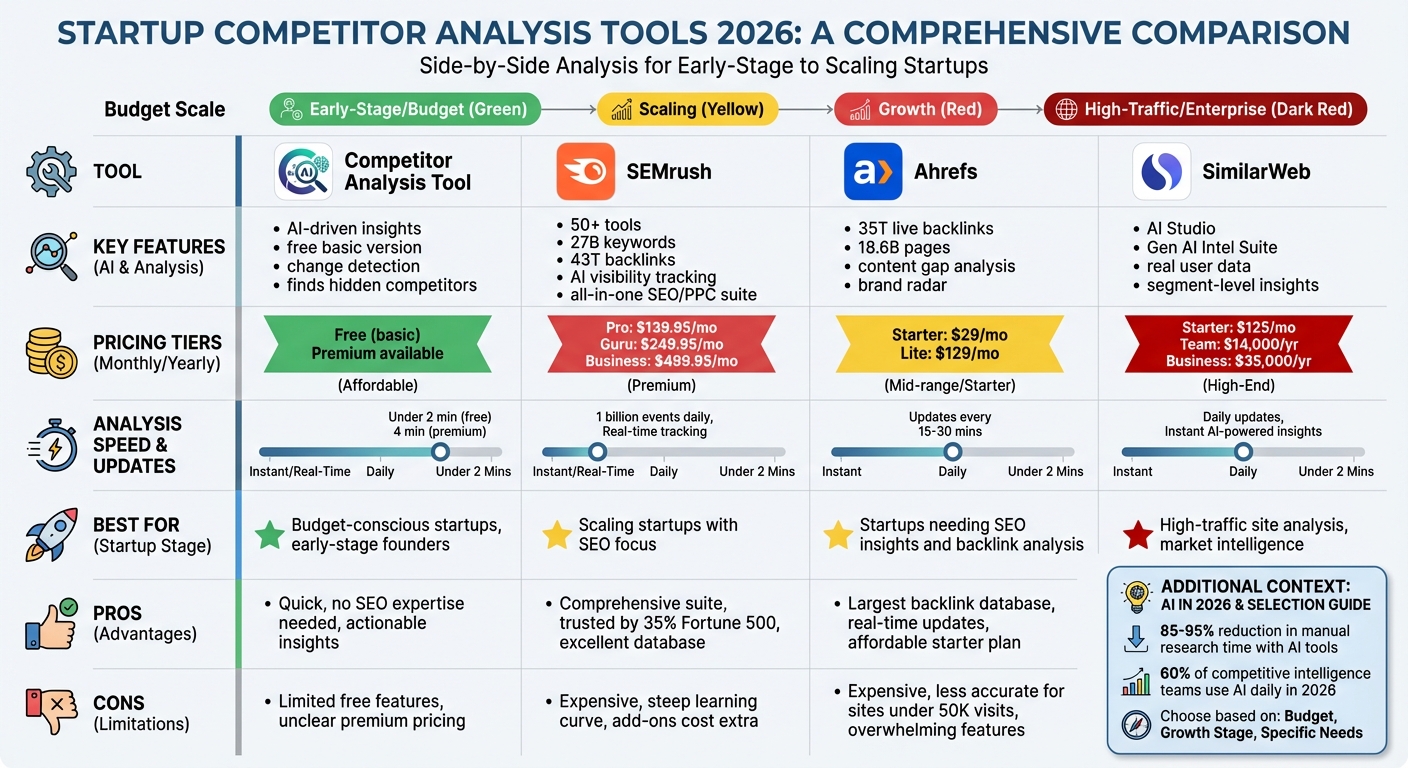
Competitor Analysis Tools Comparison 2026: Features, Pricing & Best Use Cases
1. Competitor Analysis Tool
Features
The Competitor Analysis Tool zeroes in on meaningful updates rather than bombarding you with unnecessary data. Using AI-powered change detection, it employs machine learning to differentiate minor updates (like footer copyright adjustments) from impactful changes, such as pricing overhauls or the introduction of new features. You’ll get clear, easy-to-understand summaries that explain what changed on a competitor's page and why it’s important, saving you hours of manual analysis.
What sets this tool apart is its ability to go beyond standard search rankings. It digs into less obvious spaces like app stores, GitHub, Reddit, Product Hunt, and startup directories to uncover hidden competitors. Plus, it keeps an eye on subtle shifts - think pricing adjustments, headline tweaks, or messaging changes (e.g., switching from "automation" to "AI-powered").
It’s also priced with startups in mind, making it accessible for those working with smaller budgets.
Pricing
The tool offers a free analysis that delivers actionable insights without requiring a credit card, making it easy for startups to get started. For those seeking more detailed competitive benchmarking and recommendations, premium options are available, though specific pricing isn’t disclosed.
Analysis Speed
This tool doesn’t just save time - it redefines efficiency. It condenses over 40 hours of research into just four minutes. Even the free version wraps up in under two minutes, delivering actionable recommendations almost instantly.
Startup Suitability
With its rapid insights, this platform is a game-changer for startups looking to identify growth opportunities. It’s tailor-made for early-stage founders, product managers, and investors, and you don’t need any SEO expertise to use it. Just compare your website with a competitor’s to uncover gaps in demand, messaging, and visibility. Handy visual grids highlight strengths and areas for improvement, helping you focus on what matters most for growth.
2. SEMrush
Features
SEMrush comes packed with over 50 tools, managing an impressive 27 billion keywords and 43 trillion backlinks across 808 million domain profiles. Its AI Visibility & LLM Tracking takes things a step further by analyzing how your brand and competitors appear in AI assistants like ChatGPT, Gemini, Claude, and Perplexity. This makes keeping tabs on AI-driven discovery just as important as monitoring traditional search.
Key tools like the Keyword and Backlink Gap analyzers let you compare your site to up to four competitors, uncovering keyword and backlink opportunities you might be missing. Then there’s the EyeOn feature, which keeps you updated on competitor moves in real time - whether it’s new blog posts, promotional changes, or website updates. For businesses focused on advertising, tools like AdClarity and Advertising Research provide insights into PPC spend, ad copy, landing pages, and display campaign strategies.
"When it comes to pure value, Semrush wins. That's mostly because you get a fully-featured SEO software suite AND Google Ads software for the same monthly price." – Brian Dean, Founder, Backlinko
These tools combine to deliver a comprehensive platform that’s designed to meet the needs of both SEO and advertising professionals.
Pricing
SEMrush offers three main pricing tiers:
- Pro plan: Starts at $139.95/month, offering essential SEO and PPC tools.
- Guru plan: At $249.95/month, it includes historical data and a Content Marketing Toolkit.
- Business plan: Priced at $499.95/month, this plan offers extended limits and API access.
For those opting for annual billing, the Pro plan drops to $117.33/month. There are also optional add-ons, like the Social Toolkit for $20/month and AdClarity starting at $129/month.
Startup Suitability
SEMrush’s extensive features and straightforward pricing make it a solid choice for startups aiming to scale quickly in the digital space. Trusted by millions of professionals and 35% of Fortune 500 companies, it integrates SEO, PPC, social media, and content tools into a single platform. Tools like Market Explorer and Traffic Analytics help businesses benchmark their audience share, while the Growth Quadrant visually categorizes competitors as "Game Changers" or "Leaders".
"Our organic traffic was up by 230% in 2019. Literally every day we are getting the highest traffic ever on our website." – Eric Bogard, VP of Marketing, Arkadium
That said, startups with limited budgets may find the pricing challenging if they’re not using the full range of features. However, for businesses where SEO or PPC is a key strategy, SEMrush delivers a strong return on investment.
Analysis Speed
SEMrush processes a staggering 1 billion events daily. With features like Daily Trends, Traffic Alerts, and the Top Pages dashboard, users can quickly gain insights into market shifts and competitor activity. This speed and depth of analysis make SEMrush a powerful tool for staying ahead in fast-moving markets.
3. Ahrefs
Features
Ahrefs packs a punch when it comes to tools designed for startup growth. One standout is the Site Explorer, which dives deep into competitor data like organic performance, backlink profiles, and paid traffic insights [8, 19]. With a staggering database of over 35 trillion live backlinks and 18.6 billion pages spanning 186 locations, startups gain a clear view of where competitors are thriving.
The Brand Radar feature takes things further by tracking mentions of your startup and competitors in AI chatbots and search assistants [19, 20]. Another game-changer is the Content Gap Analysis tool, which pinpoints keywords your competitors rank for but you don’t - giving you a clear direction for new content [21, 22]. The Pages Inspect Tool acts like a modern Wayback Machine, showing when competitors update their content and how those updates impact their traffic.
Ahrefs also stands out for its real-time tracking. Backlink data gets updated every 15 to 30 minutes [6, 8, 16], and the Firehose feature sends instant alerts about new or updated web content. If you’re keeping tabs on multiple competitors, the Portfolios feature lets you group websites for a big-picture view of industry trends. These tools, combined with flexible pricing, make Ahrefs a strong ally for startups.
"Ahrefs has the world's largest index of live backlinks, and it's refreshed every 15-30 minutes." – OptinMonster
Pricing
Ahrefs offers options for different budgets. The Starter Plan is priced at $29/month and is perfect for small projects or personal use [6, 8, 22]. The next step up is the Lite Plan, starting at $129/month, with annual billing bringing it down to about $108/month. For verified website owners, Ahrefs Webmaster Tools provides free access to basic data [6, 19].
Startup Suitability
The $29 Starter Plan opens the door for early-stage startups to access high-quality SEO tools without committing to expensive contracts [8, 22]. Considering that organic traffic converts 8.5× better than outbound leads, and a 14% Domain Rating increase could potentially boost organic traffic by up to 455%, the investment can pay off significantly. That said, the platform does have a learning curve, so startups should plan to spend some time mastering it to unlock its full potential.
Analysis Speed
Ahrefs processes backlink data at lightning speed, making it easy for startups to catch competitor backlink spikes, content updates, or ranking shifts right as they happen [6, 19]. In fast-paced industries, this real-time insight can be the edge you need to seize opportunities before your competitors do.
4. SimilarWeb
Features
SimilarWeb offers a range of tools designed to provide deep market insights with ease. At the heart of its offerings is the AI Studio, which delivers instant market insights in plain English, removing the need to navigate complex dashboards. The Gen AI Intel Suite is another highlight, tracking how your brand appears in AI-driven search results and analyzing prompt trends. This is increasingly important as AI search continues to transform how customers discover products.
A key differentiator for SimilarWeb is its real user data methodology, which pulls data from millions of websites and apps to ensure precision. The platform provides segment and page-level insights, helping you pinpoint which parts of a competitor's site are driving their success. Tools like the Keyword Gap feature identify keywords your competitors are leveraging that you might be missing, while the Competitor Conversion Tracker evaluates how effectively rivals turn traffic into sales.
With data updated daily, SimilarWeb covers hundreds of millions of websites and apps across over 190 countries. Its AI Agents handle routine research tasks, allowing you to focus on strategy. Trusted by more than 10,000 customers globally, the platform has been recognized as a 2024 Magic Quadrant Leader in Market Intelligence Software by G2.
"Similarweb helps you make smarter marketing decisions by providing insights into what's working well for your competitors." – Adaline Lefe Mary John, Content Manager, SaaSGenius
Pricing
SimilarWeb offers several pricing tiers tailored to different business needs. The Starter plan costs about $125/month (billed at $1,500 annually) and includes access for one user, 3 months of historical data, and analysis of up to 1,000 keywords per table. The Team plan, priced at $14,000/year, accommodates five users and extends historical data access to three years. For $35,000/year, the Business plan adds features like conversion analysis and global data coverage. For larger organizations, the Enterprise plan offers custom pricing and includes API access.
A free version on Similarweb.com provides basic data samples, and a free trial lets you explore premium features before committing. These options make it easier for startups to select a plan that aligns with their budget and growth stage.
Startup Suitability
SimilarWeb's advanced AI tools are especially useful for startups looking to make quick, data-driven decisions. The Similarweb for Entrepreneurs package is tailored for smaller teams, offering self-service subscription management and easy cancellation. However, the platform works best for mid-to-large websites; early-stage startups with minimal traffic might find the data somewhat limited. Additionally, the Starter plan's 3-month historical data window can feel restrictive, and the sheer number of features may be overwhelming for new users. That said, the AI Studio’s natural language interface simplifies the experience, making it easier for non-technical founders to get started.
Analysis Speed
With daily data updates and the AI Studio, SimilarWeb provides quick answers to competitive questions. You can type queries in plain language to instantly generate automated dashboards, removing the need for manual report creation. This speed is a major advantage for startups, allowing them to stay on top of market changes and respond swiftly. Whether tracking social, display, or referral traffic, the platform helps you monitor multiple competitors efficiently.
How to use AI to do quick competitive analysis
Pros and Cons
After diving into the features and pricing, here's a quick overview of the strengths and weaknesses of each tool:
| Tool | Pros | Cons |
|---|---|---|
| Competitor Analysis Tool | Quick analysis in under 2 minutes; doesn't require SEO expertise; delivers actionable insights with clear priorities; free basic analysis available; highlights demand, messaging, and visibility gaps | Free version offers only basic insights; premium features and pricing lack transparency |
| SEMrush | All-in-one suite covering SEO, PPC, and social media; massive database with over 26 billion keywords; user-friendly interface with excellent AI-driven GEO tracking; trusted by over 10 million marketing professionals | Expensive, starting at $139.95/month; steep learning curve for smaller teams; some features, like Social Tracker, require additional payments |
| Ahrefs | Unmatched backlink database updated every 15–30 minutes; robust Content Explorer for identifying top-performing pages; highly accurate and fresh data | No free plan; Lite plan at $129/month has strict daily limits; challenging for beginners to master |
| SimilarWeb | Uses real-user traffic data for high accuracy on large sites; provides detailed audience demographics and referral data | Accuracy drops for sites with under 50,000 monthly visits; starts at a steep $125/month |
Each tool serves different needs depending on your startup's goals. For an all-encompassing solution, SEMrush is a strong pick. If backlinks and content analysis are your focus, Ahrefs stands out. Meanwhile, SimilarWeb shines when market intelligence for high-traffic sites is a priority. Your final choice should reflect your budget, growth stage, and specific objectives.
"In the digital landscape of 2026, understanding your competitors is not just good practice - it is the cornerstone of a winning strategy." - Riff Analytics
This side-by-side comparison helps clarify how each tool can fit into your broader growth strategy.
Conclusion
Picking the right competitor analysis tool in 2026 depends on your startup's stage and immediate priorities. If you're still pre-product-market fit and working with a tight budget, start small. Free monitoring tools and basic keyword insights can help you keep your monthly expenses under $50. But as your company grows and gains traction, your needs will evolve. At this point, consider investing in a more advanced setup in the $100–$400/month range. These tools often combine broader SEO capabilities with platforms that offer actionable insights.
One of the biggest changes in 2026 is the rise of AI-driven platforms that don’t just collect data - they offer clear, actionable recommendations. This is a game-changer, especially since 60% of competitive intelligence teams now rely on AI daily, with organizations reporting an 85–95% reduction in manual research time. For startups without dedicated competitive intelligence managers, these AI tools deliver consultant-level insights in a fraction of the time.
"Competitive analysis isn't about accumulating data. It's about calibration... Tools surface information. Judgment creates advantage." - Seeto
If you're on a budget, look for tools that provide strong functionality without the hefty price tag of enterprise solutions. Platforms with AI-powered change detection and strategic recommendations can help you act faster and avoid the slow grind of manual spreadsheet analysis. The key is finding a balance between cost and tools that deliver actionable insights enhanced by AI.
Another trend to watch is Generative Engine Optimization (GEO), which monitors how brands appear in AI-generated search results and chatbot responses. As more users turn to AI assistants, this visibility metric is becoming critical. It underscores a central takeaway: actionable intelligence is what fuels startup growth. When choosing a tool, focus on where your business is now and where you aim to be in the next six months, rather than being swayed by flashy demos.
FAQs
How do I choose a competitor analysis tool for my startup stage?
When picking a competitor analysis tool, it's crucial to align your choice with your startup's specific needs and budget. If you're in the early stages, free or low-cost tools can provide valuable insights into areas like traffic sources and competitor strategies without breaking the bank. As your business grows, you might want to explore platforms that can scale with you, offering advanced features such as SEO insights and market intelligence. Look for a tool that’s easy to use and delivers the kind of data that can help shape your marketing, pricing, and product development decisions.
What is GEO, and how do I track my brand in AI search results?
GEO stands for geographic location data. It’s all about identifying and analyzing where content or activity is happening. To keep tabs on your brand’s presence in AI search results across various regions, you can use geolocation verification tools or AI-powered services.
These tools work by examining visual elements or metadata in the content. This helps pinpoint the location and gives you insights into how your brand is performing in different areas. It’s a handy way to understand and manage your brand's regional visibility.
How can I turn competitor changes into product and messaging decisions?
Stay on top of what your competitors are doing - whether it’s a new pricing strategy, a product launch, or a shift in their messaging. Tools designed for competitor analysis can give you real-time updates, helping you stay informed. With these insights, you can fine-tune your own products and adjust your messaging to better meet the needs of the market and seize new opportunities.