
5 Growth Opportunities Hidden in Competitor Data
Five actionable ways to use competitor data—SEO gaps, traffic sources, engagement, pricing, and features—to accelerate SaaS growth.

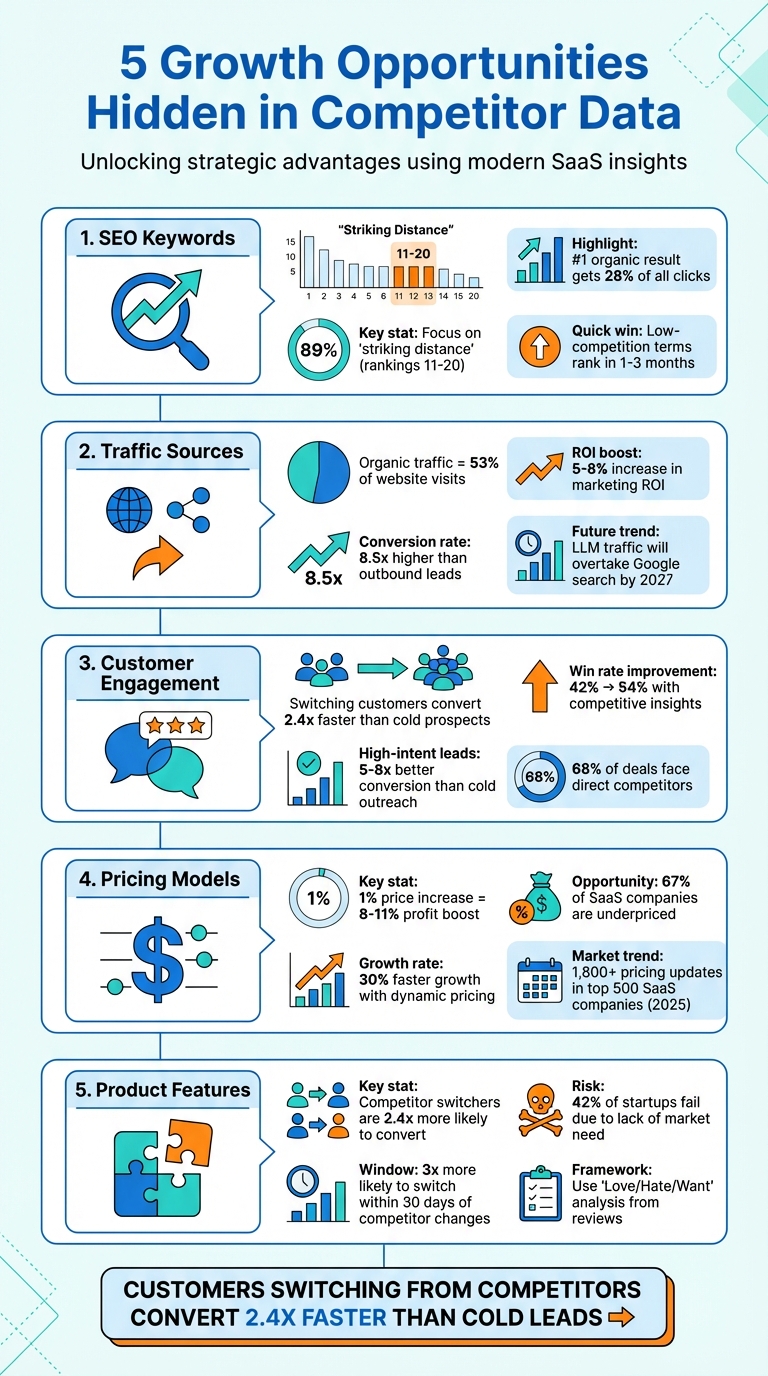
Competitor data can reveal untapped ways to grow your SaaS business. Here are five actionable areas to focus on:
- SEO Keywords: Identify keywords your competitors rank for but you don’t. Prioritize "striking distance" terms (your rankings: 11-20) for quick traffic gains.
- Traffic Sources: Look beyond Google. Niche platforms, online communities, and AI-powered search engines can drive high-intent leads.
- Customer Engagement: Monitor competitor reviews and social media for pain points. Address these gaps to win over dissatisfied users.
- Pricing Models: Study competitors’ pricing tiers to find opportunities, like offering intermediate plans or bundling valuable features.
- Product Features: Track feature requests in reviews and competitor updates. Focus on solving unmet needs or improving execution.
Key Insight: Customers switching from competitors convert 2.4x faster than cold leads. Act quickly on competitor missteps like pricing changes or outages to capture these opportunities.
Use tools like Competitor Analysis Tool to save time and turn insights into action faster. By leveraging these strategies, you can gain an edge and fuel growth.
5 Growth Opportunities Hidden in Competitor Data for SaaS Businesses
How To Analyze Your SaaS Competitors (Better Than They Do)
1. Untapped SEO Keywords
For SaaS founders, finding untapped SEO keywords can be a game-changer in capturing market share. Competitors are often ranking for thousands of keywords you’re not even tracking. The real opportunity isn’t just in discovering new terms - it’s about analyzing what’s working for your competitors and using that to drive traffic that converts.
Start with a keyword gap analysis. This involves comparing your domain against three to five competitors to uncover "missing" keywords - terms where they rank in the top 10–20 positions, but you’re nowhere to be found. The challenge? Most teams face massive spreadsheets with thousands of keyword gaps and no clear direction.
"The dirty secret of SEO competitor analysis is that the hard part was never getting the data... Analysis is looking at those 10,000 keywords and knowing that exactly 12 of them are worth pursuing, why, and in what order." - Ibby Syed, Founder of Cotera
Turning Insights into Action
Focus on "striking distance" keywords - those where you rank between positions 11–20 while competitors are ahead. These represent quick wins. A great example comes from a strategy shared by Backlinko in 2025. They noticed Ahrefs ranked for the term "website authority checker", which brought in around 2,500 organic visits a month. Further analysis revealed one page ranked for over 1,700 related keywords, generating 30,000 monthly visits. Backlinko responded by creating a competing tool and blog post. The result? Their new page now ranks for 1,000 queries and garners over 13,000 clicks per month.
To prioritize effectively, filter for keywords with search volumes between 101–1,000 and a difficulty score under 30. Tools like "Traffic Lift" can estimate the potential visitor gain if you outrank a competitor. Low-competition terms can rank in one to three months, while tougher ones might take six months or more. This approach transforms overwhelming keyword lists into clear, revenue-focused strategies.
Measuring Growth Potential
The stats don’t lie: 89% of marketers say competitor keyword research is crucial for growing online visibility. The #1 organic search result grabs about 28% of all clicks, with a steep drop-off after the fifth position.
But it’s not just about chasing high-volume terms. Understanding search intent is key. Categorize competitor keywords into informational, navigational, commercial, or transactional. High-intent commercial and transactional terms often indicate users closer to making a purchase. For instance, if competitors dominate broad terms like "online course platforms", you could target bottom-funnel variations like "how to create an online course for free".
These insights help identify quick wins while laying the groundwork for sustained growth.
Simplifying Execution
You don’t need to be an SEO expert to get started. Tools like Competitor Analysis Tool can generate a full keyword gap analysis in under two minutes, showing you exactly which terms to focus on without drowning in data. These platforms automatically highlight demand and visibility gaps, offering actionable recommendations.
Beyond tools, dig deeper by scanning customer reviews on platforms like G2, Trustpilot, and Reddit for natural language phrases that keyword tools might miss - such as "software with data import/export." These often represent untapped search opportunities. You can also analyze specific competitor subfolders (e.g., /blog or /pricing) to find gaps in their content strategy. If their blog covers high-level topics but skips detailed implementation guides, that’s your chance to fill the void.
These straightforward actions can help you build long-term authority.
Strengthening Your Competitive Edge
"Competitor keyword analysis works best when it's used to understand why pages rank - not just which keywords they rank for. The real opportunity lies in uncovering intent gaps, not copying keyword lists." - Keywordly
Consistently ranking for clusters of competitor-related keywords establishes "topical authority", signaling to search engines that your site is an expert in a specific niche. This creates a compounding effect - every new piece of content strengthens your site’s relevance, making it easier to rank for related terms.
Keep an eye on how competitors adjust their language. If several rivals start shifting from "tool" to "platform", it could indicate a market trend you should reflect in your SEO strategy. In 2026, speed in interpreting and acting on these shifts can be a significant advantage. Target keywords in positions 4–15 where competitors have traction but haven’t solidified their rankings with high-quality content. These vulnerable spots are prime opportunities to build authority and fuel SaaS growth.
2. Overlooked Traffic Sources
Many SaaS teams are laser-focused on climbing Google rankings, often neglecting niche channels that can deliver high-quality, high-intent traffic. Platforms like online communities, review directories, and emerging AI-powered answer engines are often underestimated, yet they can bring in visitors who are ready to convert. The real challenge isn't just spotting these channels - it's figuring out which ones actually drive conversions and creating a repeatable strategy to tap into them. By identifying these hidden traffic streams, you can strengthen your overall strategy and complement your keyword-focused efforts.
Actionability of Insights
Start by analyzing your competitors' traffic across various channels - direct, organic, referral, social, and paid. If a competitor leans heavily on paid ads, it might signal opportunities for organic growth. Dig into referral data from sources like industry blogs, Reddit threads, or directories such as G2 and Capterra. These can highlight high-conversion channels your competitors are already using. For instance, if a rival consistently gets traffic from a community forum or features prominently in a "best of" listicle, this could be a chance to explore partnerships or outreach.
Another tactic is targeting "alternative" and comparison keywords like "[Competitor] pricing" or "[Competitor] vs [Your Brand]." These keywords attract users who are actively comparing options and are closer to making a decision.
Potential for Measurable Growth
The numbers back up the value of these strategies. Organic traffic makes up 53% of website visits and converts at a rate 8.5 times higher than outbound leads. Companies that leverage competitor analytics see a 5–8% boost in marketing ROI, while those with strong competitive intelligence programs experience 23% higher revenue growth. With SaaS CPC rates rising 15–18% annually, tapping into lower-cost organic or long-tail traffic channels can significantly benefit your bottom line.
"LLM traffic will overtake Google search by 2027. That means getting visibility in AI answers is about to matter as much as (or more than) traditional rankings." - Backlinko
In this evolving SaaS landscape, staying ahead means optimizing for emerging channels as much as for traditional SEO. Keep tabs on your visibility in AI-generated answers from tools like ChatGPT, Perplexity, and Google AI Overviews. Search for broad industry terms like "best project management software" to see if your brand or competitors are being featured. This new channel is expected to reshape how users discover SaaS products, making early adoption critical.
Ease of Implementation
You don't need a massive budget to get started. Focus on keywords with low difficulty (under 20) and decent search volumes (over 500) to secure quick wins. Use tools to identify "dofollow" backlinks from niche-relevant sites with a Domain Rating of 40+ where your brand isn’t mentioned. Gaining backlinks from these authoritative sources can lead to a 14% boost in Domain Rating, which, in turn, could drive up to 455% growth in organic traffic.
Additionally, scrape competitor reviews on platforms like G2, Trustpilot, or Reddit to uncover the messaging that resonates with their audience. Use monitoring tools to track changes in competitor pricing or feature pages - these often hint at upcoming campaigns and strategic priorities. Tools like Competitor Analysis Tool can quickly identify traffic gaps, helping you focus on the right opportunities without getting bogged down in data.
Impact on Competitive Advantage
"Traditional tools are your binoculars; Thunderbit is your microscope." - Shuai Guan, Co-founder/CEO, Thunderbit
Understanding where your competitors succeed or fall short in their traffic strategies can reveal strategic openings. For example, if they dominate paid ads but ignore forums or communities, you could step in and establish authority in those spaces organically. SaaS product launches that are informed by competitive intelligence have a 67% higher success rate. Additionally, a 20% increase in Share of Voice often translates to lower Customer Acquisition Costs, as more high-intent leads discover your brand through organic search.
By 2026, the ability to quickly interpret and act on shifts in traffic sources will be a key competitive advantage. Teams that can pivot swiftly to capitalize on these changes will gain a lasting edge over slower-moving competitors.
Spotting these overlooked channels naturally sets the stage for improving customer engagement strategies in the next phase.
3. Better Customer Engagement Tactics
When you dive into competitors' customer feedback on platforms like review sites, support forums, and social media, you’ll often uncover their weak spots. Pairing this with insights on keywords and traffic creates a powerful view of where competitors are falling short. While many SaaS teams obsess over feature comparisons and pricing tables, the real edge lies in understanding these gaps - and positioning your product as the better choice.
Actionability of Insights
Customer reviews on platforms like G2, Capterra, and TrustRadius are goldmines for actionable insights. Use the "Love/Hate/Want" framework to break down what users adore, dislike, and wish for. For instance, if a competitor’s reviews frequently mention issues like "clunky UI" or "slow support response times", you’ve identified friction points that you can address - even if your product offers similar features.
Social media platforms like Reddit, LinkedIn, and X (formerly Twitter) also offer real-time opportunities to spot switching intent. Set up alerts for phrases like "looking for a [Competitor] alternative" or "[Competitor] pricing is getting ridiculous." These signals often come from users actively exploring other options. In fact, these high-intent leads convert 5–8x better than typical cold outreach campaigns. Timing is everything - when competitors experience outages or announce price hikes, acting fast can make a huge difference, as switching customers convert 2.4x faster than cold prospects.
Potential for Measurable Growth
The numbers back up this approach. Sales teams face direct competitors in 68% of deals, yet many rate their competitive preparedness at just 3.8 out of 10. Companies with structured competitive intelligence programs are over twice as likely to exceed revenue goals. Integrating these insights into your sales process can boost win rates from 42% to 54%.
Take TripMaster as an example. In 2025, they added $504,758 in net new annual recurring revenue (ARR) within a year by targeting competitor complaint keywords - resulting in a 650% ROI. These results show how focusing on customer engagement gaps can directly impact growth.
Ease of Implementation
You don’t need a massive budget to get started. Tools like Google Alerts, G2 reviews, and basic social listening can provide valuable intelligence without costing extra. For teams looking to scale, affordable tools like SpyFu ($39/month) or Prems AI ($49/month) can automate much of this monitoring, cutting manual tracking time (typically 8–10 hours a week) down to almost nothing.
Another effective tactic is creating sales battlecards to address competitor-specific objections. This strategy is already used by 78% of competitive intelligence leaders. For example, if a competitor’s support or pricing frequently comes under fire, you can quickly update your messaging to emphasize your strengths in those areas.
Impact on Competitive Advantage
"The best competitor analysis isn't studying your rivals. It's intercepting their unhappy customers before they find someone else." - Prems AI
By identifying where competitors fall short, you can carve out strategic opportunities in the market. If competitors excel in features but struggle with user experience, you can position your product as the simpler, more user-friendly option. Similarly, if their pricing frustrates mid-market customers, you can attract that segment with transparent and flexible pricing plans. The ability to spot and act on these gaps in real-time is what separates reactive teams from true market leaders.
With predictions that 95% of seller research workflows will incorporate AI by 2027, staying ahead with real-time insights is becoming essential. Once you’ve tackled engagement weaknesses, the next step is to dig into competitors’ pricing structures to uncover even more opportunities.
4. Pricing Model Improvements
Competitors' pricing strategies can hold the key to unlocking new revenue opportunities. By studying how they structure their pricing tiers, gate features, and position their value, you can identify gaps that directly impact revenue growth. Here’s a compelling stat: even a modest 1% price increase can elevate operating profits by 8% to 11%. Plus, companies that routinely adjust their pricing models grow 30% faster than those sticking to static models.
Actionability of Insights
Start by examining the price jumps between competitors' tiers. For instance, if a competitor has a 125% price increase between two tiers, that could signal an opportunity to introduce an intermediate pricing option. Creating a spreadsheet that compares 5–7 competitors can help you spot patterns, clusters, and gaps in the market.
Mapping features to pricing is another essential step. Build a matrix that shows which features competitors offer for free and which ones they reserve for paid tiers. If a specific feature is consistently locked behind an enterprise plan, offering it in your mid-tier plan could set you apart. Keep an eye out for "magic features" - those premium-tier capabilities that buyers are consistently willing to pay extra for.
Don’t just look at headline prices - calculate the Total Cost of Ownership (TCO). Include factors like implementation fees, annual discounts, and add-ons to uncover the real cost. For example, a competitor advertising $39/user/month might actually cost $15,860 in the first year for a 25-person team due to a $5,000 implementation fee. In contrast, a $45/month plan with no setup cost becomes a much more attractive option.
Potential for Measurable Growth
The upside of pricing intelligence is massive. A surprising 67% of SaaS companies are underpriced, with many customers willing to pay 30–50% more than current list prices. Yet, 50% of software buyers cite price misalignment as the primary reason for dropping a vendor from consideration.
"Most SaaS founders leave 20-40% of revenue on the table simply because they never study how their pricing compares to alternatives." – Jason Lemkin, Founder, SaaStr
Companies with dedicated pricing teams see 2.5× greater returns from pricing efforts. However, only 24% of SaaS companies currently use specialized pricing tools, leaving a significant opportunity for those willing to invest in this area.
Ease of Implementation
You don’t need a hefty budget to get started. Early-stage teams can use manual spreadsheets and free monitoring tools for as little as $0–$100/month to track market trends. As your company grows, investing in automated platforms ($300–$1,000/month) can save you 20–40 hours per quarter on manual analysis. Establish a rhythm: review pricing alerts weekly, analyze trends monthly, and conduct a full strategic review quarterly. Focusing on 3–5 direct competitors, rather than trying to monitor the entire industry, ensures deeper and more actionable insights.
Impact on Competitive Advantage
Strategic pricing goes beyond simply matching competitors. For example, if competitors offer strong features but lack pricing transparency, you can appeal to mid-market customers by offering clear, flexible plans. Additionally, if most of your competitors rely on seat-based pricing, consider a hybrid model that combines seats with usage-based pricing to better align with customer needs.
The pace of change is accelerating - over 1,800 pricing updates were recorded among the top 500 SaaS and AI companies in 2025 alone. Companies treating pricing as a dynamic strategy, rather than a static decision, are gaining market share. Take Intercom, for instance: they justify prices nearly 4× higher than market averages by bundling unique AI agents - a move revealed through competitive analysis.
"The best SaaS companies don't just monitor competitor prices. They use competitive intelligence to inform value-based decisions." – Kyle Poyar, General Partner, Creandum
Leverage these insights to refine your pricing strategy. Once optimized, you’ll be ready to tackle product feature gaps for even more growth.
5. Product Feature Gaps
After addressing pricing strategies, identifying gaps in product features becomes a key opportunity for growth.
Competitor feature gaps translate into direct revenue opportunities. By pinpointing functionalities that users want but competitors lack, you can capture market share more effectively. Research shows that customers switching from a competitor are 2.4× more likely to convert compared to cold prospects. Similarly, high-intent signals - like users actively seeking alternatives on social media - lead to conversion rates 5–8× higher than traditional cold outreach.
Turning Insights into Action
The "Love/Hate/Want" framework is a great tool for uncovering feature requests. Platforms like G2, Capterra, and TrustRadius often highlight what users "Want", offering clear signals of unmet market needs. Creating a feature and pricing matrix that scores competitors from "None" to "Excellent" on core capabilities can expose areas where competitors fall short. This process, which takes just 2–3 hours, can reveal actionable opportunities to address what buyers value most.
Keep an eye on competitor changelogs and release notes to track what they’re adding - or removing. When competitors eliminate features or make significant UI changes, it often triggers a "switching-intent window", where users are 3× more likely to explore alternatives within 30 days. Similarly, monitoring social media for real-time user frustrations or alternative searches can provide valuable insights. This targeted analysis helps refine your product roadmap while directly boosting growth.
Driving Measurable Growth
Acting on these insights can significantly improve market traction. Since 42% of startups fail due to a lack of market need, avoiding feature parity and focusing on solving core problems more effectively is critical. Identifying "magic features" - those that consistently encourage users to upgrade from basic to premium tiers - can position your product as the better value option.
It’s not about replicating every competitor feature. Instead, ask what problem the feature was designed to solve and whether you can address it more effectively. For instance, a simple CSV export might outperform a complex, hard-to-navigate reporting dashboard.
Simplifying Implementation
Use your matrix to weigh each feature by its importance to buyers. A "Good" score in a critical feature can outweigh an "Excellent" score in a less relevant one. Automate weekly monitoring of 5–10 competitors and update your feature matrix monthly to stay agile.
Adopt a tiered approach to competitor analysis: set up weekly automated alerts, perform monthly updates to your feature matrix, and conduct quarterly deep dives to assess strategic shifts. This structured cadence helps you stay ahead without overloading your roadmap.
Strengthening Competitive Advantage
Feature gaps aren’t always about missing functionality - they can also highlight poor execution. A competitor might offer similar features but lose users due to clunky interfaces or inefficient onboarding. Many users switch products for a smoother experience and less friction.
"The 'Want' column is gold. Feature requests appearing across multiple competitors represent unmet market demand - that's your roadmap signal." – Prospeo Team
Monitoring competitor status pages for outages and service disruptions can also provide timely insights. Users dealing with downtime are 3× more likely to explore alternatives within 30 days. These moments create opportunities where switching costs feel lower, allowing you to attract users when competitors falter. By capitalizing on these insights, you can turn competitor missteps into growth opportunities for your SaaS product.
Tools and Resources
When it comes to leveraging insights from SEO, traffic, engagement, pricing, and feature analysis, having the right tools can make all the difference. The Competitor Analysis Tool is designed to simplify this process, turning complex competitor data into actionable growth strategies. With this tool, you can perform a demand and visibility gap analysis in under two minutes - no SEO expertise needed. It delivers clear, decision-ready recommendations across five key growth areas without overwhelming you with unnecessary data.
One standout feature is its visibility gap analysis, which helps you understand where your competitors are gaining traffic. It maps out their channel mix across organic search, paid ads, social media, referrals, and email. By highlighting the channels where your brand is missing, it uncovers untapped SEO keywords and overlooked traffic sources. These insights can also feed into refining your pricing and product strategies.
For businesses looking to improve pricing models or address product feature gaps, the tool’s demand gap analysis is invaluable. It tracks traffic spikes to your competitors' pricing and product pages, identifying shifts in market demand and pinpointing successful promotions.
Another powerful feature is competitive benchmarking, which provides a side-by-side comparison of your website and your competitors. This feature prioritizes growth opportunities by identifying real market gaps. You can start with a free analysis for basic insights or upgrade to premium for deeper recommendations and a more detailed look at your competitive positioning. Considering that manual competitive pricing analysis can take 20–40 hours per quarter, automating this process frees up your team to focus on executing strategies rather than crunching numbers.
Conclusion
Competitor data can open doors to growth opportunities that can push your SaaS business ahead. The five areas we’ve discussed - SEO keywords that competitors overlook, untapped traffic sources, improved customer engagement strategies, pricing model adjustments, and gaps in product features - offer clear, actionable ways to achieve measurable growth. These strategies can help you stay ahead of the competition.
While many companies recognize the value of competitive intelligence, the insights often go unused. The key difference between businesses that grow and those that stall lies in execution. The ability to act on accurate data faster than your competitors can be your real edge.
Focus on the area that poses the biggest challenge for your business. For instance, if your conversion rates are lagging, study how competitors handle onboarding and customer engagement. If pricing is a sticking point, analyze competitor pricing models to find opportunities. If your organic traffic has hit a plateau, zero in on keyword and content gaps that your competitors haven’t addressed. Keep in mind, high-intent switching signals convert 5–8x better than cold outreach, so prioritize customers actively searching for alternatives.
Tools like Competitor Analysis Tool can provide actionable recommendations in minutes, giving you the insights needed to gain an edge. Establish a regular monitoring routine - set up weekly automated alerts, update matrices monthly, and conduct deep-dive analyses quarterly. Share these insights across your teams to drive coordinated and effective action.
FAQs
Which competitor data should I analyze first for fastest growth?
Digging into your competitors' site traffic can uncover a goldmine of insights. By understanding the traffic sources and keywords fueling their success, you can pinpoint opportunities you might be missing.
Focus on actionable takeaways, like identifying their top-performing keywords or key referral sources. This information can help you refine your approach and make quick, impactful adjustments to your marketing strategy.
How do I find high-intent “switching” signals from competitor users?
Keep an eye on social media and review platforms to catch phrases like “looking for a [competitor] alternative.” These can be telltale signs of customers considering a change. A sudden increase in competitor ad spend or traffic might also hint at growing dissatisfaction among their users.
Using tools that analyze reviews, comments, and intent signals - especially mentions of frustration or dissatisfaction - can give SaaS companies a head start. By identifying potential switchers early, you can craft personalized outreach strategies to win them over before they decide to leave.
How often should I monitor competitors without wasting time?
To stay informed without wasting time, set up a 30-minute weekly routine to monitor your competitors. Focus on tracking 3–5 key areas, such as pricing adjustments, new feature rollouts, changes in messaging, traffic patterns, or hiring trends. This streamlined approach helps you stay on top of market changes and competitor strategies without drowning in irrelevant details.