
Competitor Analysis for Local SEO: Guide
Step-by-step local SEO guide to find competitors, uncover keyword gaps, optimize your Google Business Profile, and prioritize quick wins.

Local SEO is essential for businesses targeting specific geographic areas, including SaaS companies. To stand out locally, understanding your competitors' strategies is critical. Here's how competitor analysis can help:
- Identify Keyword Gaps: Find high-intent local keywords competitors rank for but you don’t.
- Spot Content Weaknesses: Improve on competitors' content by addressing gaps and creating localized resources.
- Analyze Visibility Factors: Examine Google Business Profiles, reviews, and local citations to enhance your local presence.
- Leverage Tools: Use tools like CompetitorScan.io to streamline keyword research and technical analysis.
Key Stats:
- 87% of consumers use Google to evaluate local businesses.
- 76% of "near me" search users visit a business within 24 hours.
- Local pack results can vary by 26–65% based on searcher location.
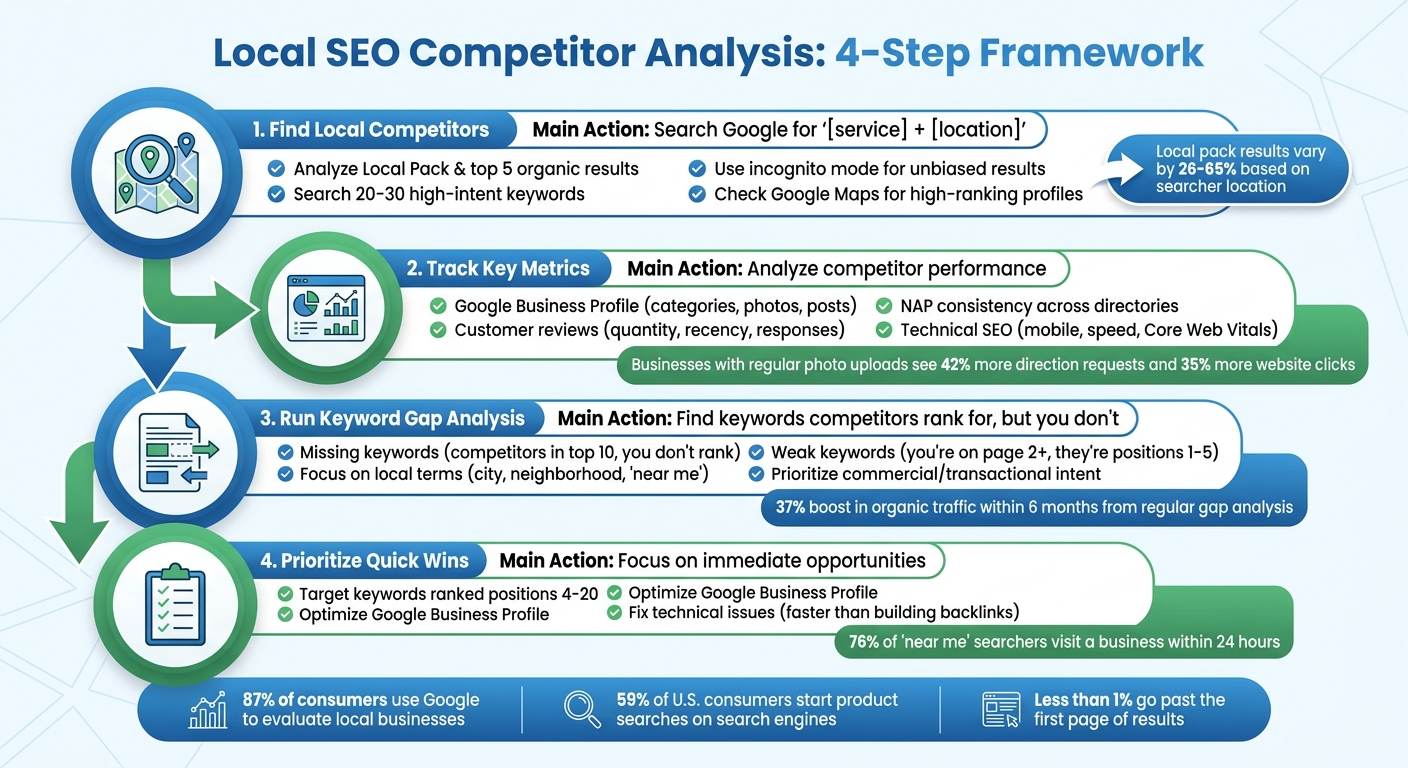
Local SEO Competitor Analysis: 4-Step Framework for Finding and Outranking Competitors
Finding Local Competitors and Understanding Their Strategies
How to Identify Competitors in Your Local Market
If you’re a SaaS business targeting specific geographic areas, figuring out who your local competitors are is a crucial first step to mapping out the competitive landscape. The easiest way to start? Search Google for your primary service along with your target location (e.g., “project management software Austin”). Pay close attention to the businesses that show up in the Local Pack and the top five organic search results. These are likely your main competitors. To get a clearer picture, run searches using 20–30 high-intent keywords and note which competitor domains keep showing up.
Keep in mind, local SaaS competitors aren’t the only ones targeting these terms. You’ll also see indirect players like industry news sites, app stores, and local directories. To ensure you’re seeing unbiased results, search in incognito mode.
It’s also helpful to perform searches from your target location or use tools that simulate being in that location. Google tailors results heavily based on proximity, so what one person sees in one part of town may differ significantly from what someone else sees in another area. In fact, studies show local pack results can vary by as much as 26% to 65% for the same query depending on the searcher’s location. Don’t forget to check Google Maps as well - it’s a great way to spot businesses with high-ranking profiles in your area. Take note of details like their categories, photos, and posting habits.
Once you’ve identified your competitors, it’s time to dive deeper into their strategies by analyzing key performance metrics.
Which Metrics to Track When Analyzing Competitors
After pinpointing your local competitors, the next step is to evaluate their performance using specific metrics. Start by analyzing their Google Business Profile (GBP). Look at things like their primary and secondary categories, the number and quality of photos they’ve uploaded, how often they post updates, and how active they are in the Q&A section. For instance, businesses that regularly upload photos to their profiles see 42% more requests for directions on Google Maps and 35% more clicks to their websites compared to those that don’t.
Customer reviews are another critical factor. Pay attention to the total number of reviews, their average star rating, how recent the reviews are, and how responsive the business owners are to feedback. If your competitor is getting new reviews every week while your business only gets them quarterly, that difference in activity could give them an edge in local rankings. Also, check for NAP (Name, Address, Phone) consistency across local directories and see how many backlinks they’re getting from local sources like chambers of commerce, regional news sites, or community blogs.
From a technical standpoint, dig into their website’s mobile-friendliness, page load speed, and Core Web Vitals. Even a one-second delay can hurt bounce rates significantly. Look at whether they’re using local keywords in their title tags, H1 headers, and meta descriptions, and if they’ve created dedicated pages for specific locations or service areas. Tools like Competitor Analysis Tool (https://competitorscan.io) can make this process easier by identifying gaps in visibility and messaging without requiring deep SEO expertise.
These metrics are a great starting point for identifying localized keyword opportunities through a focused gap analysis.
sbb-itb-0a8c96a
Running a Localized Keyword Gap Analysis
Finding Keyword Opportunities Through Gap Analysis
Once you've analyzed your local competitors' performance, the next step is to find location-specific keywords they rank for, but you don't. This process, called keyword gap analysis, helps you uncover areas where competitors are pulling in local search traffic that you're missing out on. It's a practical way to turn competitor insights into actionable opportunities.
Keyword gaps generally fall into two categories: "Missing" keywords (where competitors rank in the top 10, but you don't rank at all) and "Weak" keywords (where you're stuck on page 2 or lower, while competitors rank between 1 and 5). Missing keywords are perfect for brainstorming new content, while Weak keywords highlight pages that could benefit from optimization. Businesses that regularly perform keyword gap analyses often see a 37% boost in organic traffic within six months.
For local opportunities, focus on keywords that include city names, neighborhood terms, "near me" phrases, or combinations like service-plus-city. For instance, if you're a SaaS company offering project management software in Austin, your competitors might rank for terms like "project management software downtown Austin" or "task tracking tools near me." Meanwhile, your site might only target the broader term "project management software Austin." These hyper-local variations are critical since search results can vary even within ZIP codes.
"A competitive SEO gap analysis is the strategic process of identifying exactly where your competitors are outperforming you... and building a precise roadmap to close that distance." - Ross Cohen, CEO, GetPhound
When prioritizing keywords, focus on commercial or transactional terms, as they often indicate users closer to making a purchase. A striking distance report can also be useful, highlighting keywords where you rank between 11–20 while competitors dominate the top spots. These represent quick-win opportunities. If your domain authority is lower than your competitors', start with Missing keywords that have a keyword difficulty (KD) score under 40 to increase your chances of ranking.
Tools That Simplify Keyword Research
To make the process more efficient, consider using tools designed for keyword research. While manually searching Google in incognito mode can reveal some ranking patterns, specialized tools save time and effort. For example, the Competitor Analysis Tool (https://competitorscan.io) compares your site with a competitor's to identify gaps in visibility and messaging. The tool delivers actionable recommendations in under two minutes, making it especially helpful for SaaS businesses that need fast, data-driven insights without requiring deep SEO expertise.
How To Do A Competitive Analysis For Local SEO - Expert Tutorial
Reviewing Competitor Content and Technical SEO
Once you've identified keyword gaps, the next step is to analyze how competitors optimize their content and technical setup to dominate local search rankings.
Comparing Competitor On-Page Content and Structure
After spotting keyword gaps, take a close look at how competitors organize their pages for local SEO. For instance, check if their title tags and H1 headers include the city name - if they do, it's a clear signal to follow suit. Pay attention to how they weave location-specific keywords into meta descriptions, headers (H1–H6), and general body content.
Another key strategy is to see if competitors use dedicated location pages. Some businesses create these pages outside their main navigation to capture local traffic effectively. Also, check if they leverage LocalBusiness Schema markup, which helps Google understand details like operating hours, locations, and services.
When it comes to content, depth often trumps length in local markets. High-ranking pages tend to provide comprehensive answers to common questions about costs and processes. They also incorporate local trust signals like neighborhood mentions, embedded Google Maps, and city-specific testimonials. Balancing informative content, like blog posts and FAQs, with commercial pages, such as service or product pages, can reveal how competitors prioritize their strategies. Don't forget to review their internal linking patterns and URL structures - using folders like "/blog/" is generally more effective than subdomains for consolidating link equity.
Here’s a quick breakdown of key on-page elements to analyze:
| On-Page Element | What to Analyze | Local SEO Impact |
|---|---|---|
| Title Tags | [Service] + [City] | Major signal for local search intent |
| Meta Descriptions | Local keywords and clear call-to-action | Boosts organic click-through rates |
| NAP Data | Consistency across pages | Builds trust with search engines |
| Schema Markup | LocalBusiness or Review schema | Helps secure rich snippets in search results |
| Location Pages | Number of dedicated service area pages | Expands reach to multiple geographic areas |
| Internal Links | Links to local landing pages | Distributes authority to high-value pages |
Beyond content structure, technical SEO factors are just as critical for achieving strong local rankings.
Checking Technical SEO Elements for Local Rankings
Pair your content analysis with a technical SEO review to identify potential roadblocks. Even the best content won't rank if technical issues hold your site back. The upside? Fixing technical gaps is often quicker than building backlinks or writing lengthy content.
Start by benchmarking your Core Web Vitals against your top three local competitors using Google PageSpeed Insights. Focus on real-user data (field data) instead of lab data. Aim to meet Google's standards: Largest Contentful Paint (LCP) ≤ 2.5 seconds, Interaction to Next Paint (INP) ≤ 200 ms, and Cumulative Layout Shift (CLS) ≤ 0.1. Speed matters - a single extra second of load time can reduce conversions by 7%.
Also, check if competitors are using schema types like LocalBusiness, FAQ, Review, or Product to secure rich snippets in local search results. Use the Schema.org Validator to confirm their implementation. Since most local searches happen on mobile, audit mobile responsiveness carefully. Look for issues like buttons or links placed too close together or content that doesn’t fit properly on smaller screens. Another detail to assess is the internal linking volume on competitor service pages. Pages ranking well locally often include 8–15 internal links per page.
"Technical SEO gaps are often faster to fix and equally impactful. If a competitor has 10,000 backlinks and you have 100, you won't catch up soon. But if they have poor Core Web Vitals and you don't, you can win that advantage today." - Rankture
For a quick comparison, tools like the Competitor Analysis Tool (https://competitorscan.io) can highlight visibility and messaging gaps between your site and your competitors, offering actionable insights without requiring deep technical expertise.
Recording Findings and Ranking Local SEO Opportunities
This final step turns your competitor analysis into a focused local SEO plan that delivers measurable results. To make this work, you need a clear strategy to distinguish between immediate opportunities and long-term projects.
Building an SEO Gap Analysis Report
Start by compiling your findings into a multi-tab spreadsheet. Include separate tabs for keywords, rankings, content gaps, backlinks, and technical issues. Then, categorize your competitors into three groups:
- Direct competitors: Those offering the same service in the same neighborhood.
- Indirect competitors: Businesses with different products but targeting the same audience.
- Aspirational competitors: Top-performing businesses in nearby areas.
This categorization helps you focus on the competitors that matter most for specific opportunities.
To effectively prioritize, use an Impact vs. Effort matrix. Evaluate each opportunity based on its potential impact - like traffic gains, commercial value, or search volume - and the effort required, such as content creation, technical fixes, or link building. Here’s a simple framework for scoring opportunities:
| Opportunity Type | Potential Impact | Difficulty | Resource Needs |
|---|---|---|---|
| Quick Wins | High (Immediate traffic) | Low (Positions 4–20) | Low (On-page tweaks) |
| Strategic Pillars | Very High (Market authority) | High (High KD/DA gap) | High (New long-form content) |
| Technical Fixes | Medium (Ranking stability) | Variable | Medium (Dev time) |
| Local Citations | Medium (Map Pack visibility) | Low (Standardized) | Low (Manual/Tool entry) |
Also, track baseline metrics like Share of Voice (SoV) - the percentage of total estimated traffic you capture from your target keywords. Other key metrics include new top-10 keywords, growth in non-brand traffic, and backlink acquisition.
If spreadsheets feel overwhelming, tools like the Competitor Analysis Tool can simplify this process, providing actionable insights in just a couple of minutes.
With a refined report in hand, you can now focus on immediate areas for improvement.
Identifying Quick-Win Opportunities
Once your report is ready, shift your attention to quick-win opportunities - tasks that can deliver noticeable results within 30 days. Start by targeting keywords where competitors rank between positions 4 and 20. These rankings indicate that you're already in the game, and small improvements could lead to significant gains.
To prioritize, use the Traffic Lift metric. This metric estimates how much organic traffic you could gain by improving your ranking for a specific keyword. For example, boosting your position for a high-volume keyword can lead to a meaningful increase in traffic.
Another quick-win area is optimizing your Google Business Profile (GBP). This free tool can improve your visibility in the map pack within 2–6 weeks. Create a GBP scoring sheet to evaluate factors like profile completeness, category selection, review responses, and the number of photos. Compare your score against competitors to identify areas for improvement.
"Most local businesses think they have an SEO problem when they really have a visibility gap." - Ross Cohen, CEO, GetPhound
Finally, establish a routine for ongoing optimization. Perform quick ranking and review checks weekly, and schedule more detailed audits every 90 days to stay on top of your progress.
Conclusion and Next Steps
Competitor analysis isn’t something you do once and forget about - it’s an ongoing process that keeps your local SEO strategy on point. Businesses that succeed treat visibility gaps as opportunities they can measure and improve. By consistently evaluating what your competitors excel at and where they fall short, you can build a clear plan to outperform them in your target areas.
"The gap between where you are and where your competitor sits is not random. It's measurable. And more importantly, it's fixable." - Ross Cohen
Focus first on the easy wins you’ve uncovered - like targeting keywords ranked in positions 4–20, refining your Google Business Profile, and cleaning up citations. These straightforward updates can lead to noticeable ranking improvements in just a few weeks. Considering that 59% of U.S. consumers start their search for a product or service on a search engine, and less than 1% go past the first page, every position you gain can make a huge difference.
To simplify the process, tools like the Competitor Analysis Tool can help you quickly identify actionable insights in under two minutes, even if you’re not an SEO expert. It highlights demand, messaging gaps, and visibility opportunities, making it easier to prioritize your next steps - whether you’re managing one location or scaling across several markets.
Make it a habit to check your rankings weekly and review your citations monthly. This way, you can spot new competitors, adapt to algorithm changes, and protect the rankings you’ve worked hard to achieve. Use these strategies to take control of your local market and stay ahead.
FAQs
How do I know which local competitors actually matter for my SaaS?
To strengthen your local SEO strategy, start by pinpointing competitors dominating search results for keywords tied to your SaaS services. Look for businesses that appear in top rankings for search terms like "SaaS solutions in [your city]" or "software providers near me."
Focus on competitors that:
- Target the same audience as your business.
- Offer services or solutions similar to yours.
- Consistently rank for high-value, location-specific keywords.
By analyzing these competitors, you can uncover areas where their strategies excel and identify gaps you can fill. This insight allows you to refine your keyword targeting, content, and overall approach to stand out in your local market.
What’s the fastest way to find local keyword gaps I can win?
The fastest way to spot local keyword gaps is through a competitor keyword gap analysis using SEO tools. These tools let you compare your website's keyword rankings against your competitors, revealing high-value keywords they rank for but you don’t. By targeting these opportunities, you can zero in on location-specific, high-intent keywords to improve your local search presence and gain an edge over competitors.
How should I prioritize quick wins vs. bigger local SEO projects?
To achieve a balance between immediate results and larger local SEO goals, target high-impact, low-effort tasks first - like adding internal links. These can deliver quick wins. At the same time, dedicate resources to long-term strategies such as improving proximity, relevance, and prominence. This dual approach not only drives fast improvements but also sets the stage for steady, sustainable growth.