
Organic vs Paid Traffic: Which Drives SaaS Growth?
Paid ads deliver fast, targeted SaaS leads; organic content lowers CAC, builds trust, and compounds traffic over time.

Organic and paid traffic are two key drivers of SaaS growth, each with unique strengths and challenges. Here's the bottom line: paid traffic gets you immediate results but stops when the budget runs out, while organic traffic takes time to build but delivers long-term, compounding benefits. The best SaaS strategies combine both.
Key Takeaways:
- Paid Traffic: Delivers fast results, precise targeting, and scalability. However, it's expensive and stops working when spending halts.
- Organic Traffic: Builds trust, reduces costs over time, and creates a durable lead pipeline. But it requires upfront investment and patience (6–12 months for results).
Quick Comparison:
| Aspect | Organic Traffic | Paid Traffic |
|---|---|---|
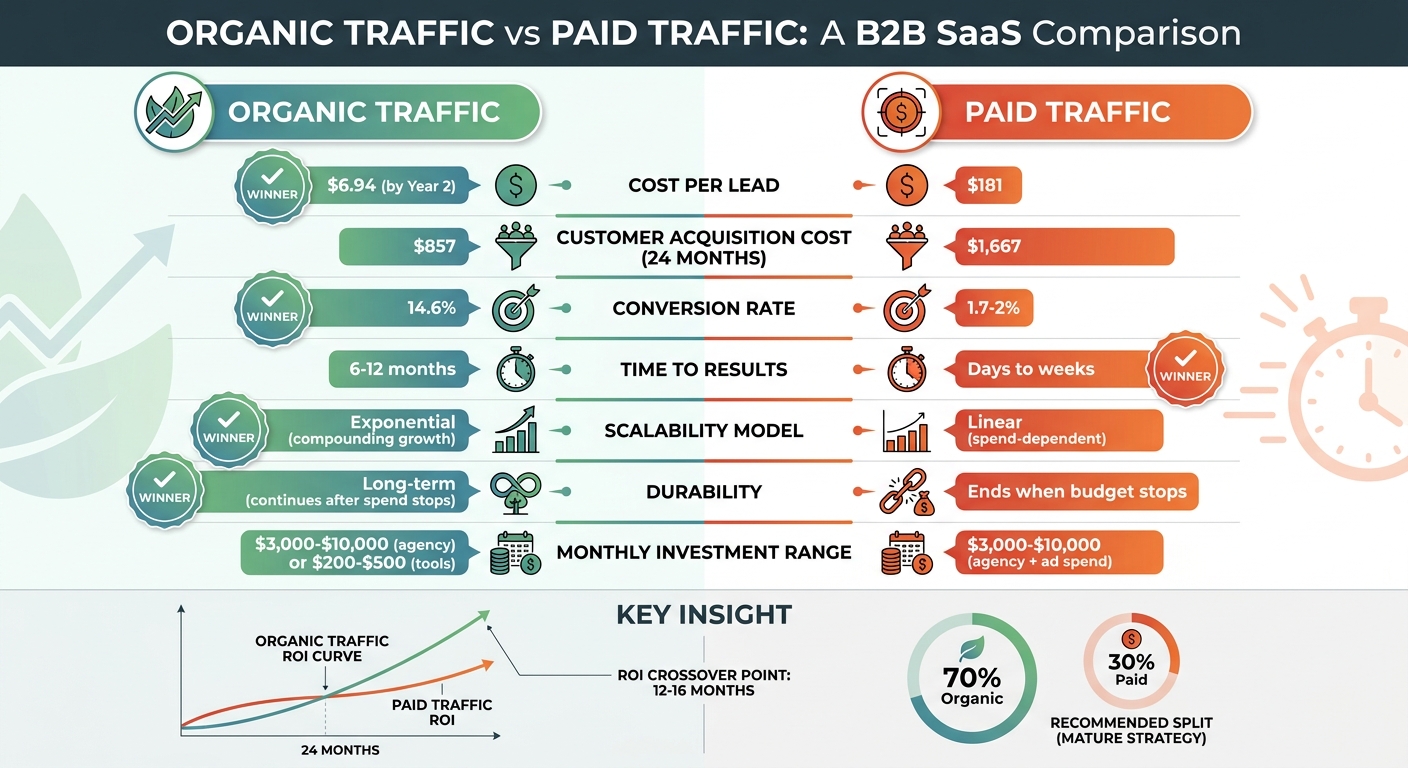
| Cost Per Lead | $6.94 (by Year 2) | $181 |
| Time to Results | 6–12 months | Days to weeks |
| Scalability | Exponential (compounding growth) | Linear (spend-dependent) |
| Durability | Long-term | Ends when budget stops |
| Conversion Rate | 14.6% | 1.7%–2% |
Best Approach: Use paid traffic for quick wins and testing, while investing in organic traffic for sustainable growth. Transition to a 70% organic and 30% paid split as your content strategy matures.
Organic vs Paid Traffic for SaaS: Cost, Conversion & ROI Comparison
Organic Traffic: Pros and Cons for SaaS
Benefits of Organic Traffic
Organic traffic operates on a compounding growth model, meaning each piece of content you create becomes a long-term asset that continues to generate leads over time. Unlike paid channels, where costs scale with performance, the initial investment in content and SEO remains fixed, while returns grow as your domain establishes authority in your niche.
The financial benefits become especially apparent over time. For instance, by the 24-month mark, the customer acquisition cost (CAC) for organic traffic can drop to approximately $857, compared to $1,667 for paid ads. Consider this: a SaaS company publishing just four blog posts per month could see their monthly traffic grow from about 400 visits in Month 3 to a staggering 24,000 visits by Month 24.
Beyond cost savings, organic traffic also boosts trust and credibility. When potential customers find your content while searching for solutions, they’re already engaging with your brand in a meaningful way. This positions you as an expert in your field - an edge that’s particularly valuable in the B2B SaaS space, where buyers often conduct thorough research before making decisions.
Another major advantage is durability. Unlike paid campaigns, which stop delivering the moment you halt spending, organic content continues to work for you 24/7. This creates a more reliable and predictable lead pipeline compared to the often volatile nature of paid channels.
But while these benefits are compelling, organic traffic isn’t without its challenges.
Drawbacks of Organic Traffic
Despite its long-term potential, organic traffic comes with its own set of obstacles. One of the biggest hurdles is the time it takes to see meaningful results. For new websites, it can take anywhere from 6 to 12 months to gain traction, with the "crossover point" - when organic ROI surpasses paid ROI - typically occurring between months 12 and 16. Until then, your efforts may feel like they’re yielding minimal returns.
The upfront investment can also be considerable. While you’re not spending on ads, you’ll need to allocate resources to build a strong foundation. This includes costs like agency retainers, which range from $3,000 to $10,000 per month, hiring in-house content writers at $70,000–$120,000 per year, or outsourcing to freelance writers who charge $300–$800 per post. On top of that, expect to spend around $200–$500 per month on SEO tools and infrastructure.
Another challenge is the vulnerability to search engine algorithms. Sudden updates can cause traffic fluctuations, making organic visibility less predictable. For example, evolving search result layouts in 2026 have led to declining click-through rates, adding pressure to refine organic strategies continuously.
Targeting precision is another limitation. Unlike paid ads, which allow you to pinpoint specific job titles, industries, or company sizes, organic content typically casts a wider net. This can make it harder to focus on your ideal customer profile. Additionally, chasing high-volume keywords can result in traffic that looks impressive on paper but doesn’t convert into signups due to a lack of commercial intent.
Finally, the technical demands of running a SaaS site can’t be ignored. Without proper site architecture, schema markup, and fast page speeds, even the best content strategy can stall. Many SaaS companies fall into the trap of publishing educational content that doesn’t align with their product, leading to traffic that fails to convert.
These challenges highlight the complexities of organic traffic, setting the stage for a deeper look at how paid strategies compare for SaaS businesses.
sbb-itb-0a8c96a
Paid Traffic: Pros and Cons for SaaS
Benefits of Paid Traffic
Paid advertising delivers something organic strategies can't: speed. While it might take months for organic efforts to gain momentum, paid campaigns can start generating leads in a matter of hours or days. This immediacy makes it especially useful for launching new products, testing market fit, or meeting aggressive growth goals.
Another big win with paid traffic is precision targeting. Platforms like LinkedIn and Google Ads allow you to zero in on specific audiences, such as decision-makers or users searching for high-intent keywords. This level of control is tough to achieve through organic efforts alone.
Paid traffic also offers a linear path to scaling. Want more leads? Increase your budget. This straightforward relationship between spending and results makes it easier to validate messaging, pricing, or even product-market fit.
And let’s not forget about those high-intent keywords. Some of these are almost impossible to rank for organically, but paid ads give you access. About 89% of ad clicks are incremental, capturing users who might never find you through organic search.
Drawbacks of Paid Traffic
Despite its advantages, paid traffic has some clear downsides. For starters, it’s a "rental" model. The moment you stop paying, the traffic disappears. Unlike organic content, which can keep working for you long after it’s published, paid campaigns require constant investment to maintain performance. This reliance on ongoing spending can be tough, especially for SaaS products with lower price points.
Cost is another hurdle. Consider a SaaS product priced at $50 per month. With a $20 cost-per-click and standard conversion rates, your customer acquisition cost could balloon to $3,333 - meaning it would take 67 months to break even. In competitive niches, CPCs can skyrocket. Keywords like "CRM for startups" often cost $25–$45 per click, while LinkedIn ads range from $15–$30 per click.
Over time, the return on investment for paid traffic tends to lag behind organic efforts. In fact, over 24 months, paid traffic typically delivers ROI that's five times lower than organic lead generation. Organic leads also convert at higher rates - 14.6% compared to 1.7–2% for paid leads.
Then there’s ad fatigue. Over time, audiences stop engaging with the same ads, forcing you to constantly refresh your creative. This often requires either in-house expertise or an agency, which can cost $3,000–$10,000 per month. And unlike organic content, which builds value over time, paid campaigns stop delivering the moment you stop spending.
"The companies that win in SaaS aren't the ones that spend the most on ads. They're the ones that build content engines so strong that their CAC drops every month while their competitors' rises." - Ink Engine
Next, we’ll dive into key metrics to see how these strategies compare for driving SaaS growth.
Organic VS Paid Marketing Search Strategies The Pros and Cons | Neil Patel
Direct Comparison: Organic vs Paid Traffic for SaaS
Organic and paid traffic operate on two very different financial timelines. Paid traffic delivers quick, predictable results, while organic traffic builds momentum over time, creating lasting benefits. For SaaS companies, where every dollar has to work hard, these differences can shape growth strategies in a big way.
Let’s break it down financially. Imagine a $5,000 monthly budget over 24 months. If you put that into paid ads, you might gain around 72 customers, with a Customer Acquisition Cost (CAC) of $1,667 per customer. Now, take that same budget and invest it in content marketing - you could bring in 140 customers at a CAC of just $857 per customer. The difference? Stop paying for ads, and the leads vanish. But with organic content, you’ll keep generating 12–15 leads per month, and those numbers will only grow.
The tipping point comes between months 12 and 16. That’s when the cumulative ROI from organic traffic overtakes paid ads. For SaaS companies with over $50 million in Annual Recurring Revenue (ARR), about 60% of new ARR comes from organic channels and existing customers.
Here’s a closer look at the metrics that highlight these differences:
Metrics Comparison Table
| Metric | Organic Traffic | Paid Traffic | Advantage |
|---|---|---|---|
| Customer Acquisition Cost | $31 per lead (drops to $6.94 by Year 2) | $181 per lead (static or increases) | Organic |
| Conversion Rate (2026) | 14.6% | 1.7%–2% | Organic |
| Click-Through Rate | Varies by ranking position | 3.17%–6% for search ads | Paid (for speed) |
| Scalability Model | Exponential (compounding authority) | Linear (requires proportional spend) | Organic |
| Pipeline Durability | High (continues after spend stops) | Zero (stops when budget pauses) | Organic |
| Time to First Results | 6–12 months | Days to weeks | Paid |
The numbers make it clear: organic traffic shines when it comes to long-term metrics. Paid traffic, on the other hand, is all about instant results. The best approach? Combine the two. Paid traffic can drive immediate leads, while organic growth ensures your pipeline stays strong over time.
Next, we’ll dive into how you can measure these performance differences effectively.
How to Measure Organic and Paid Traffic Performance in SaaS
When evaluating traffic performance for your SaaS business, focus on metrics that directly tie to value, rather than vanity numbers. For example, instead of obsessing over keyword rankings or organic session counts, zero in on organic pipeline contribution - the total dollar value of qualified opportunities generated by organic search. This is the kind of data that boards and investors care about most.
Compare Organic CAC vs. Paid CAC
Tracking customer acquisition costs (CAC) for both organic and paid channels is critical. Organic CAC tends to decrease over time as your content gains momentum, while paid CAC often remains constant or even rises. Keep an eye on your LTV:CAC ratio for each channel - organic cohorts often achieve a 5:1 ratio or higher, compared to the industry benchmark of 3:1. Additionally, calculate your CAC payback period; for B2B SaaS, the median is about 6.8 months.
The Role of Generative AI in Traffic Performance
Generative AI tools are reshaping buyer behavior. A staggering 94% of B2B buyers now use these tools during their purchasing process. For instance, ChatGPT referral traffic boasts a conversion rate of 15.9%, compared to just 1.76% for traditional Google organic search. However, AI tools often mask their referral data as "Direct" in GA4. To address this, add a simple "How did you hear about us?" field to your forms to better track AI-driven influence.
Use W-Shaped Attribution for Longer Sales Cycles
For sales cycles exceeding 30 days, W-shaped attribution is an effective model. It assigns 30% credit each to the first interaction, lead creation, and the final touchpoint. This approach provides a more balanced perspective on how organic and paid channels contribute to conversions. To refine your strategy further, run quarterly incrementality tests. For example, pause branded search ads in one region while keeping them active elsewhere to see if those ads are driving new conversions or merely cannibalizing organic clicks.
Digging Into "Direct" Traffic
AI-referred visitors often land on specific product or comparison pages and show higher engagement than typical "Direct" traffic. Segment this traffic by landing page and engagement depth to uncover trends. Additionally, track your AI citation share of voice - the percentage of AI-generated answers that mention your brand. With 90% of buyers clicking through to sources featured in AI answers, this metric can reveal hidden opportunities that traditional analytics might overlook.
Conclusion: Selecting the Right Traffic Strategy for Your SaaS
To drive growth effectively, your traffic strategy needs to align with both short-term goals and long-term sustainability. Paid traffic offers quick scalability when actively funded, while organic traffic builds a steady, self-sustaining lead generation engine over time. Successful SaaS companies often see their customer acquisition costs (CAC) decrease as their content gains authority and delivers ongoing results.
For a balanced approach, aim for at least 40% of your traffic to come from organic sources as you scale. This ensures your lead pipeline remains strong even if you need to pause ad spending, keeping your blended CAC manageable. Early-stage SaaS businesses might start with a 70% paid and 30% organic split to validate their product quickly, then shift to 70% organic and 30% paid as their content strategy matures. The tipping point - where organic traffic delivers a better return than paid ads - often occurs within 12 to 18 months.
The key is to use both channels strategically. A good resource allocation framework is the 70/20/10 rule: dedicate 70% of your budget to proven channels, 20% to adjacent opportunities, and 10% to experimental tactics. This approach balances immediate wins with sustainable growth. Paid ads can help you test messaging quickly and retarget visitors who didn’t convert, while organic efforts - like building topic clusters - establish long-term authority.
To refine your strategy further, leverage competitor analysis to uncover growth opportunities. Tools like Competitor Analysis Tool can identify high-intent keywords and content gaps where your competitors rank but you don’t. In just a couple of minutes, you can get actionable insights to focus your efforts on content that drives meaningful results.
FAQs
When should a SaaS shift from mostly paid to mostly organic traffic?
When aiming for steady growth and less dependence on ad spending, a SaaS company should focus more on organic traffic. While paid traffic delivers fast results, it vanishes as soon as you stop funding it. Organic traffic, on the other hand, creates a lasting and more budget-friendly growth path. The right time to make this shift is when you’ve built a solid foundation of quality content, established authority in your niche, and are consistently generating organic leads. At this stage, organic channels can drive growth while keeping acquisition costs in check over the long run.
How do I measure organic ROI if conversions happen weeks later?
To gauge the ROI of organic efforts when conversions take time, it's important to track metrics that connect organic strategies to revenue over an extended period. Start by analyzing organic pipeline contribution - this shows how much of your sales pipeline stems from organic traffic. Next, compare organic customer acquisition cost (CAC) to paid CAC to assess efficiency. Finally, leverage attribution models that factor in delayed conversions, ensuring you capture the full picture of how organic channels drive results.
Keeping an eye on long-term engagement and revenue from organic sources is key. Even if conversions happen weeks after the initial interaction, this approach helps you accurately measure the impact of your organic efforts.
What organic content actually converts, not just drives traffic?
Organic content that drives conversions zeroes in on high-intent, revenue-focused topics. This includes content like product-led pieces, technical guides, and detailed educational resources that establish trust and credibility. These formats are designed to inspire actions such as signing up for demos, creating accounts, or fueling long-term business growth.