
How to Position SaaS Value Proposition vs Competitors
Map alternatives, link pains to business impact, close messaging gaps, and promise one clear outcome to beat the status quo.
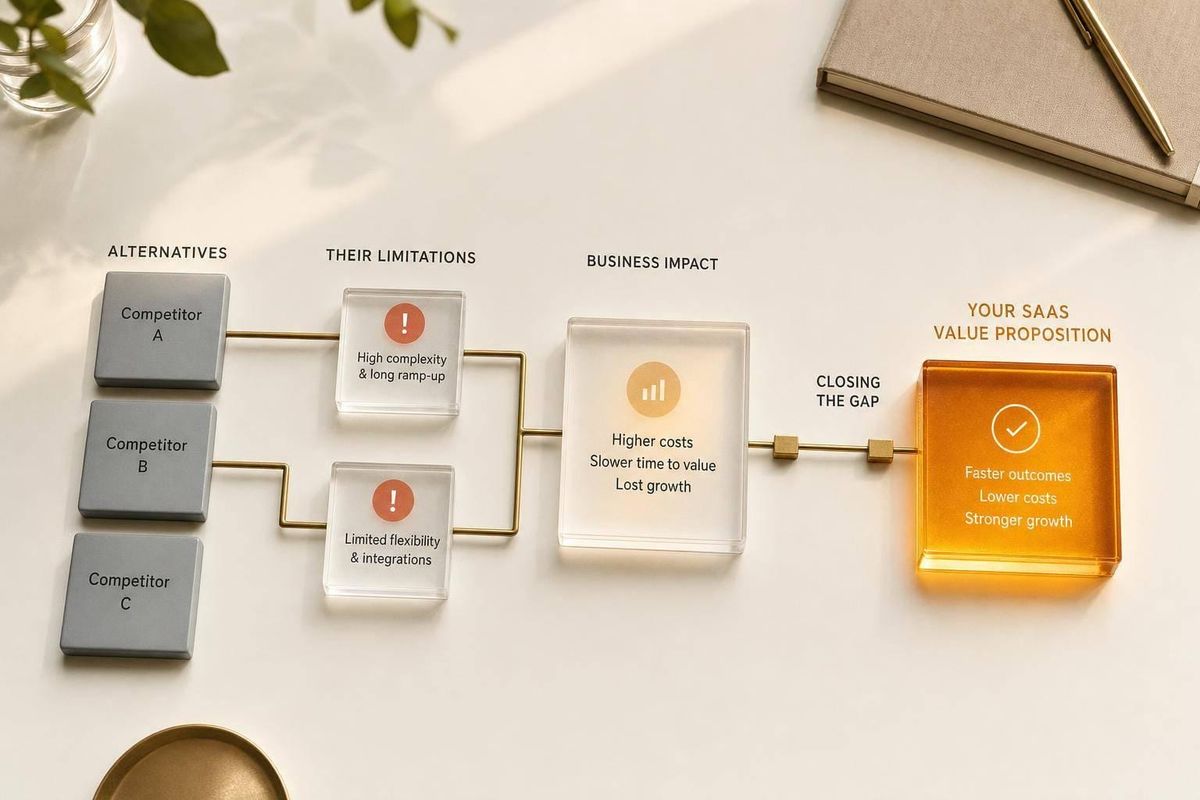
Most SaaS buyers don’t compare you to one rival. They compare you to everything: other tools, spreadsheets, internal fixes, consultants, and doing nothing. If your message ignores that, the status quo often wins. In many B2B deals, up to 60% of losses go to no decision.
Here’s the short version: I’d position a SaaS value proposition by mapping the full set of buyer options, tying pain to business impact, finding growth gaps vs competitors by mapping message differences, and then writing one clear promise for one buyer and one outcome. That keeps the message sharp and gives sales a line they can defend.
What matters most:
- Name the real alternatives buyers weigh, not just direct rivals
- Show the cost of waiting or doing nothing
- Translate pain into business terms like lost revenue, wasted spend, churn risk, or slow decisions
- Cut vague claims that sound like every other SaaS site
- Use proof like metrics, reviews, case studies, or onboarding time
- Write for one buyer and one outcome, not everyone at once
A few points stood out to me from the article:
- Buyers judge options by fit, effort, risk, proof, approval, and delay cost
- 3-star reviews and 1–3 star competitor reviews often show the clearest friction
- 94% of SaaS marketing leaders say they compete in a “sea of sameness”
- A simple 5-second test can show whether your message is clear
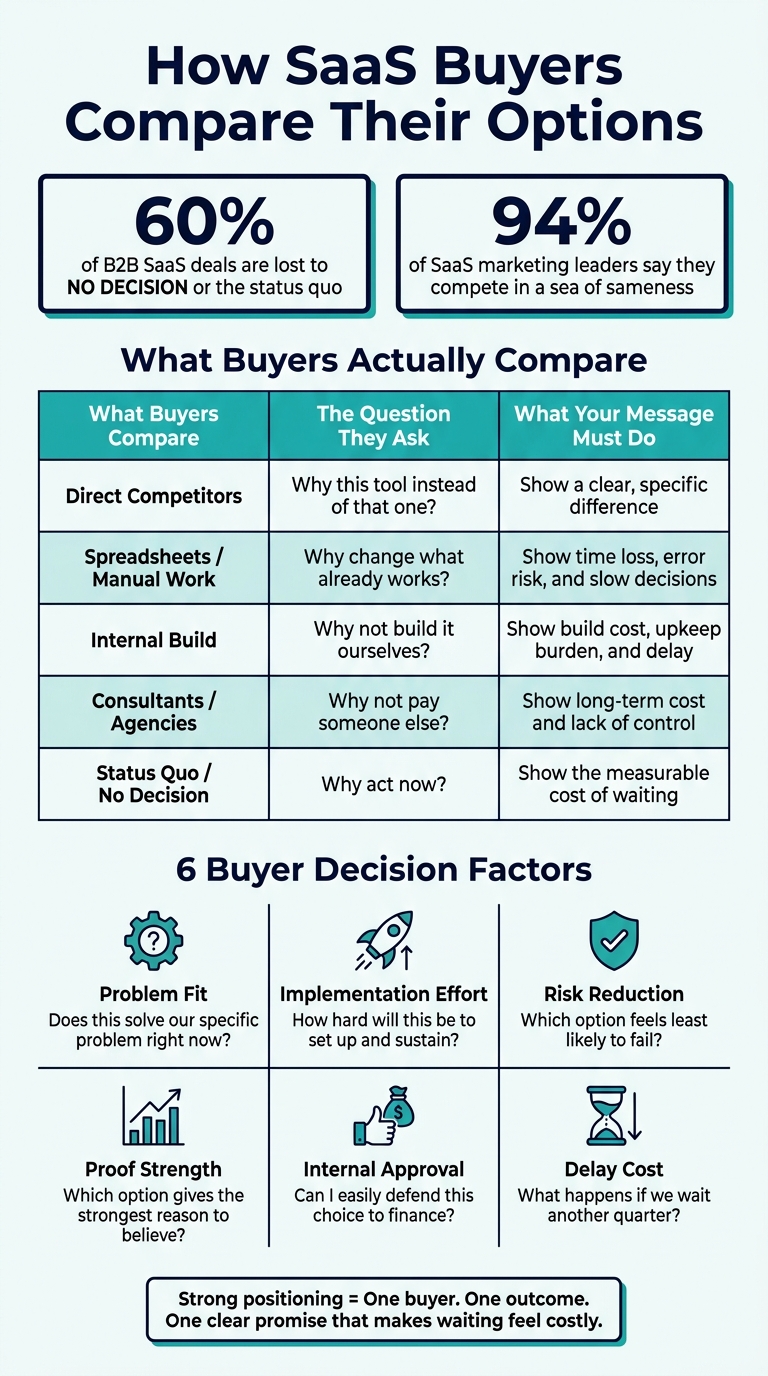
SaaS Competitive Positioning: How Buyers Compare Their Options
How to Nail B2B SaaS Positioning and Homepage Messaging - Anthony Pierri (FletchPMM)
sbb-itb-0a8c96a
Quick Comparison
| What buyers compare | What they ask | What your message should do |
|---|---|---|
| Direct competitors | “Why this tool instead of that one?” | Show a clear difference |
| Spreadsheets/manual work | “Why change what already works?” | Show time loss, error risk, and slow decisions |
| Internal build | “Why not build it ourselves?” | Show build cost, upkeep, and delay |
| Consultants/agencies | “Why not pay someone else to handle it?” | Show long-term cost and lack of control |
| Status quo/no decision | “Why act now?” | Show the cost of waiting |
My takeaway: strong positioning is not about listing more features. It’s about making the buyer say, “This is for my problem, my team, and my situation - and waiting will cost me more.” That’s the frame for the rest of the article.
1. Define your competitive set before writing your value proposition
Base your positioning on the buyer’s actual alternatives, not on your own product list.
That means starting with every option a buyer might pick: direct competitors, substitute options, internal workarounds, and the status quo.
Map direct competitors, substitutes, and the status quo
Your real competitive set is usually bigger than it looks. It can include direct competitors, spreadsheets, internal builds, legacy platforms, consultants, larger enterprise suites, and cheaper point solutions. In many cases, the status quo is the toughest rival because it avoids budget approval, training, and political risk.
A good place to start is one simple question: What was the buyer doing before they looked for a solution?
That answer usually tells you what you’re up against.
If a team is using a spreadsheet, they’re not just weighing your product against another SaaS tool. They’re weighing it against a routine they already know. And habits can be hard to beat.
For each option, capture:
- the buyer
- the main promise
- the price level
- the key message
- the main tradeoff
That last column matters more than it may seem. The tradeoff tells you which objection your message needs to handle.
Build a simple competitor map around buyer decision factors
Once you’ve mapped the full set, score each option based on how buyers make the decision.
Buyers tend to compare options through a few common lenses: fit, effort, risk, proof, and ease of approval.
| Buyer Decision Factor | Buyer Question |
|---|---|
| Problem fit | Does this solve the specific problem we have right now? |
| Implementation effort | How hard will this be to implement, use, and sustain? |
| Risk reduction | Which option feels least likely to fail or cause disruption? |
| Proof strength | Which option gives us the strongest reason to believe it works? |
| Internal approval | Can I easily defend this choice to my boss or finance team? |
| Delay cost | What happens if we wait another quarter to decide? |
Score each competitor - including the status quo - against these factors. That scorecard makes the pressure points easy to spot. It shows which objections your value proposition needs to answer first.
2. Map buyer pain points to jobs, urgency, and business impact
Once you know who you're up against, the next step is figuring out why buyers feel stuck in the first place.
Focus on pains that are underserved, urgent, and tied to business results. The best language usually comes straight from buyers, not from your internal docs. Pull it from sales calls, reviews, support tickets, and interviews. 3-star reviews are often gold because they tend to show specific friction without turning into pure venting. It also helps to scan 1–3 star competitor reviews for complaints that show up again and again.
Use the competitor set from Section 1 to spot which pains each option still leaves hanging by finding gaps vs competitors.
Separate functional pain from business impact
The main lever here is business impact: what happens if the pain doesn't get fixed?
“Reporting takes too long” is one thing. “Budget decisions slow and pipeline visibility drops” is something else entirely. The first is a workflow issue. The second puts revenue and planning at risk.
| Level | Example | Primary Audience |
|---|---|---|
| Functional pain | "Reporting takes too long." | End-user or department lead |
| Business impact | "Delayed budget decisions and lost pipeline visibility." | Executive or economic buyer |
A simple way to pressure-test this is the "So What" test. Take any functional complaint and ask why it matters to the business. If the answer doesn't lead to revenue, churn risk, wasted spend, or missed deadlines, keep going.
A pain point without a measurable consequence usually doesn't create urgency. And if your positioning doesn't make the cost of doing nothing clear, buyers often stick with the status quo.
Once you've pinned down which pains create urgency, connect each one to the outcome behind it.
Connect each pain point to an outcome the buyer is trying to achieve
Behind every pain point is an outcome the buyer is trying to reach. That might mean helping an internal champion justify the purchase to finance or IT. Or it might mean cutting adoption and rollout risk.
One useful signal is the first action new users take. That often tells you what job they hired the product to do. From there, look for the thread your best-fit customers share: their role, their moment of urgency, and the exact result they're after.
"Buyers don't care that you have 50 integrations. They care about not having to manually export data every week." - Apricot Studio
One buyer and one outcome usually lead to stronger positioning than a message aimed at everyone. Those pain patterns show where your message has to work harder than competitor claims.
3. Find messaging gaps between your site, competitor claims, and buyer needs
Once you've mapped buyer pain points, line them up against three things: your site, competitor claims, and the status quo. Then compare those pains with the language buyers see on your pages and on competitor sites. This is messaging analysis, not a simple feature-by-feature competitor check.
Audit overused claims and missing benefits
Start with what Natalia Slota of Apricot B2B Marketing calls the Logo Test:
"If you removed your logo from your homepage right now, would buyers know they were looking at your company? Or would they assume they'd landed on a competitor's site?"
If the answer is no, your messaging may blend in. Phrases like "seamless integration", "AI-powered", "all-in-one platform," and "streamline your workflows" appear so often that buyers tune them out. In one survey, 94% of SaaS marketing leaders said their companies operate in a "sea of sameness", and only 6% said their brand is very distinctive.
A simple fix: build a do-not-use list of phrases that appear on three or more competitor sites. Then remove them from your homepage, pricing page, ads, and sales deck.
Also watch for credibility gaps. These are claims like "easiest to use" or "enterprise-grade security" with no proof behind them. If you can't back a claim with a metric, quote, or case study, cut it.
Prioritize demand, messaging, and visibility gaps
Not every gap deserves the same amount of effort. Some change how buyers think. Others just clean up what you already have.
| Gap Type | What It Means | Priority |
|---|---|---|
| Demand Gap | Problems or segments the market cares about that competitors ignore | High - best chance to stand apart |
| Messaging Gap | Areas where you sound the same as competitors | High - needed for clarity |
| Visibility Gap | Strengths you already have but bury too deep on the site | Medium - quick win once spotted |
Start with demand gaps first, messaging gaps second, and visibility gaps third.
A competitor analysis tool can help speed this up by spotting demand, messaging, and visibility gaps fast.
The point here is to shift buyer criteria, not fight on competitor terms.
Use the biggest gap to shape the positioning statement in the next step.
4. Turn your analysis into a positioning statement and value proposition
You’ve mapped your competitors, found buyer pain points, and spotted the holes in your messaging. Now comes the part that turns research into something buyers can actually remember: a positioning statement and value proposition they can repeat.
The goal is simple. Pick the biggest gap from your analysis and turn it into the one claim you want buyers to associate with your product.
Write a positioning statement for one buyer and one outcome
A positioning statement is an internal guide that keeps marketing, sales, and product pointed at the same message. It answers a basic question: "Who should choose you, and why?"
Start with the buyer segment and outcome that matter most. Not all buyers. Not every use case. Just the one that matters most right now.
Use this structure:
"For [specific customer] who [specific problem], [product name] is the [category] that [distinctive benefit] - unlike [alternative], which [limitation]."
The word that matters most here is specific. “For growing SaaS teams” is too broad. It doesn’t tell you much. “For revenue operations managers at B2B SaaS companies who need a clearer way to manage pipeline data” is far more useful because it points to a real buyer, a real problem, and a clear outcome. Use the buyer’s language, not your internal product terms.
You also need to name the alternative being replaced. In B2B SaaS, that’s often not a direct competitor. It’s the status quo. Up to 60% of lost deals go to "no decision" or the status quo. So if buyers are staying with spreadsheets or a manual process, say that out loud. Your positioning should make doing nothing feel more costly than making the switch.
Stick with the single buyer-outcome pair that has the highest urgency and the clearest proof.
Draft the final value proposition with proof and clarity
Once the positioning statement is set, turn it into copy for your homepage, ads, and sales pages. A simple formula works well here:
- Clear promise
- Concrete outcome
- Proof
Proof is what makes the promise believable. As Alexander Chua, Co-Founder of Growigami, puts it:
"Specific claims beat superlatives. 'Onboard in 48 hours' beats 'the fastest onboarding.'"
Your proof should match your main claim. If your message is about speed, show onboarding data. If it’s about ROI, show a revenue or efficiency metric from a real customer. Good proof can come from case studies, reviews, logos, certifications, compliance data, or screenshots.
Before you lock in the copy, run a quick 5-second test: show it for five seconds, then ask what you do and who it’s for. If they can’t answer both, the message still needs work.
Conclusion: A simple process to make your SaaS stand apart
Strong SaaS positioning starts with evidence. You define the real alternatives, map buyer pain points, find message gaps, and write one value proposition for one buyer and one outcome.
The test is simple: specificity. As Salesmotion puts it:
"If a rep can swap your company name with a competitor's and the sentence still sounds believable, the positioning isn't strong enough."
If that sentence still works after you swap in a competitor's name, your positioning is too generic.
But specificity on its own isn't enough. The whole team has to use the same language. Sales, marketing, and product need to line up on the message before launch. If people inside the company describe the product in different ways, buyers will pick up that mixed signal too.
If you want a faster audit, use a tool to spot the gaps first. Competitor Analysis Tool can speed up the Step 3 audit by showing demand, messaging, and visibility gaps between your site and a competitor's.
It also helps to revisit your positioning when competitors change pricing, ship new features, or your target buyers shift.
FAQs
How do I know which buyer alternative matters most?
Don’t stop at direct competitors. In many deals, the main alternative isn’t another vendor. It’s the status quo: manual work, spreadsheets, or simply doing nothing. That option often feels safest because it avoids budget fights and political risk.
Map those alternatives against the factors that shape the decision. Then check your assumptions with win/loss analysis, sales calls, and customer interviews. Put your attention on the option that appears most often in active deals, and spell out the cost of doing nothing in plain terms.
What proof makes a SaaS value proposition believable?
A SaaS value proposition works when it moves past generic feature lists and makes a clear promise about results. Phrases like “AI-powered” or “all-in-one” sound vague on their own. But a claim like resolving support tickets 40% faster tells buyers what they might get, and that makes the message easier to trust.
The proof has to line up with what the buyer cares about most. For some teams, that means implementation data. For others, it’s ROI numbers or case studies from their industry. Strong proof can include:
- Statistics
- Customer testimonials
- Analyst recognition
- Certifications
How often should I update my positioning?
Positioning isn’t a one-and-done project. It’s something you come back to on a regular basis.
Do a light competitive review at least every 90 days. That helps you spot changes in competitor messaging, pricing, and the topics they’re pushing in their content.
Then take a deeper look at your value proposition every 6 to 12 months. You should also revisit it any time there’s a major market shift, a product launch, or a strategic pivot.