
ICE Framework for SaaS Growth Experiments
Score Impact, Confidence, and Ease to rank SaaS growth ideas and ship tests most likely to move sign-ups and revenue.

If I have a long list of SaaS growth ideas, ICE helps me rank them fast. I score each idea on Impact, Confidence, and Ease on a 1–10 scale, multiply the numbers, and ship the tests with the best scores first.
Here’s the whole idea in plain English:
- Impact: How much could this change sign-ups, demo requests, activation, MRR, or ARR?
- Confidence: What proof do I have that it might work?
- Ease: How much time and work will it take to launch?
A few points matter most:
- A high-impact idea can still drop if confidence is weak.
- Confidence should come from data, research, support tickets, or past tests - not opinion.
- Ease should be scored by the person building the test, not just by founders or PMs.
- ICE works well for early-stage SaaS because I don’t need perfect traffic data to use it.
- Competitor site gaps - like weak pricing pages, missing comparison pages, or thin use-case pages - can turn into test ideas and then into ranked backlog items.
- If my team gets larger or I have better reach data, I may outgrow ICE and move to RICE or PIE.
One useful rule from the article: don’t give Confidence a high score without outside proof. Another: keep top-tier Impact scores rare so every idea doesn’t end up looking like a “10.”
Quick Comparison
| Framework | What it scores | Best for | Main limit |
|---|---|---|---|
| ICE | Impact, Confidence, Ease | Lean SaaS teams and early-stage testing | Doesn’t account for reach |
| RICE | Reach, Impact, Confidence, Effort | Teams with more traffic and stronger data | Takes more input to score well |
| PIE | Potential, Importance, Ease | Page-level CRO work | Less useful for backlog ranking across teams |
So if I want a simple way to sort growth tests, keep debates shorter, and focus on the 2–3 ideas most likely to move revenue, ICE is a solid starting point.
sbb-itb-0a8c96a
How to Score Impact, Confidence, and Ease
Each part of ICE answers a different question.
Impact asks: how much will this move trial sign-ups, demo requests, activation, MRR, or ARR?
Confidence asks: what proof do I have?
Ease asks: how fast can we ship it?
If one score is weak, the total takes a hit. That’s why these three numbers work well for comparing competitor-gap ideas in your backlog.
Impact: Estimate Movement in Core SaaS Metrics
Impact scores should tie straight to the metrics that matter: trial sign-ups, demo requests, activation rate, MRR, and ARR. Set 10 as your best proven lift, then score everything else against that mark.
| Score | Impact Level | SaaS Metric Example | Typical Lift |
|---|---|---|---|
| 1–3 | Minor | UI tweaks, footer link labels | < 2% |
| 4–6 | Moderate | Hero copy rewrite, funnel step optimization | 2–10% |
| 7–8 | Significant | Social proof additions, demo request form changes | 10–20% |
| 9–10 | Transformative | Pricing page redesign, new core feature launch | > 20% |
To avoid score creep, it helps to put a ceiling on top scores. For example, you might limit 9s and 10s to no more than 20% of your backlog at any given time.
Confidence: Score Evidence, Not Gut Feelings
This is where a lot of teams slip up.
Confidence is not about how much you like an idea. It’s about the proof behind it. Score confidence based on evidence, not preference.
A simple rule works well here: never score Confidence above 3 without external evidence. That proof can come from customer interviews, analytics, heatmaps, support ticket trends, or competitor messaging and visibility gaps. A Competitor Analysis Tool can surface demand, messaging, and visibility gaps fast, without SEO expertise. That gives you a starting point for competitor-gap tests.
| Evidence Source | Suggested Confidence Score |
|---|---|
| Pure hunch / internal opinion | 1–2 |
| Competitor observation / messaging gaps | 3–4 |
| Support tickets / customer feedback trends | 5–6 |
| User research / heatmaps / session recordings | 7–8 |
| Prior A/B test results / quantitative analytics | 9–10 |
Ease: Prioritize Tests That Ship Fast
Ease is effort flipped around. A 10 means a few hours with no code. A 1 means a multi-week project with multiple teams involved.
Always let the engineer building the test assign the Ease score. Founders and PMs often underrate technical debt and QA.
| Score | Ease Level | Implementation Effort | Timeline |
|---|---|---|---|
| 1–3 | Hard | Multi-team coordination, backend or infrastructure changes | 2+ weeks |
| 4–6 | Moderate | Requires design and frontend dev (e.g., new onboarding step) | 3–5 days |
| 7–8 | Light | Mostly copy changes or simple configuration | 1–2 days |
| 9–10 | Trivial | No-code changes, CMS updates, hours of work | < 1 day |
If two ideas land on the same score, go with the one tied to the higher-revenue step first. That keeps the backlog aimed at tests your team can ship now.
How to Turn Competitor Website Gaps into ICE-Scored Experiments
Founders usually have more test ideas than their backlog shows. And a competitor website can give you plenty to work with on its own. You don't need an SEO audit to spot openings.
Start with the obvious places:
- Missing comparison pages
- Unclear pricing
- Weak social proof
- Thin use-case pages
Each gap should connect to a business outcome like trial starts, demo requests, activation, or paid conversion. A Competitor Analysis Tool can surface demand, messaging, and visibility gaps fast, without SEO work. Then the job is simple: turn each gap into an ICE-scored test instead of leaving it as a loose idea.
Find Gaps in Messaging, Pages, Pricing, and Visibility
Messaging gaps are often where the biggest upside sits. If a competitor's hero headline is vague, but your product fixes a clear pain point, that's a clue. Your own message may need to be sharper for U.S. buyers.
Page gaps matter too. If competitors have comparison pages or use-case pages that you don't, that can point to missed intent. Pricing gaps can show up when a pricing page feels hard to follow or doesn't help buyers make a choice. Visibility gaps can hint at places where your message isn't showing up clearly enough in the market.
Turn Each Gap into a Specific Test Idea
Now turn each gap into ONE testable idea.
"Their pricing page is confusing" isn't a test. It's just an observation. A better version is tied to a change and a result: "By adding a segment-specific landing page, we will improve headline clarity for US buyers and increase trial starts."
That's the level of detail you want. Each idea should answer a clear question and include a clear hypothesis. To keep things clean, track every idea in one row with the audience, change, page, hypothesis, and success metric.
"'Their pricing page is confusing' is not testable."
That one line is a good gut check. If an idea can't be measured, it probably isn't ready yet.
Calculate the ICE Score and Sort Your Backlog
Score each idea once, using the same ICE method from the previous section. Then sort the backlog by score. Write each item as a test, score it, and rank the list.
Use one scoring method across the whole backlog. If you switch methods halfway through, the list gets messy fast. Refresh the backlog quarterly, or sooner if a competitor redesigns its site or makes a product shift.
Once the backlog is scored, you can compare ICE with other prioritization frameworks, but only if the team wants more structure.
ICE vs. Other Prioritization Frameworks
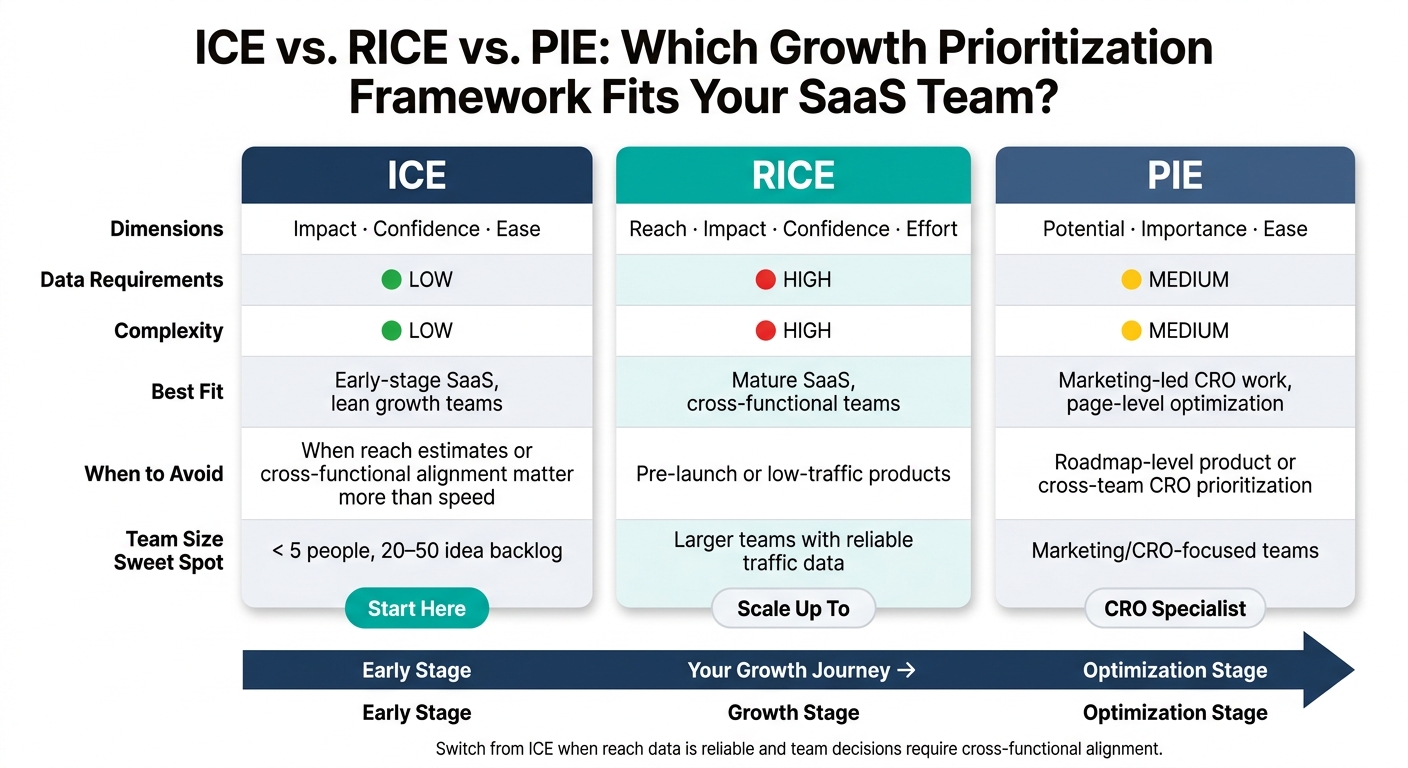
ICE vs RICE vs PIE: SaaS Growth Prioritization Frameworks Compared
After you score competitor-gap ideas, the next step is simple: decide whether ICE is still doing the job or whether the backlog needs more structure. A good rule of thumb is to use ICE until you need reach-based ranking or tighter alignment across teams. For competitor-gap experiments, ICE helps you keep moving before traffic data is strong enough to support Reach.
When ICE Is Enough
RICE stands for Reach, Impact, Confidence, and Effort. It adds Reach, which measures how many users a test affects, and it replaces Ease with Effort. That makes RICE more useful when you have enough data to estimate reach with some confidence. The tradeoff is pretty clear: you need more data before you can rank ideas.
PIE stands for Potential, Importance, and Ease. It is a CRO framework that works best for page-level optimization.
Use the table below to match the framework to your team’s data maturity and how fast you need to make decisions.
| Framework | Dimensions | Data Requirements | Complexity | Best Fit | When to Avoid |
|---|---|---|---|---|---|
| ICE | Impact, Confidence, Ease | Low | Low | Early-stage SaaS, lean growth teams | When reach estimates or cross-functional alignment matter more than speed |
| RICE | Reach, Impact, Confidence, Effort | High | High | Mature SaaS, cross-functional teams | Pre-launch or low-traffic products |
| PIE | Potential, Importance, Ease | Medium | Medium | Marketing-led CRO work | Roadmap-level product or CRO prioritization |
ICE is the fastest option when you need a ranking system, not a forecasting model.
When to Switch Beyond ICE
For teams with fewer than five people and a backlog of 20–50 ideas, ICE is often enough. It works well in the messy early stage, where rough accuracy is better than fake precision.
The signs that you need more structure are pretty easy to spot: more people get involved in decisions, reach data becomes dependable, or the team keeps disagreeing on what should come first. Once your product has enough traffic to estimate reach with confidence, RICE starts to make more sense. And when growth experiments begin competing with core product work, a framework that measures effort more directly becomes much more useful.
Make the switch when Confidence starts sounding more like opinion than evidence.
If ICE still matches the backlog, keep using it. If it doesn’t, move to a framework with more structure.
Conclusion: A Simple System for Faster SaaS Growth Decisions
Once ICE is in place, the job is simple: keep the backlog moving. ICE helps teams make calls without waiting for perfect data. It also gives lean teams a fast way to rank ideas without building a heavy analytics model.
The part that matters most is keeping Confidence tied to evidence. That means using inputs like interviews, funnel data, or competitor patterns. When Confidence comes from gut feel alone, scores get inflated, and engineering time drifts toward the wrong tests.
For competitor-gap ideas, start with a quick scan. Use Competitor Analysis Tool to spot demand, messaging, and visibility gaps that can become scored experiments.
Then rank the list and ship the top tests first. Keep the team focused on the 2–3 experiments most likely to move sign-ups or revenue. A simple spreadsheet with columns for Idea, Impact, Confidence, Ease, and Total Score is all the infrastructure you need. Run ICE monthly, keep Confidence evidence-based, and move the highest-scoring tests first. Over time, that habit turns ICE from a scoring method into a growth system.
FAQs
How do I set fair ICE scores?
Prioritize consistency over precision. Write out a 1–10 rubric for impact, confidence, and ease, then tie each score to past experiments so the scale stays grounded in what your team has already seen.
Score ideas in one session. Start with impact. Then score confidence based on the evidence you have. Score ease with input from engineering. If a score is partly a guess, drop the confidence score. Treat ICE as a rough way to sort ideas, not a perfect system, and update scores as new data comes in.
When should my SaaS team use RICE instead of ICE?
Use RICE instead of ICE when your team has enough reliable data to score ideas with more precision. ICE is a good fit for early-stage, fast-moving tests, where there’s more uncertainty and less hard data to work with.
Move to RICE when you can estimate audience size with confidence and measure effort in clear, concrete units. That extra structure helps you avoid underrating high-impact ideas when reach plays a big role.
What makes a website gap testable?
A website gap is testable when you can turn it into a clear, measurable experiment. That could mean adding missing keywords, fixing thin content, or shipping a feature your competitors already offer.
To decide if a gap is worth testing, use the ICE framework:
- Impact: How much could this move an important metric?
- Confidence: How sure are you that the change will help?
- Ease: How simple is it to put live?
Tools like Competitor Analysis Tool can help you spot clear gaps you can act on without doing a lot of manual SEO work.