
Low Affiliate Reach? Benchmark Competitor Programs
Low affiliate reach usually signals poor partner mix, weak terms, or signup friction—benchmark competitors to spot and fix the gaps in 90 days.

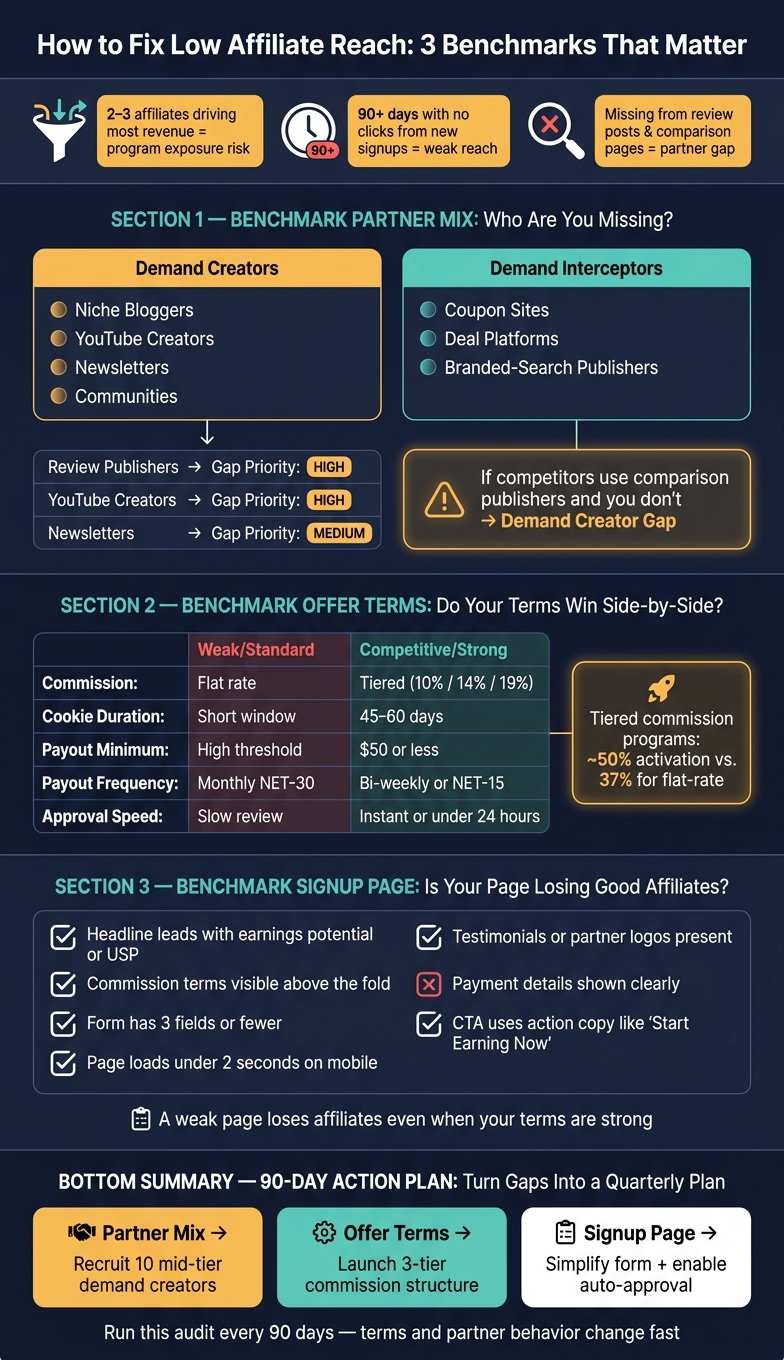
If your affiliate program isn’t getting reach, the fix usually comes down to three things: who you recruit, what you offer, and how easy it is to join. That’s the core point.
Here’s the short version:
- If 2–3 affiliates drive most revenue, your program is exposed.
- If new signups produce no clicks for 90+ days, your reach is weak.
- If competitors show up in review posts, comparison pages, and category lists but you don’t, you likely have a partner gap.
- Tiered commission programs see about 50% activation, vs. 37% for flat-rate setups.
- Affiliates often compare commission, cookie length, payout timing, approval speed, and promo rules before they choose where to send traffic.
- A 45–60 day cookie window, $50 or lower payout minimum, and fast approval can make a program easier to say yes to.
- Even when terms are fine, a weak signup page can still hurt results - especially if it hides commission details, loads slowly on mobile, or asks for too much upfront.
If I were reviewing this article fast, I’d sum it up like this: benchmark competitor partner mix, benchmark competitor terms, then benchmark signup-page friction. That gives you a simple 90-day plan instead of guessing.
Affiliate Program Benchmarking: Partner Mix, Terms & Signup Page Gaps
Best Practices for Businesses Running Affiliate Marketing Programs
sbb-itb-0a8c96a
Quick Comparison
| Area to Benchmark | What to Check | Common Problem |
|---|---|---|
| Partner mix | Review sites, bloggers, YouTube, newsletters, communities, coupon sites | Too much reliance on a few partners |
| Offer terms | Commission structure, recurring pay, cookie length, payout minimum, payout timing, approval speed | Flat terms that lose in side-by-side checks |
| Signup page | Headline, CTA, commission visibility, form length, mobile load time, payment details, social proof | Friction that makes good affiliates leave |
Bottom line: low affiliate reach is often not a traffic problem. It’s a comparison problem. When I benchmark competitor programs, I can usually spot the gap fast and decide what to fix this quarter.
Benchmark Competitor Partner Mix to Find Who You Are Missing
Most affiliate programs don't have a recruitment problem. They have a partner mix problem.
They keep recruiting from the same small pool while competitors spread reach across more channel types. That matters, because if your mix is too narrow, growth starts to stall.
Start with partner mix first. It helps you see whether the issue is simply weak channel coverage or something more serious.
Demand Creators vs. Demand Interceptors: Know the Difference
Not all affiliate partners play the same role.
Demand creators - niche bloggers, YouTube creators, newsletters, and communities - get in front of buyers early. They build interest before someone is ready to buy.
Demand interceptors - coupon sites, deal platforms, and branded-search publishers - step in later. They catch people who are already comparing choices or looking for a deal.
Here's the key point: if competitors rely on comparison publishers and you do not, you have a demand creator gap.
Build a Partner Gap Table Before Changing Recruitment
Before you change outreach, map the partner categories you already have and compare them with your competitors. A simple audit table makes missing channels stand out fast.
| Partner Type | Role in Funnel | Primary Value | Gap Priority |
|---|---|---|---|
| Review Publishers | Consideration | SEO visibility for "Best [Category]" keywords | High |
| Niche Bloggers | Awareness/Consideration | Deep topical authority and long-tail search reach | High |
| YouTube Creators | Awareness | Visual demonstration and high engagement rates | High |
| Newsletters | Retention/Conversion | Direct access to a warm, segmented audience | Medium |
| Communities (Discord/Slack/Telegram/WhatsApp) | Engagement | Real-time support and high-trust recommendations | Medium |
| Deal/Coupon Sites | Conversion | Capturing price-sensitive users at checkout | Low |
Use this table to spot the categories competitors already cover that your program is missing. Go after the biggest gaps first.
Once those missing partner types are clear, check whether your offer gives them a reason to join.
Use Website Visibility Signals to Support the Partner Audit
The gap table shows what to look for. Visibility signals show where competitors are getting traction.
One practical place to start: run a search like intitle:review [competitor name] "affiliate" to find niche bloggers and review sites that promote them but don't show up on page one of Google. These are often mid-sized publishers with highly targeted audiences. In many cases, they outperform larger publications on conversion because their readers have stronger topical intent.
You can also use Competitor Analysis Tool to compare your site with a competitor's and spot the demand and visibility gaps your affiliate program is missing.
Once you know which partner types are absent, benchmark the terms that would make them want to join.
Benchmark Offers and Terms to See Why Affiliates Do Not Join or Promote
Once you know your partner mix, look at the offer itself. When affiliate results stay flat, the problem is often simple: your terms don’t win in a side-by-side comparison. And that’s how affiliates judge programs. If they have to choose where to send traffic, they usually pick the option with steady payouts and fewer hurdles.
The Terms Affiliates Compare First
Affiliates usually look at commission, cookie length, payout timing, approval speed, and promo rules first.
And rate alone isn’t the whole story. Structure matters too. Programs with tiered commission setups see much higher activation rates - about 50%, compared with 37% for flat-rate programs.
Cookie windows also shape how attractive the program feels. A 45- to 60-day window gives affiliates more time to get credit when conversions happen later, instead of within a tighter 30-day period. On top of that, high payout minimums and slow payment cycles tend to push away mid-tier affiliates.
Top affiliates usually want to start right away. A 3- to 7-day review process adds friction and can send them somewhere else.
Use a Terms Comparison Table to Spot Weak Points
The fastest way to find weak spots is to compare your program against two or three competitors.
| Attribute | Weak/Standard Term | Competitive/Strong Term |
|---|---|---|
| Commission | Flat rate | Tiered with entry-, mid-, and top-tier rewards |
| Payout Model | One-time only | Recurring payouts |
| Bonus Terms | None | Volume bonus or fast-start reward |
| Cookie Duration | Short window | 45–60 days |
| Payout Minimum | High threshold | $50 or less |
| Payout Frequency | Monthly NET-30 | Bi-weekly or NET-15 |
| Approval Speed | Slow review | Instant or under 24 hours |
| Restrictions | Vague or restrictive | Clear, consistently enforced rules |
Check Whether Your Messaging Makes the Offer Look Weaker
Even a strong offer can fall flat if the page explaining it feels thin or generic. That happens more often than people think. If your signup page only shows the bare terms, affiliates may assume the whole program is weaker than it is. So don’t just benchmark payouts. Benchmark the page copy too.
You can use Competitor Analysis Tool to compare your site’s messaging against a competitor’s and spot gaps in how you present your value proposition. If your terms hold up, the next leak is often page friction.
Compare Affiliate Signup Pages to Reduce Conversion Friction
Your terms can be strong on paper. But if the page that explains them feels thin, vague, or weak, good affiliates will bounce before they apply. At that point, it’s a conversion issue. Once your terms look competitive, the page itself starts doing the heavy lifting. If the offer clears the terms check, the signup page becomes the next bottleneck.
Audit the Page Elements That Affect Affiliate Signup Rates
Start with the first screen an affiliate sees. If the main terms and primary CTA aren’t visible above the fold, you’re adding friction right away.
Form length is another big one. Long forms with too many required fields often push qualified partners to drop off before they finish. And on mobile, speed matters more than most teams think. Pages should load in under 2 seconds.
Weak pages also tend to miss trust signals. Testimonials, success stories, partner logos, and clear payment details help a prospective partner feel like the program is credible and predictable. Top affiliates look for predictable earnings, simple tracking, and fast support.
Create a Signup Page Benchmark Table
Open two or three competitor signup pages and score them against your own. Focus on the elements that actually affect application volume. Use the table below as a working framework. This helps you find growth gaps vs competitors that are currently limiting your reach.
| Page Element | What Strong Pages Do | Common Friction on Weak Pages |
|---|---|---|
| Headline Hook | Leads with a clear USP or earnings potential | Generic "Join our program" text with no hook |
| Commission Visibility | Key terms shown above the fold | Buried in terms or requires login to view |
| Form Field Count | Minimal fields for quick entry | Long forms asking for too much detail upfront |
| Mobile Load Experience | Responsive design, loads under 2 seconds | Slow, unformatted layout that breaks on phones |
| Trust Signals | Testimonials, success stories, and partner logos | No social proof or evidence the program is credible |
| Payment Terms | Payment details shown clearly | High thresholds and slow payouts |
| CTA Clarity | High-contrast button with action-oriented copy like "Start Earning Now" | Small text link or a vague "Register" button |
After you fill this in for your page and a competitor’s, the weak spots usually jump out fast. A page that hides key terms, loads slowly on mobile, and asks for too much upfront will often lose to a better-presented offer, even when the program itself is stronger. Use this benchmark to sort the page fixes that belong in next quarter’s reach plan.
Turn Competitor Benchmarks Into a Quarterly Affiliate Reach Plan
Once you’ve benchmarked partner mix, terms, and signup pages, turn those gaps into a 90-day plan.
Run this audit every 90 days. Commission rates, program terms, and partner behavior can change fast. Affiliates will move traffic to programs that pay faster, track better, or explain things more clearly. So it makes sense to refresh your benchmark each quarter, especially when you expect programs to update their terms.
Use a Simple Audit Table to Assign Next Actions
Use the table below to rank the biggest gaps first.
| Dimension | Current Status | Priority | Next Action | Evidence/Benchmark |
|---|---|---|---|---|
| Partner Mix | Relying on 2–3 big affiliates | High | Recruit 10 mid-tier demand creators | Competitor A has 50+ active mid-tier partners |
| Offer Strength | Flat 10% commission | Medium | Implement 3-tier structure (10% / 14% / 19%) | Programs with three or more commission tiers see activation rates of about 50% vs. 37% for flat-rate programs |
| Signup Friction | 5-field form + manual review | High | Simplify to 3 fields + auto-approval for vetted sites | Competitor C uses instant approval for vetted sites |
A simple audit table helps you turn benchmark gaps into owners, deadlines, and next actions. The goal is pretty straightforward:
- Match the baseline terms affiliates expect
- Beat competitors on one high-impact offer
- Stand out with faster payouts, clearer tracking, or better support
Use the audit to decide what gets fixed this quarter, not what gets pushed into a later review.
Conclusion: Most Fixes Come Down to Partner Mix, Terms, and Page Clarity
Low affiliate reach usually comes back to three issues: weak partner mix, weak terms, and thin signup pages. Benchmarking shows which gap is costing you reach. Then a quarterly audit keeps the fix moving.
Competitor Analysis Tool can surface visibility and messaging gaps that point you toward the partner types and content angles your competitors are already winning with - without deep SEO expertise.
FAQs
How do I know if my affiliate reach is too concentrated?
You may be too concentrated if your affiliate results lean on a small handful of partners while most of the program barely moves the needle.
Take a close look at which partner accounts keep promoting you or your competitors. If most recent mentions and promotions come from the same 2–3 large creators, that’s a concentration risk. It means you’re more exposed if one partner slows down, switches focus, or leaves the program.
It also helps to benchmark competitors. See whether they rely on the same pattern or if they’ve built deeper program participation with more active partners across their roster.
Which affiliate program terms matter most to new partners?
Commission rate matters, but new partners often look harder at total earning potential and whether they can count on getting paid.
A few terms come up again and again:
- Commission structure: tiers, bonuses, and recurring revenue
- Cookie duration
- Payout speed and reliability
- Minimum payout thresholds
- Tracking ease
- Clear conversion data, such as earnings per click
Put simply, a program can offer a high rate on paper and still fall flat if tracking is messy, payouts drag on, or the data doesn’t help partners see what’s working.
What should I fix first on my affiliate signup page?
Start by cutting friction and making your value crystal clear. Put your program terms, commission structure, and payout details front and center, so prospects don’t have to hunt for them.
Then look at competing programs to find weak spots in your signup flow, especially in areas like:
- discoverability
- clear commission and payment details
- your value proposition
- tracking and attribution policies