
Positioning Statement vs Messaging Framework
Positioning defines who you serve and why you win; messaging turns that decision into reusable copy for pages, sales, and emails.

If your team keeps rewriting the homepage, the problem is often not the copy. It’s the decision behind the copy.
I’d sum it up like this:
- A positioning statement is the internal decision: who the product is for, what it is, why it wins
- A messaging framework is the working system: how that decision turns into homepage copy, landing pages, emails, and sales talk tracks
- You need both, because one sets direction and the other turns that direction into words teams can use
- This matters because 40% to 60% of B2B deals end in no decision, and 94% of buyers build a shortlist before they talk to sales
- In SaaS, one fixed position can still lead to many message angles, since a deal may involve 13 stakeholders on average
If I had to make the difference simple, I’d say this:
- Positioning = the choice
- Messaging = the expression
- Positioning is short and internal
- Messaging is broader and used across channels
- Positioning changes rarely
- Messaging gets updated more often
A fast rule: if you’re trying to decide what your company should stand for in the market, work on positioning first. If you already know that and need page copy, proof points, and objection handling, build the messaging framework next.
Quick comparison
| Criteria | Positioning Statement | Messaging Framework |
|---|---|---|
| Main job | Define the market choice | Turn that choice into usable copy |
| Used by | Leadership, founders, PMM | Marketing, sales, content, product teams |
| Main audience | Internal only | Internal teams that ship and sell |
| Format | Short, often 2 to 4 sentences | Multi-page doc with pillars, proof, and variants |
| Focus | Audience, category, value, difference | Headlines, value props, proof, objections, channel use |
| Changes | Rarely | More often |
| Best use | Before copy gets written | After the position is set |
If you mix them up, two things usually happen: your copy sounds generic, or every team tells a different story. That’s the gap this article clears up.
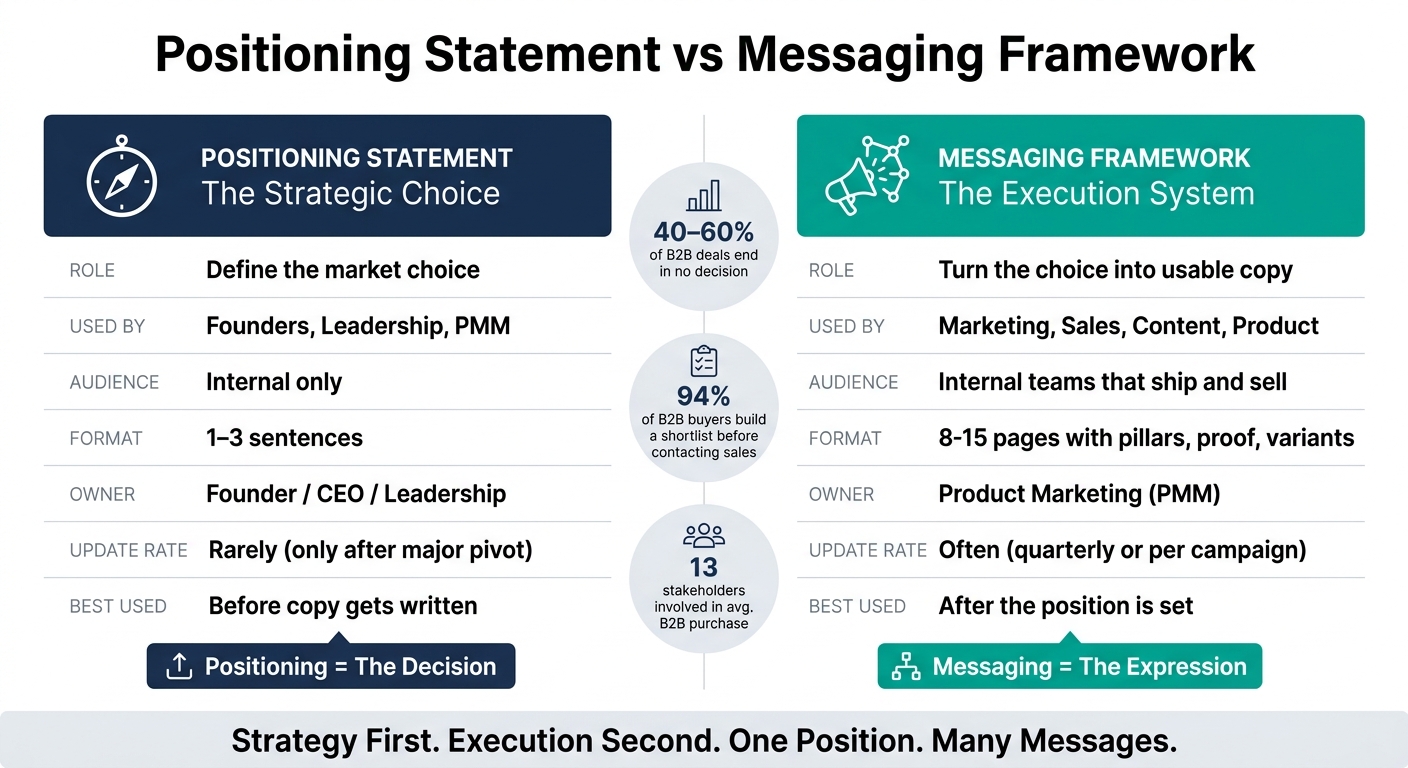
Positioning Statement vs Messaging Framework: Key Differences
Positioning: The Positioning Framework | B2B Messaging course
sbb-itb-0a8c96a
What a positioning statement does
A positioning statement is a short internal document, usually 2 to 4 sentences, that defines how your product should stand against other options. It is not customer-facing. Think of it as the internal source of truth for copy, sales, and the story your team keeps telling.
Core purpose, format, and ownership
A strong positioning statement covers four things:
- Target audience
- Category
- Main value
- Reason to believe
A common format is the Geoffrey Moore template: "For [target customer] who [statement of need], the [product name] is a [product category] that [key benefit]. Unlike [primary competitive alternative], our product [statement of primary differentiation]."
Positioning is usually owned by founders, leadership, or product marketing. It should change only after a major market shift, like moving into a new segment or facing a new primary competitor.
Here’s a simple gut check: ask three teammates who the product is for and what it is up against. If you get three different answers, your positioning still isn’t settled.
That strategy matters only when teams turn it into copy people can use.
How it guides homepage, landing page, and sales copy
The positioning statement does not belong on the page itself. It sits behind the page, acting as the brief for everything customers see.
On a homepage, it shapes what the hero section should say. If the hero message keeps turning into a long debate, the positioning likely isn’t finished.
On a landing page, it keeps the message tied to the buyer and the outcome the product is built for. Without that anchor, the page starts to sound generic.
For sales decks, it gives reps one steady story: who you serve, what category you fit, and why you win. That choice becomes useful only when a messaging framework turns it into repeatable headlines, proof points, and talk tracks.
What a messaging framework does
Positioning makes the choice. Messaging makes that choice usable.
A messaging framework turns positioning into repeatable copy that marketing, sales, and content teams can actually use. Without it, every campaign, deck, and email sequence gets rewritten from scratch. That’s when the message starts to drift.
Main components and scope
A full messaging framework usually covers more than teams expect at first.
At the center is the core narrative - your market point of view. Around that, you build 3 to 5 message pillars tied to buyer outcomes, persona-level value propositions, proof points like customer ROI or outcome data, and objection responses for the pushbacks sales teams hear most often.
In B2B, that matters even more because buying decisions rarely come down to one person. Most deals involve people with different goals, different concerns, and different ways of judging risk. On average, 13 stakeholders are involved in a single B2B purchase, so one catch-all message usually falls flat.
That’s why the framework maps value in different ways for technical buyers, financial buyers, and end users. Same product. Different angle.
These pieces turn positioning into copy teams can use across audiences and channels.
| Component | What It Does |
|---|---|
| Message Pillars | 3–5 outcome-led themes mapped to buyer roles or demand states |
| Value Propositions | Persona-specific promises for technical, financial, and end-user buyers |
| Proof Points | Verifiable evidence - data, customer outcomes, ROI metrics |
| Objection Reframes | Pre-approved responses to the top buyer pushbacks |
| Channel Variants | Adapted copy for homepage, paid ads, email, and sales decks |
How it improves execution across channels
In day-to-day work, this framework makes homepage copy, landing pages, and sales materials much easier to produce.
Writers stop guessing at tone and angle. Sales reps stop making up their own pitch. New hires get a shared language from day one instead of stitching it together from old decks and random docs.
On a homepage, message pillars can shape hero headlines, supporting copy, and proof sections. On a landing page, the framework works like a messaging matrix, shifting value propositions based on awareness stage - whether the buyer is problem-aware, solution-aware, or product-aware. In sales calls, it gives reps approved responses to common objections, which keeps the story steady.
That matters because 94% of B2B buyers build a shortlist before contacting a vendor. In many cases, the homepage, ads, and email copy are doing the selling before sales ever joins the conversation.
Positioning statement vs messaging framework: key differences
A company has one position. But it needs many messages for different buyers, channels, and moments in the journey. Positioning is the market call. Messaging spreads that call across personas and touchpoints.
You can see the gap most clearly in who owns it, how often it changes, and what it produces. A positioning statement is usually owned by founders or leadership. A messaging framework is usually owned by Product Marketing.
| Feature | Positioning Statement | Messaging Framework |
|---|---|---|
| Role | Strategic decision on market space | System for adapting one position across channels and buyers |
| Reach | Internal fixed strategic reference | Multi-channel, multi-persona |
| Audience | Internal leadership and stakeholders | Sales, marketing, and product teams |
| Length | 1–3 sentences | 8–15 pages |
| Owner | Founder / CEO / Leadership | Product Marketing (PMM) |
| Update Rate | Rarely; usually only after a major pivot | Often; quarterly or per campaign |
| Execution | Turns strategy into the market decision | Turns strategy into channel-ready usable copy |
This is where teams get tripped up. They either treat positioning like copy, or they write copy without a fixed position underneath it.
Where teams mix them up and what goes wrong
The most common mistake is using the positioning statement as if it were customer-facing copy. A team grabs one line, drops it into a homepage hero, and then wonders why it sounds flat or vague. That happens because a positioning statement tells you what to say at the strategy level. It does not tell you how to say it to a CFO, a developer, or an end user.
The other mistake cuts just as deep. Teams write homepage, email, or sales copy before the position is locked in. That leads to a rewrite loop. The homepage gets rewritten again and again, not because the writers are bad, but because the team is trying to solve a strategy problem with new phrasing. As Greg Rosner, Founder of PitchKitchen, puts it:
"Messaging is how you say it. Positioning is what you decided to say. Rewrite the words all you want, you can't word your way out of a decision you never made."
Once the position is clear, the messaging framework does the heavy lifting. It turns that decision into page-level copy and sales-ready language. From there, teams can use both in homepage, landing page, and sales copy work.
How to use both in real SaaS copy work
A simple workflow for homepage, landing page, and sales assets
Once your position is set, the next step is putting it to work across every channel.
Start with positioning first. Lock in the target audience, category, differentiation, and proof before you write page copy or sales talk tracks. Get leadership aligned on the position up front.
Then turn that strategy into 3–5 outcome-led message pillars tied to each persona. A CFO and an end user may want the same product for very different reasons. That’s normal. Add two proof points per pillar and a short do/don’t vocabulary list so the language stays sharp and consistent.
For homepage and landing pages, use the headline to set the frame of reference and show differentiation. Use the subhead to name the audience and the outcome. For sales assets, lead with the current pain point or a counter-insight before you introduce the solution. Then use battle cards to spell out win/loss conditions and the top objections.
If the copy feels generic, run the logo test. Hide the logos and compare your homepage with a competitor’s. If a stranger can’t tell the difference in five seconds, the issue usually isn’t word choice. It’s weak positioning.
Using website comparison data to sharpen both
When that test fails, compare messaging across competitor sites to see where the gap sits. Is it proof? Category language? Differentiation? That’s the stuff you need to pin down.
Use competitor reviews to separate the claims everyone makes from the claims no one owns. Competitor Analysis Tool compares your site with a competitor’s and surfaces messaging, demand, and visibility gaps so you can decide what to fix first.
"If your homepage could be swapped with your top competitor's and nobody would notice, you don't have messaging. You have noise." - The Starr Conspiracy
That output should feed back into both documents. A messaging gap may mean one of your pillars needs stronger proof. A visibility gap may mean your category language needs to be sharper or tied more closely to demand.
Conclusion: Positioning sets direction and messaging makes it usable
In practice, the split is pretty simple: strategy first, execution second. A positioning statement spells out who the product is for, what category it fits into, and why it wins. A messaging framework then turns that into the words your team uses on the homepage, landing pages, sales materials, and email.
That’s why positioning stays steady while messaging shifts based on audience and channel. The core idea doesn’t move. The way you say it does.
Greg Rosner, Founder of PitchKitchen, puts it clearly:
"Positioning is the architecture... Messaging is the paint and the furniture. Both matter. But if you paint a room that's built wrong, you've got a beautiful room nobody can live in."
Without both pieces in place, teams usually run into one of two problems: they sound generic, or they sound different every time they show up. If a team locks in positioning but never builds a messaging framework, sales and marketing are left to fill in the blanks on their own. That’s when inconsistency starts creeping across touchpoints.
Put simply, positioning makes the call. Messaging makes that call usable everywhere the market sees it.
FAQs
When should we rewrite positioning?
Rewrite your positioning when it stops matching the market you’re in. That can happen after a big shift in your space, new competitors entering the picture, or internal changes such as a product launch, moving into a new market, or a rebrand.
It’s also worth reviewing when pipeline or win/loss data shows your message isn’t connecting. The same goes for cases where teams give different answers about who you serve or who you’re up against.
Who should own the messaging framework?
In most B2B companies, product marketing owns the messaging framework. Then marketing leadership gives final approval, and the founder or CEO signs off on the core narrative.
In smaller teams, that job usually sits with the founder or the leadership team. Even then, one person should make the final call when messaging clashes with the core positioning - most often a product marketing manager or CMO.
Can one position support multiple audiences?
Yes. Your positioning statement should stay the same across the business. The messaging framework then shapes that core idea for each audience.
Think of it this way: positioning claims your place in the market. Messaging explains why that matters to different people.
So you don’t change your brand identity for end users, technical buyers, or executive decision-makers. Instead, you adjust how you express it through audience-specific value propositions, proof points, and copy.
That lets you stay consistent at the brand level without sounding like you’re talking to everyone in the exact same way.