
SaaS Value Proposition vs. Competitor Messaging
Compare crafting a clear SaaS value proposition with tracking competitor messaging to find differentiation and drive growth.

In a SaaS market projected to exceed $465 billion by the end of 2026, standing out is critical. Success depends on two key elements: a clear value proposition and effective competitor messaging.
- SaaS Value Proposition: A concise statement explaining what your product does, why it’s better, and who it’s for. It’s your promise to customers, helping them understand your product’s unique value - especially important since B2B buyers spend only 17% of their time engaging with sales reps.
- Competitor Messaging: Focuses on how rivals position their products and communicate strengths. Identifying gaps in their messaging (the "white space") can help you differentiate.
Key Takeaways:
- Companies like TripMaster and Clientjoy achieved measurable growth by refining their messaging to address specific customer frustrations or niches.
- Tools like the Competitor Analysis Tool provide fast insights into competitor strategies by monitoring messaging changes, revealing trends, and identifying untapped opportunities.
- Effective messaging focuses on outcomes over features, tailoring to Ideal Customer Profiles (ICPs) for better alignment with buyer needs.
Quick Comparison:
| Aspect | Value Proposition | Competitor Messaging |
|---|---|---|
| Purpose | Defines your product’s unique promise | Analyzes how competitors position themselves |
| Focus | Customer outcomes and benefits | Highlighting gaps and differentiation opportunities |
| Impact | Drives customer clarity and trust | Helps refine positioning and strategy |
To succeed, refine your value proposition, monitor competitor messaging, and focus on delivering clear, outcome-driven promises to your audience.
Value Proposition Examples for Your SaaS Business (10x Your Growth and Valuation)
The Competitor Analysis Tool's Value Proposition
The Competitor Analysis Tool (https://competitorscan.io) takes a fresh approach to competitive intelligence by cutting through the clutter of keywords and backlinks. Instead, it zeroes in on messaging, positioning, and strategic changes. By tracking updates like headline tweaks, CTA adjustments, and shifts in value propositions, it delivers actionable insights in under two minutes. This streamlined focus sets the stage for a closer look at its standout features.
Main Features of the Competitor Analysis Tool
At its core, the tool excels in automated messaging tracking. It builds a historical record of how competitors evolve their narratives, providing early alerts for strategic changes.
As Seeto explains, "Messaging changes happen faster than feature releases and earlier than pricing adjustments. Updating a homepage value proposition takes hours. Rebuilding a product roadmap takes quarters".
The tool also offers a landscape analysis feature, allowing users to compare over 10 competitors simultaneously. This broader view uncovers trends that isolated comparisons might miss. For instance, if several competitors shift their messaging from "affordability" to enterprise-focused language, it could signal an industry-wide move upmarket. Additionally, market positioning maps visualize where competitors stand, helping leadership teams align on differentiation strategies.
Another key feature is gap identification. This highlights overlooked customer segments, missing features, and "crowded narratives" to avoid, as Seeto describes. Companies that implement structured competitive intelligence programs like this are 2.3 times more likely to report above-average revenue growth in their industries.
Benefits for SaaS Businesses
For SaaS companies, the tool speeds up decision-making while improving accuracy. It delivers battlecards and insights in as little as 60 seconds, cutting down the weeks of manual research typically required. In today's capital-conscious environment, messaging must deliver clear ROI and measurable results.
SaaS businesses that refine their positioning around a clearly defined Ideal Customer Profile (ICP) often see 15–20% higher expansion revenue over 12 months. This tool supports that refinement by tracking messaging changes as early indicators of strategic shifts. For example, if a competitor replaces "affordability" messaging with enterprise-focused language, it may signal an upcoming price increase - allowing you to adjust your strategy accordingly.
The tool also identifies growth opportunities by revealing high-intent topics competitors are neglecting. This is crucial, given that the top search result captures 28% of all organic clicks. By acting on these insights, SaaS companies can refine their value propositions and stay ahead in a rapidly changing market.
How It Differs from Standard SaaS Messaging
Unlike traditional SaaS tools that emphasize features or technical specs, the Competitor Analysis Tool focuses on strategic outcomes. It shifts the narrative from reactive monitoring to predictive insights.
As Seeto puts it, "If you read a competitor's site as 'design', you see aesthetics. If you interpret it as 'data', you see strategy".
This focus on predictive monitoring is a game-changer. Traditional competitive intelligence often involves manual tracking and scattered documentation, which slows down response times. By reducing this latency from months to days, the tool helps businesses quickly interpret and act on market changes. It’s not just about tracking what competitors have done - it’s about anticipating their next moves based on evolving language.
Best of all, the tool requires no SEO expertise. Product managers, marketers, and founders can access strategic insights without needing to analyze data themselves. Considering that nearly one-third of startups fail within three years due to poor market fit, this accessibility can be the difference between reacting too late and staying ahead of the curve.
Common Competitor Messaging Strategies in SaaS
SaaS companies often focus on three main messaging strategies: revenue growth, cost reduction, and productivity. Each approach is designed to appeal to different decision-makers. For example, sales and marketing leaders are drawn to revenue-driven messaging, CFOs gravitate toward cost-saving narratives, and team leads prefer productivity-focused claims that improve collaboration tools.
The global SaaS market is forecasted to grow from $273.55 billion in 2023 to a staggering $908.21 billion by 2030, with a compound annual growth rate of 18.7%. This growth underscores how these strategies both shape market trends and offer insights into refining your own messaging.
Cost-Saving Messaging
Cost-saving narratives position software expenses as investments by emphasizing clear ROI metrics. For instance, Zendesk highlights its ability to "Reduce support costs by 25% while improving customer satisfaction". Similarly, MailChimp showcases a specific 7.3% ROI from targeted email marketing campaigns.
A growing trend in this area involves "Agentic AI" or "Invisible Workers", where software autonomously handles entire workflows. This goes beyond traditional automation by replacing manual tasks altogether, offering a compelling case for cost reduction.
Efficiency and Productivity Messaging
Efficiency-focused messaging emphasizes quick results and immediate impact, which is especially appealing in a crowded market. Stripe, for example, promises businesses they can "Start accepting payments in minutes, not months". HubSpot, leveraging customer feedback, adopted the headline "Grow your business like a team twice your size", addressing the needs of small teams seeking scalable solutions.
Productivity messaging often tackles the "Toggle Tax", or the inefficiency caused by switching between multiple tools and tabs. Companies like Figma and Slack highlight how their platforms enhance teamwork, which is particularly relevant for remote teams. HubSpot's claim that its customers grow their traffic six times faster than non-customers further illustrates the tangible benefits of productivity-focused solutions.
Personalization and Enterprise Messaging
Enterprise and personalization strategies build trust by showcasing industry-specific expertise and compliance with regulatory standards. These approaches justify premium pricing by addressing unique workflows. For example, Veeva Systems leads the life sciences sector with its "Industry Cloud" approach, which integrates HIPAA compliance and specialized workflows directly into its interface. Similarly, Procore tailors its platform to the construction industry, reflecting a shift toward vertical SaaS solutions that cater to niche markets.
Competitors also often reframe their offerings to elevate their perceived value. For instance, repositioning a "Live Chat" tool as "Conversational Marketing" or a "Call Recording" feature as "Revenue Intelligence" can command significantly higher Annual Contract Values - sometimes three to five times more.
| Messaging Strategy | Primary Appeal | Example Claim | Typical Buyer |
|---|---|---|---|
| Revenue Growth | Drives business expansion | "37% higher sales revenue" (Salesforce) | VP of Sales/Marketing |
| Cost Reduction | Justifies budget allocation | "25% reduction in support costs" (Zendesk) | CFO/Operations |
| Efficiency | Reduces implementation risk | "Payments in minutes, not months" (Stripe) | Team Leads/Founders |
| Enterprise-Grade | Builds trust through compliance | Industry-specific certifications (Veeva) | CTO/IT Procurement |
Competitor Analysis Tool vs. Standard SaaS Messaging
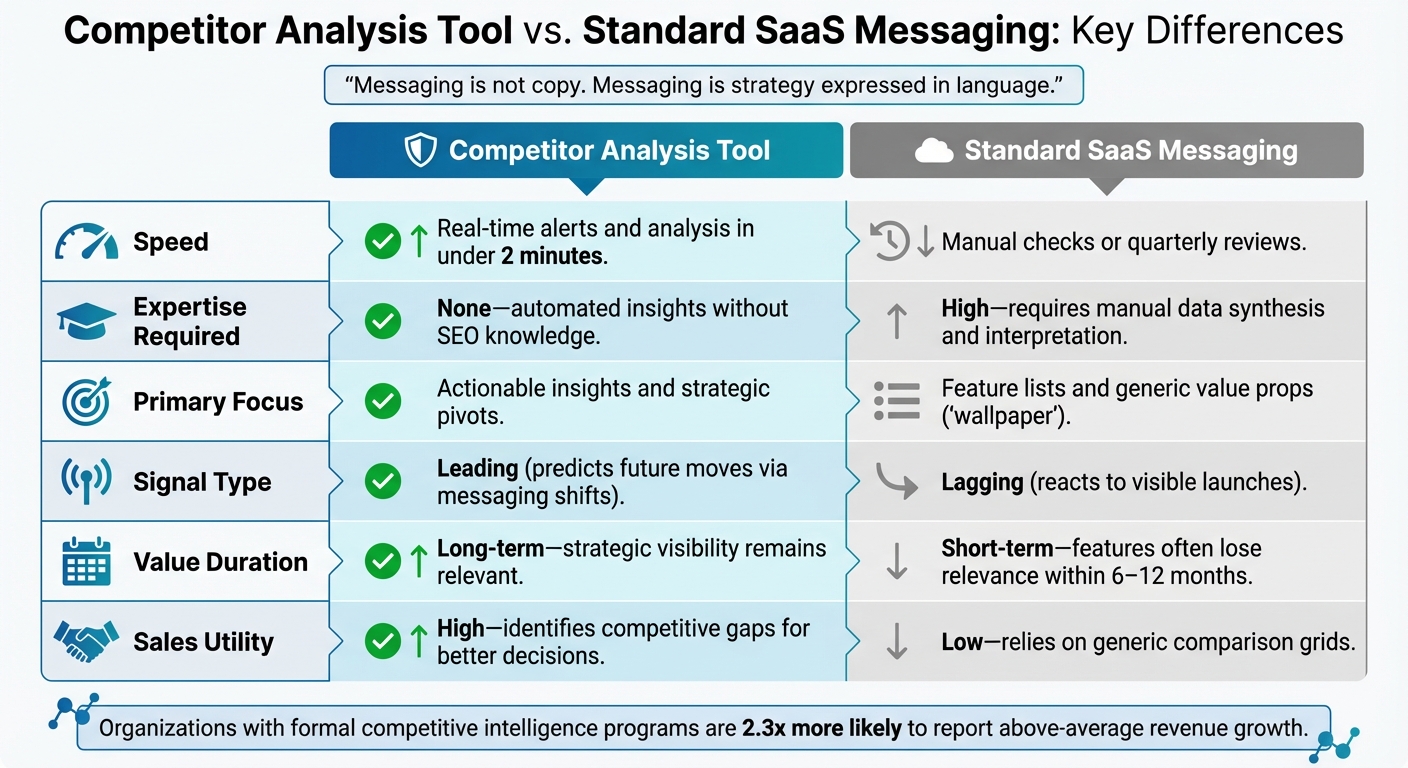
SaaS Competitor Analysis Tool vs Standard Messaging Comparison
Main Messaging Differences
Many SaaS companies rely on generic messaging like "all-in-one platform" or "AI-powered." While these phrases sound appealing, they often fail to make an impact or differentiate the product. The Competitor Analysis Tool, however, takes a different route, focusing on speed, simplicity, and actionable outcomes instead of just listing features.
"Messaging is not copy. Messaging is strategy expressed in language." - Seeto
Traditional SaaS messaging can overwhelm buyers with dense technical details, leaving them to interpret what it all means. In contrast, the Competitor Analysis Tool delivers decision-ready insights in under 2 minutes - no SEO expertise required. This makes it easy to analyze a competitor website without technical overhead. This streamlined approach is particularly important when you consider that B2B buyers spend only 17% of their purchase journey actually meeting with sales reps.
Another standout feature is its focus on leading indicators. While most SaaS platforms react to visible changes like product launches or pricing updates, the Competitor Analysis Tool identifies messaging shifts within hours. By analyzing updates in headlines and value propositions, it provides early warnings of strategic changes.
Instead of relying on generic feature lists, this tool highlights real outcomes, such as spotting growth gaps vs competitors or identifying new opportunities. This approach matters because organizations with formal competitive intelligence programs are 2.3x more likely to see above-average revenue growth in their industry.
Comparison Table: Competitor Analysis Tool vs. Standard SaaS Messaging
Here’s a side-by-side look at how the Competitor Analysis Tool stacks up against traditional SaaS messaging:
| Aspect | Competitor Analysis Tool | Standard SaaS Messaging |
|---|---|---|
| Speed | Real-time alerts and analysis in under 2 minutes | Manual checks or quarterly reviews |
| Expertise Required | None - automated insights without SEO knowledge | High - requires manual data synthesis and interpretation |
| Primary Focus | Actionable insights and strategic pivots | Feature lists and generic value props ("wallpaper") |
| Signal Type | Leading (predicts future moves via messaging shifts) | Lagging (reacts to visible launches) |
| Value Duration | Long-term - strategic visibility remains relevant | Short-term - features often lose relevance within 6–12 months |
| Sales Utility | High - identifies competitive gaps for better decisions | Low - relies on generic comparison grids |
How to Refine Your SaaS Value Proposition
Align Messaging with Ideal Customer Profiles
Start by analyzing your top 10–15 customers. Look at metrics like retention, Net Promoter Score, and expansion revenue to build a clear picture of your Ideal Customer Profile (ICP). Dive deeper with interviews to uncover any past challenges and pinpoint the real value your product offers.
Define your ICP with precision. Consider factors like company size, industry, specific roles (e.g., VP Revenue Ops), tech stack maturity, and pain points. For many B2B SaaS companies, the main competition isn't another platform - it’s often something as basic as a spreadsheet. Knowing this allows you to target frustrations with manual processes instead of just comparing features.
Tailor your value proposition to different buyer roles. For instance, a C-suite executive may focus on how your product impacts revenue, while end users care more about saving time in their day. A great example of this is when Drift shifted from "live chat" to "Conversational Marketing." This repositioning moved their target audience from the VP of Support to the VP of Marketing, unlocking access to budgets 3–5× larger by focusing on pipeline acceleration instead of ticket management.
Focus on Outcomes Over Features
Buyers will evaluate your positioning before they even look at your features. If your messaging feels generic, they’ll default to comparing price or brand recognition. To stand out, translate every feature into a clear, tangible outcome for the customer.
One way to avoid vague claims is by creating a "Burn List" of overused phrases from competitors - things like "streamline workflows", "all-in-one platform", or "AI-powered". Then, reframe these features into specific results. For example, instead of saying "AI-powered", try "Resolves support tickets 3× faster." Instead of "enterprise-grade security", say "Eliminates compliance risks in document workflows".
"If you can't articulate the business impact, the feature doesn't belong in your UVP." - Alex Fine, Author, Understory
A great case study here is Gridle, which later rebranded as Clientjoy. In 2020, they differentiated themselves from Salesforce by focusing on small creative agencies and freelancers. While competitors highlighted complex enterprise features, Gridle worked with Eleken UI/UX agency to simplify its platform, prioritizing ease of use and an exceptional user experience. This shift helped them secure $800,000 in Series A funding just six months later. By focusing on outcomes, they connected with their audience in a way that larger competitors couldn’t.
Use Competitor Analysis Tool Insights
Once you’ve refined your value proposition, leverage a competitive analysis framework and automated tools to uncover strategic gaps. These tools can spot shifts in competitor messaging, demand trends, and visibility gaps in under two minutes. Real-time alerts replace manual quarterly reviews, often revealing early signs of a competitor's strategic pivot.
For example, competitor boilerplates in press releases often provide a distilled version of their strategy and target audience. Signing up for competitor free trials can also reveal their onboarding "aha!" moments and friction points. Additionally, review platforms like G2 and Capterra are goldmines for recurring complaints - like requests for integrations with tools like HubSpot - that can guide your roadmap priorities.
Use these insights with the "Best, Better, Only" framework to sharpen your positioning. Identify what your company does best, where you outperform others, and what makes you truly irreplaceable. Companies that align their positioning with a well-defined ICP often see 15–20% higher expansion revenue within a year. Competitor analysis tools help pinpoint weak spots in your rivals' strategies and reveal untapped opportunities in the market.
Conclusion
Main Takeaways
Differentiation is at the heart of long-term SaaS growth. If your product's value proposition sounds just like your competitors', you're not giving potential buyers a compelling reason to choose you over them.
"If your value proposition matches your competitors', then there's something wrong".
Top-performing SaaS companies zero in on outcome-driven messaging, focusing on measurable results rather than a laundry list of features. For instance, leading SaaS businesses achieved growth rates of 65.4% in 2025 by tailoring their value propositions to meet the expectations of AI-era customers.
Internal alignment also plays a critical role.
"Your value prop can be very helpful to your brand... but without internal alignment, it can undermine your brand".
Ensure your team can deliver on any new positioning. Companies that align their messaging with a clear Ideal Customer Profile often see 15–20% higher expansion revenue within a year.
Your value proposition needs to pass the 5-second test: visitors should instantly understand what your product does, who it's for, and why it matters. Avoid vague claims like "streamline workflows" or "AI-powered." Instead, make specific, outcome-based promises like "reduce churn by 15%" or "onboard in 48 hours". Companies with formal competitive intelligence programs are 2.3 times more likely to report above-average revenue growth in their industry.
Next Steps for SaaS Businesses
To put these insights into action, start by refining your product positioning. Conduct an audit of your top 10–15 accounts, and interview these customers to uncover why they chose your product over alternatives, including spreadsheets or simply doing nothing. This exercise will help you identify what truly sets you apart in the market.
Remember, competitive analysis isn’t a one-and-done task. Revisit your analysis every six months or whenever significant market changes occur. Tools like the Competitor Analysis Tool can streamline this process by identifying demand, messaging, and visibility gaps in real time - eliminating the need for tedious manual reviews. Use these insights to fine-tune your positioning across your website, sales materials, and competitive battlecards.
Keep a close eye on shifts in competitor messaging, as these often signal strategic repositioning before changes to features or pricing emerge. Equip your sales team with targeted questions based on competitor insights to highlight weaknesses during buyer evaluations. And remember, as your product evolves, your positioning must evolve with it - otherwise, it risks becoming a barrier to future growth.
FAQs
How can I tell if my value proposition is too generic?
A value proposition loses impact when it’s too generic, failing to set your product apart or connect with your audience. To stand out, your messaging needs to clearly show how your product solves specific problems, outshines competitors, and meets the unique needs of your customers. Broad, vague statements that could describe any product won’t grab attention or communicate the distinct advantages you bring to the table. Focus on being specific and relevant to make a real impression.
What messaging changes should I track first on competitor sites?
Tracking updates to competitor homepages, value propositions, and key landing pages - such as product, comparison, and industry-specific pages - can reveal important shifts in their strategy. These areas often reflect changes in positioning, adjustments to target audiences, or new priorities. By keeping an eye on how competitors describe their offerings, you can spot early signs of evolving messaging and gain actionable insights into their strategic direction.
How can I turn features into outcome-based claims fast?
To turn features into outcome-based claims, focus on how those features address customer problems and deliver clear, measurable results. Make it about solving real needs and creating value. Highlight what sets your offering apart by showing how it tackles challenges effectively. Research your market and competitors carefully to shape messaging that resonates with your audience, ensuring your claims are both relevant and impactful.