
Ultimate Guide to Traffic Source Benchmarking
Benchmark your traffic channels to find which sources deliver real, convertible users—not just empty visitor counts.

Traffic source benchmarking helps you measure your website's performance against industry standards and competitors. By analyzing where your traffic comes from - organic search, paid ads, social media, referrals, or direct visits - and tracking engagement metrics like bounce rates and conversions, you can identify gaps and prioritize improvements. This is especially useful for SaaS founders, as 68% of deals involve competitors, and benchmarking can uncover untapped opportunities to grow traffic and revenue.
Key takeaways:
- Traffic sources include direct, referral, organic search, social, and paid.
- Metrics to track: traffic volume, engagement (bounce rate, session duration), and conversion rates.
- Tools like Google Analytics, SimilarWeb, and Competitor Analysis Tool provide insights into your traffic and competitors.
- Focus on improving high-performing channels and diversifying to avoid over-reliance on one source.
Benchmarking isn't just about traffic volume - it’s about understanding which channels deliver quality visitors who convert into leads and customers.
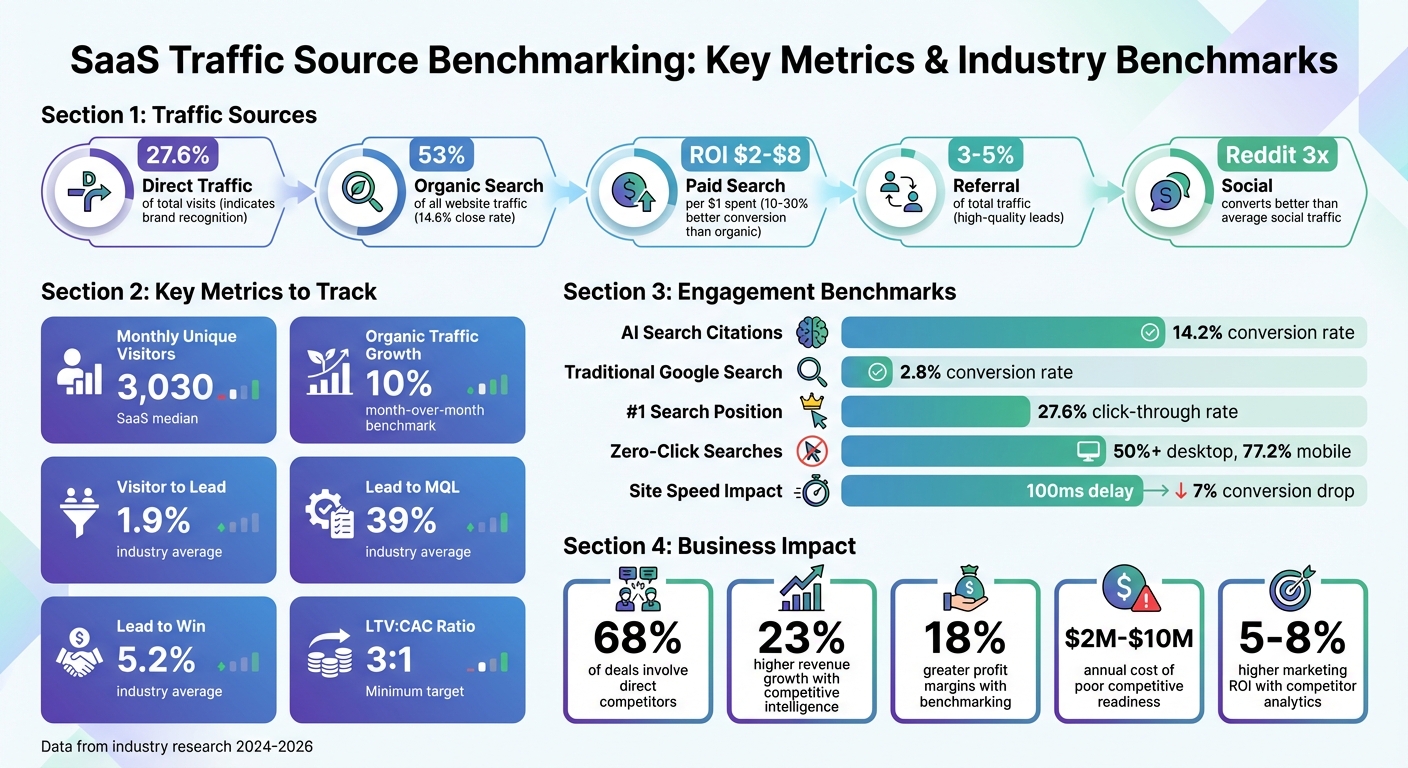
SaaS Traffic Source Benchmarking: Key Metrics and Industry Benchmarks
Key Metrics to Track for Traffic Source Benchmarking
Traffic Volume and Distribution
Keeping tabs on Monthly Unique Visitors is a great way to measure your audience size and evaluate how well different channels are performing. For SaaS companies, the median is around 3,030 unique visitors per month. Beyond overall volume, it's important to analyze how traffic is divided among your channels or analyze competitor website traffic to see how you stack up.
Your Channel Mix gives insight into whether you're driving growth through paid ads or earning it organically via SEO and referrals. Typically, traffic comes from five main sources: Direct (indicating brand recognition), Referral (from partnerships or PR efforts), Organic Search (showing SEO success), Social (reflecting community engagement), and Paid (measuring ad campaign effectiveness). Strong direct traffic suggests a solid brand presence, while high organic search traffic points to an effective content strategy.
"Understanding where [traffic] comes from tells you what's actually working for them - are they SEO powerhouses, social media darlings, or just outspending everyone on ads?" - Shuai Guan, CEO, Thunderbit
A good benchmark for organic traffic growth is 10% month-over-month. However, relying too much on one channel can backfire if algorithms or platforms change. Diversifying your traffic sources is essential to maintaining stability.
Once you've tracked traffic sources, the next step is to see how visitors engage with your site.
Engagement Metrics
Traffic numbers only matter if visitors actively engage with your site. Metrics like Bounce Rate, Average Session Duration, and Pages per Session help determine whether a traffic source is bringing in engaged users. For example, if search traffic has a high bounce rate compared to referral traffic, it could indicate that your landing page content doesn't align with the search intent.
SaaS companies should also monitor Stickiness (the ratio of Daily Active Users to Monthly Active Users) and Activation Rate to see if a traffic source is bringing in users who interact meaningfully with the product. Define an "active user" based on actions that show value - like setting up a feature or syncing data. By comparing these metrics across channels, you can identify which ones bring in high-quality traffic and focus your efforts there.
Conversion Rates by Source
"A million extra visitors who don't convert into leads or customers are less valuable to your business than an extra hundred who do." - Contentsquare
Tracking conversions is key to understanding the quality of your traffic. Measure Visitor to Lead, Lead to MQL, and Lead to Win conversions to identify which channels are producing the best prospects. Industry averages for SaaS include a 1.9% Visitor to Lead conversion rate, 39% Lead to MQL, and 5.2% Lead to Win.
The conversion rate formula is simple:
Conversion rate = (Conversions / Total Visitors) × 100.
Organic search often outperforms other channels in conversion rates because visitors are actively looking for solutions. On the other hand, if a paid channel drives a lot of traffic but few conversions, it may indicate a mismatch between the ad and the landing page.
You should also aim for an LTV-to-CAC ratio of at least 3:1. If a paid channel is stuck at 1:1, it might not be worth the investment and may need adjustments or discontinuation. Many SaaS companies are now prioritizing Product-Qualified Leads (PQLs) - users who find value during a trial - over traditional MQLs since PQLs often provide a clearer picture of source quality. Understanding these conversion metrics can help you refine your approach and improve performance across channels.
Website Traffic Analysis Tutorial (Yours + Competitors)
Tools for Traffic Source Benchmarking
Choosing the right tools can turn traffic benchmarking into a precise, data-driven process. For SaaS founders, selecting the best tools is a key step toward gaining actionable insights.
Competitor Analysis Tool
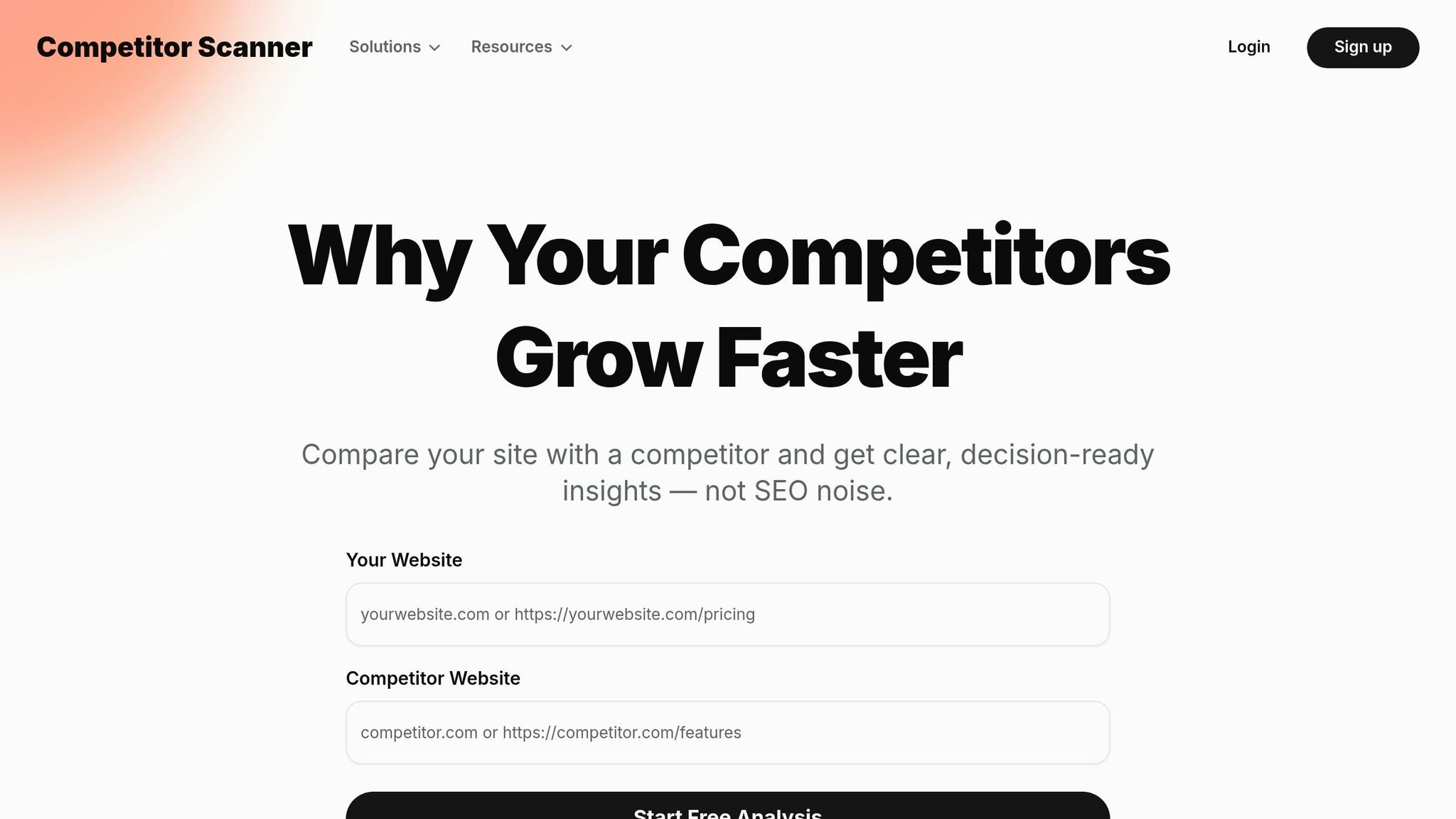
Competitor Analysis Tool simplifies the process of comparing your site with competitors. It identifies gaps in demand (keywords and topics your competitors rank for but you don’t), messaging (how competitors position their value), and visibility (areas where they appear in search results, but you don’t). What sets it apart is its focus on providing clear, decision-ready recommendations - no SEO expertise required. This allows you to prioritize growth opportunities without sifting through complicated data. Plus, the free analysis option doesn’t require a credit card, making it a convenient choice for SaaS founders seeking quick insights.
Google Analytics

Google Analytics 4 (GA4) is essential for tracking your own traffic data with precision. Unlike third-party tools that rely on estimates, GA4 provides exact, first-party data on visitor activity, user behavior, and channel performance. To enable industry benchmarking, go to Admin > Account Settings and turn on "Modeling contributions & business insights." Also, extend "Event data retention" from 2 months to 14 months to make the most of historical data. GA4 categorizes traffic by direct, referral, organic search, social, and paid channels, offering detailed engagement metrics like bounce rate and session duration. This complements the broader estimates provided by third-party platforms.
SimilarWeb
SimilarWeb estimates competitor traffic volumes and channel breakdowns using data from over 200 million users. It also highlights whether competitors are building organic reach or relying on paid strategies. The platform segments competitors into categories like "Game Changers" (rapid growth) and "Leaders" (maintaining high market share), giving a clear market snapshot. A free browser extension offers quick metrics like monthly visits, bounce rates, and traffic sources, while premium plans unlock deeper insights, including traffic journey mapping that shows where users go before and after visiting a competitor’s site. These features help you pinpoint where competitors excel and guide your benchmarking efforts.
"First-party data gives exact numbers only for properties you control. Third-party tools provide estimates."
– MonsterInsights
When using third-party tools, focus on trends rather than exact numbers. Since these tools rely on data modeling, they’re best suited for tracking momentum, seasonality, and growth patterns rather than delivering precise figures. With these tools, you’re equipped to benchmark your traffic sources effectively.
How to Benchmark Traffic Sources: Step-by-Step
Benchmarking your traffic sources is all about turning raw data into clear, actionable steps for growth. Here’s how to approach it systematically.
Step 1: Identify Your Current Traffic Sources
Start by breaking down your traffic into categories like organic search, paid search (PPC), direct, referral, social, email, and display ads. Tools like Google Analytics 4 can help you understand how visitors are finding your site.
Go a step further by separating branded traffic (users searching for your brand specifically) from non-branded traffic. This distinction reveals how well your brand is recognized and how effective your organic discovery strategies are. You can also segment traffic by keyword intent:
- Informational: Users looking for advice or answers.
- Navigational: Users searching for a specific site.
- Commercial: Users comparing products or services.
- Transactional: Users ready to make a purchase.
Don’t just focus on traffic volume. Look at metrics like bounce rate, pages per visit, and average visit duration to gauge the quality of your traffic. Engaged visitors are far more valuable than sheer numbers. Once you’ve mapped your current traffic, it’s time to look outward.
Step 2: Gather Competitor Data
Use tools like the Competitor Analysis Tool to quickly compare your website to competitors. In just a couple of minutes, you can uncover gaps in demand, messaging, and visibility. For a deeper dive, platforms like SimilarWeb can estimate your competitors' traffic volumes and break down their channel mix.
Create a dashboard to track key competitor metrics. Include details like:
- Domain name
- Monthly visits
- Traffic share by channel
- Top-performing pages
- High-ranking keywords
Make sure to monitor both direct competitors (those targeting the same audience) and search competitors (sites ranking for your target keywords, even if their offerings differ). AI-powered tools like ChatGPT or Perplexity can help identify rising competitors, while resources like the Google Ads Transparency Center or Meta Ad Library allow you to analyze competitor ad strategies.
With both your own data and competitor insights in hand, you’re ready to compare and identify opportunities.
Step 3: Compare Metrics and Identify Gaps
Focus on trends rather than exact numbers, as third-party traffic tools often provide estimates. Use multiple platforms - such as SimilarWeb for overall traffic, SEMrush for market share, and Ahrefs for SEO insights - to build a well-rounded picture.
A comparison table can make it easier to spot key patterns:
| Metric | What It Reveals | Why It Matters |
|---|---|---|
| Total Visits | Popularity and growth momentum | Measures your market share |
| Channel Mix | Split between paid and organic | Shows if growth is earned or paid |
| Bounce Rate | Content and messaging relevance | Reflects user satisfaction |
| Pages per Visit | User engagement depth | Indicates how engaging content is |
| Branded vs. Non-Branded | Brand strength vs. SEO reach | Guides focus on branding or SEO |
Run a keyword gap analysis to identify high-volume keywords where competitors rank in the top 10 but you don’t. Also, look for search categories with no clear leader - these can be prime targets for growth.
"Traffic data reveals the 'what' - content and offers explain the 'why'."
– Shuai Guan, Co-founder/CEO, Thunderbit
Step 4: Prioritize Areas for Improvement
Not all gaps are equally important. Narrow your focus by geography (e.g., the U.S. market) to ensure fair comparisons. Look for "unclaimed territory", where no competitor dominates, and prioritize these opportunities for quick wins.
Allocate resources based on potential impact. For example, if competitors are outperforming you in organic search, it’s time to invest in SEO. If their paid search campaigns are more effective, study their ad copy and landing pages for ideas.
Set a regular schedule for reviews - monthly or even weekly in fast-paced industries like SaaS. Tools like Visualping can notify you when competitors change pricing or features, while automated data scraping can simplify routine checks. With 68% of deals influenced by direct competition, staying on top of these trends ensures your strategy remains agile and responsive.
How to Improve Traffic Source Performance
Once you've pinpointed traffic gaps, it's time to take action. Below are strategies designed to fine-tune your channels and drive SaaS growth.
Improving Organic Search Traffic
Did you know that organic search accounts for 53% of all website traffic? Even better, it boasts a 14.6% close rate, far surpassing the 1.7% achieved through outbound methods. But random blog posts won't cut it - you need a structured plan.
Start by adopting the topic cluster model. Instead of scattering unrelated articles, build a central pillar page (3,000+ words) that links to multiple cluster pages (1,000–2,500 words) targeting related long-tail keywords. This creates a network of content that establishes authority and effectively distributes link equity. For example, PipelineRoad.com went from zero to over 1,400 indexed pages in just 12 weeks by employing this strategy. They also published competitor comparison pages targeting high-volume searches like "vs Clari", which helped them dominate search results.
Next, align your keywords with the buyer journey. Use problem-aware keywords (e.g., "how to improve team productivity") for top-of-funnel content, solution-aware keywords (e.g., "best Asana alternatives") for comparison pages, and transactional keywords (e.g., "ClickUp pricing plans") for product pages. This ensures your content matches user intent at every stage.
Technical SEO is another key factor. Focus on Core Web Vitals - aim for a Largest Contentful Paint (LCP) under 2.5 seconds, or ideally under 1.5 seconds. If your site relies heavily on JavaScript, consider server-side rendering (SSR) to improve crawlability. Simple fixes, like addressing "Pages blocked by robots.txt" or "Noindex" tags in Google Search Console, can increase traffic by 15–35%.
"SaaS SEO is not ecommerce SEO... The buying cycle is long and nonlinear. A SaaS buyer does not Google your product category, read one blog post, and sign up."
- Alexander Chua, Founder, PipelineRoad
Don't overlook "striking distance" keywords - those ranking in positions 6–10. Updating these pages with 300–500 words of fresh content can push them into the top 5, where the #1 spot garners a 27.6% click-through rate. Updating title tags with the current year (e.g., "2026") can boost CTR by 8–15%.
Lastly, optimize for Generative Engine Optimization (GEO). Structure your content with clear definitions, comparison tables, and FAQ schema so AI systems like ChatGPT and Perplexity can cite it. With over half of desktop searches and 77.2% of mobile searches resulting in zero clicks, being featured in AI-generated answers is becoming increasingly important.
For rapid scaling, programmatic SEO can be a game-changer, allowing you to target thousands of landing pages at once. These strategies help close the gaps uncovered during traffic benchmarking.
Enhancing Paid Search Campaigns
Paid search is known for quick results and high conversion rates, but rising costs mean you need to be efficient. Google Search Ads, for instance, deliver an ROI of $2–$8 for every $1 spent, and paid visitors convert 10–30% better than organic users.
Focus on high-intent keywords - those that signal users are ready to compare or buy. Keywords tied to commercial or transactional intent perform better than informational queries. For example, transactional queries have a 34% zero-click rate compared to 74% for informational ones.
Use tools like the Google Ads Transparency Center and Meta Ad Library to analyze competitors' ads. Study their headlines, calls-to-action (CTAs), and offers to understand what drives conversions. This insight can help refine your own campaigns.
To track performance accurately, implement detailed UTM tagging and adopt multi-touch attribution models. Moving beyond last-click attribution is crucial, as 67% of paid search conversions involve multiple interactions over a 30+ day period.
Retargeting is another powerful tool. Focus on users who have shown high intent, such as those who abandoned a cart or visited pricing pages. Retargeting campaigns can convert 3–5 times better than cold display ads. To avoid ad fatigue, set frequency caps of 3–5 impressions per user.
Boosting Direct and Referral Traffic
Diversifying your traffic sources is essential for stability. Direct traffic accounts for 27.6% of total website visits on average and converts 15–20% better than other channels, as these users already trust your brand. Referral traffic, while smaller (3–5% of total traffic), delivers high-quality leads and supports SEO through backlinks.
To improve direct traffic, prioritize brand recognition. Use consistent messaging and aim for strong "Share of Voice" metrics. Simplify your URLs to make them more memorable for offline sharing or word-of-mouth referrals. Also, keep in mind that even a 100ms delay in website response can reduce sign-up conversions by about 7%.
Be aware that 30–50% of "direct" traffic may actually be misattributed traffic from mobile apps, email clients, or HTTPS-to-HTTP transitions. Using UTM parameters on all external links can help you better distinguish true direct traffic from other sources.
For referral traffic, build strategic partnerships with complementary SaaS brands for co-marketing and cross-linking. Engage with high-authority blogs and news outlets through digital PR and guest posts. Platforms like Reddit and Quora can also be valuable - Reddit referral traffic converts three times better than average social traffic. Additionally, ensure your product is listed on high-intent directories like G2 and Capterra. Tools like the Competitor Analysis Tool can help identify top referring sites from your competitors, pointing you toward new partnership opportunities.
And don't forget about AI search citations. Traffic from AI systems like ChatGPT and Perplexity currently converts at 14.2%, far exceeding the 2.8% average for traditional Google search. Structuring your content with clear definitions, Q&A formats, and schema markup increases your chances of being featured in AI-generated answers - a trend expected to grow significantly by 2026.
"Referral traffic from authoritative sources improves SEO through backlinks AND drives highly targeted visitors."
Conclusion
Traffic source benchmarking plays a crucial role in driving SaaS growth. The numbers back it up: companies with well-established competitive intelligence programs experience 23% higher revenue growth and 18% greater profit margins. With 90% of Fortune 500 companies relying on competitive intelligence to shape their strategies, it’s clear that this practice separates industry leaders from those trying to keep up.
Consider this: 68% of deals involve direct competitors, yet competitive readiness scores only 3.8 out of 10. This gap can cost businesses anywhere from $2 million to $10 million annually. Benchmarking not only highlights the most effective traffic channels but also sheds light on competitor strategies and unexplored market opportunities. These insights are the foundation for impactful strategic decisions.
"Traffic data reveals the 'what' - content and offers explain the 'why.'"
- Shuai Guan, Co-founder/CEO, Thunderbit
Key Takeaways for SaaS Founders
To get the most out of benchmarking, take a multi-tool approach. Focus on trends and share of voice rather than obsessing over exact numbers. Use tools like the Competitor Analysis Tool to spot demand gaps and uncover critical referral sources. Then, validate these findings with first-party data from Google Analytics. This approach helps you understand both the "what" (traffic volumes) and the "why" (user intent, messaging, and offers).
Set up a dashboard to track metrics like visits, channel mix (organic, paid, social, referral), and top-performing pages for at least 5–10 competitors. Schedule regular reviews - monthly or quarterly - to stay ahead of shifts in the market. Automating alerts for changes in pricing, new content hubs, or promotional campaigns can also be a game-changer.
Keep in mind, traffic alone isn’t the ultimate goal. A million visitors mean nothing if they don’t convert. Instead, analyze traffic alongside engagement metrics like bounce rates, session durations, and conversion rates by source. This ensures you’re optimizing for meaningful business outcomes rather than chasing inflated visitor numbers. Marketers who incorporate competitor analytics report 5–8% higher marketing ROI, proving that consistent benchmarking delivers real results. By following these strategies, SaaS founders can build sustainable growth and ensure their traffic efforts translate into long-term success.
FAQs
What’s the fastest way to benchmark my traffic sources?
The fastest way to evaluate your traffic sources is by leveraging tools such as Similarweb, Ahrefs, SEMrush, or Exploding Topics. These platforms offer quick insights into competitors' traffic, key pages, and sources with little effort on your part. For instance:
- Similarweb provides directional traffic estimates and a breakdown by country.
- SEMrush and Ahrefs focus on analyzing traffic and keywords, helping you uncover valuable data without the hassle of manual research.
These tools streamline the process, saving you time while delivering actionable insights.
How can I tell which traffic source brings the best leads?
To pinpoint the most effective traffic source for generating leads, you’ll need to dig into attribution and performance data. The goal is to figure out which channels are bringing in high-quality prospects - those that are more likely to convert into paying customers.
Focus on key metrics like:
- Lead-to-opportunity conversion rates: How many leads actually turn into viable sales opportunities?
- Customer acquisition costs (CAC): How much are you spending to acquire a customer through each channel?
Tools like Google Analytics make this process easier by helping you evaluate traffic sources and their impact on your bottom line. The best traffic source isn’t just about driving lots of visitors - it’s about consistently delivering leads that convert into real, paying customers. Quality always beats quantity in this game.
How often should I benchmark against competitors?
Benchmarking competitors on a regular basis is a smart way to stay updated on market trends and spot potential opportunities. While the best frequency can vary based on your industry and objectives, a common recommendation is to review traffic data every 3 to 6 months. This kind of ongoing analysis lets you monitor changes in traffic sources, engagement levels, and keyword performance, so you can tweak your strategies when needed. Tools like the Competitor Analysis Tool make this process easier by offering insights you can act on.