
Competitor Analysis For Identifying Buyer Pain Points
Mine competitor reviews and site signals to uncover buyer frustrations and refine messaging, pricing, onboarding, and product strategy.

Competitor analysis is a powerful way to understand what frustrates buyers and how your product can solve their problems better than the competition. Many SaaS companies fail because they focus too much on features and ignore buyer pain points like inefficiencies, pricing confusion, onboarding struggles, and poor support. By identifying these frustrations in competitor reviews, forums, and other public feedback, you can refine your messaging and product strategy to address unmet needs.
Key Takeaways:
- Common Buyer Pain Points: Inefficiencies, pricing friction, onboarding issues, and support gaps.
- Why It Matters: Customers frustrated with competitors are 2.4x more likely to convert.
- What to Do:
- Look beyond feature comparisons; focus on frustrations buyers share publicly.
- Use competitor reviews and feedback to identify gaps in the market.
- Align pain points with stages of the buyer journey (awareness, consideration, decision, onboarding).
- Measure Success: Track metrics like sales win rates, onboarding time-to-value, and Net Revenue Retention (NRR).
By focusing on pain points rather than features, you can stand out in a crowded market and drive real growth.
Your Competitor's Weaknesses Are Your Biggest Advantage
sbb-itb-0a8c96a
The Problem: Where Standard Competitor Analysis Goes Wrong
Many teams follow a familiar routine when analyzing competitor websites: they examine pricing, compile a feature checklist, and call it a day. While this approach pinpoints what competitors offer, it completely overlooks the frustrations driving customer behavior. This oversight often leads to missteps in interpreting data and understanding market signals.
Focusing on Features Instead of Customer Problems
Relying on feature comparisons often results in what's known as the "parity trap." When your analysis boils down to a spreadsheet of checkboxes, the logical next step is to mimic what competitors are doing. This creates products and messaging that blend into a sea of sameness. More importantly, it misses the real driver of customer decisions: the frustrations and challenges they face.
Here’s the catch: feature gaps are easy to close. Unless a feature demands complex technical infrastructure, competitors can quickly catch up. What’s much harder to replicate is addressing a frustration that others have learned to live with. Take Zoom, for example. When it entered the market in 2011, it targeted a specific pain point with legacy tools like WebEx and Skype - long join times, often exceeding 60 seconds. By engineering a seamless one-click join experience, Zoom grew to 10 million daily participants well before the pandemic reshaped the video conferencing landscape.
And let’s not forget, buyers rarely base decisions solely on feature grids. Factors like perceived risk, ease of internal buy-in, and overall onboarding costs weigh heavily in the decision-making process. These critical elements are completely absent from standard feature comparisons.
Siloed Data Across Teams
Even when teams gather valuable insights, these insights often remain isolated within their respective silos. Sales teams hear objections on calls. Support teams handle recurring complaints. Product teams monitor where users drop off. But without a unified system to share this information, key insights rarely reach the people who need them most.
This lack of alignment has tangible consequences. Poor coordination between marketing and sales teams can result in up to 30% of leads being lost. For instance, marketing might craft messaging based on assumed pain points, while sales hears entirely different concerns from prospects. This disconnect leads to positioning that simply doesn’t resonate. HubSpot tackled this issue head-on in 2006 when they realized that fragmented tools were causing significant lead leakage. By bringing marketing and sales workflows together on a single platform, HubSpot managed to grow to 100,000 customers by 2020. Aligning internal insights with competitor data can make all the difference in sharpening your strategy.
On top of internal misalignment, ignoring public feedback creates an even bigger blind spot in understanding what buyers truly need.
Ignoring Signals From Competitor Content
Competitor websites often reflect the image they want to project, not the real issues customers face. The true frustrations emerge in public reviews, forums, and social media.
"A competitor's website tells you what they want you to think about them. Their G2 reviews tell you what customers actually experience." - Manoj Saharan, Co-Founder, AI Avengers
The challenge? Fewer than 1 in 3 consumers now provide direct feedback to the companies they use. Overlooking these external sources means missing out on an unfiltered view of the market. In fact, relying only on website research is estimated to miss 80% of available strategic intelligence. That’s a massive gap when your goal is to uncover the frustrations driving buyer decisions.
Solution: A Workflow for Pain-Focused Competitor Analysis
Tackle these challenges with a buyer-centered strategy that sharpens your research process.
Segment Your Audience and Develop Pain Point Hypotheses
Before diving into competitor research, clearly define the audience segment you're focusing on. Broad research leads to vague insights, so break your target audience into practical categories like company size, technical expertise, and workflow maturity.
For each competitor, summarize in one sentence who their product is actually designed for - not who their marketing claims to serve. This can be revealed through clues like pricing models, onboarding complexity, and the depth of their documentation. For instance, a lengthy, admin-heavy onboarding process likely targets enterprise clients, even if the homepage suggests otherwise. Similarly, a sparse help center might indicate a newer product still in development.
"The most durable positioning names a specific customer type. 'Project management for marketing agencies' beats 'project management software' every time for the right buyer." - Monolit
Once you've identified your audience segments, create hypotheses for their unmet needs. For example, you might hypothesize that "Non-technical founders are underserved because most competitors assume IT involvement during setup." These hypotheses guide your research, helping you zero in on key signals as you analyze competitors. With your audience and hypotheses in place, you're ready to dig into competitor websites to find growth gaps vs competitors.
Analyze Competitor Websites for Pain Signals
The hero headline on a competitor's homepage is a goldmine of information. It represents the core message their team believes will resonate most with buyers. Use tools like the Wayback Machine to track how these headlines evolve over time. Changes often reflect shifts in their strategy or their response to buyer frustrations.
Expand your research beyond the homepage. Explore pricing pages, testimonials, and support documentation. For example:
- Pricing models that charge per seat can create tension as teams scale - a potential pain point to address in your messaging.
- Thin or unclear documentation often hints at implementation challenges buyers might be quietly struggling with.
For the most candid feedback, turn to review platforms like G2 or Capterra. Filter for 3-star reviews, as these often provide balanced critiques. Pay special attention to the "What do you dislike?" sections. When the same complaint appears across multiple competitors, it signals a category-level gap - an issue that no product in the market has adequately solved.
"A competitive gap analysis SaaS teams can actually use goes beyond feature parity. It identifies unmet market needs - problems that users have, that they are vocal about, and that no product in the category adequately solves." - Compttr
After gathering these pain signals, the next step is to connect them to the buyer journey for a more targeted approach.
Align Pain Points with Buyer Journey Stages
Pain points can emerge at different stages of the buyer journey, and each requires a tailored response. Mapping these issues to specific stages ensures your messaging and product decisions address the right concerns at the right time. This approach bridges internal insights with external findings.
| Journey Stage | Where to Find Pain Signals | What to Look For |
|---|---|---|
| Awareness | Blog topics, hero headlines, problem-first search queries | The core problem buyers are trying to define and understand |
| Consideration | Comparison pages, feature matrices, "alternatives to" listicles | Capability gaps and recurring complaints |
| Decision | Pricing tiers, trust signals (e.g., SOC 2), CTA structure | Purchase barriers like pricing complexity or security concerns |
| Onboarding | Help centers, support docs, changelogs | Friction in time-to-value and common implementation hurdles |
Pay attention to a competitor's main call-to-action (CTA). For example, "Start free" often targets self-serve buyers in the awareness stage, while "Book a demo" aims at buyers further along in the consideration or decision stages. These CTAs reveal where their buyers face friction - and might offer clues about your audience's challenges, too.
Using Competitor Analysis Tool to Speed Up Pain Point Discovery
Manually sifting through competitor websites, reviews, and pricing pages can take a staggering 15–20 hours. But with our tool, that process is slashed to just 5 minutes - saving you 99% of the time. This aligns perfectly with the earlier strategy of focusing on practical, pain-driven competitor analysis. It’s not just about collecting data; it’s about turning that data into actionable insights quickly.
Spot Messaging and Demand Gaps
The Competitor Analysis Tool lets you directly compare your website to a competitor’s, helping you identify messaging gaps. These gaps highlight areas where your positioning either overlaps with theirs or where critical language that resonates with buyers is missing. Why does this matter? When multiple competitors use overused phrases like "AI-powered" or "all-in-one", those claims lose their impact, blending into the background. By identifying these patterns, you can refine your messaging to stand out in a crowded market.
Similarly, demand gaps are just as revealing. If buyers are searching for solutions to specific problems that neither you nor your competitors address clearly, you’re looking at a major missed opportunity. Spotting these gaps early helps you focus your messaging on the pain points that truly matter to buyers.
Beyond messaging, identifying areas where competitors lack visibility can sharpen your strategy even further.
Find Visibility Gaps That Point to Unmet Buyer Needs
Visibility gaps highlight where buyers are searching but not finding useful content. If a competitor ranks poorly - or not at all - for high-intent search terms, it’s a clear signal that those buyer needs aren’t being met. The Competitor Analysis Tool uncovers these gaps and ties them to real pain points, helping you position your content and value proposition more effectively.
For instance, if buyers are searching for information on implementation or onboarding challenges but can’t find targeted content, it’s a clear sign of a positioning gap. Addressing these gaps gives you an edge in meeting buyer needs.
Build a Repeatable Pain Point Review Process
One-time analysis only offers a snapshot, but buyer pain points shift as markets evolve. Compressing 15–20 hours of research into just minutes allows you to conduct regular, strategic reviews without the time drain. By establishing a consistent review process, you can stay ahead of changing buyer needs and market dynamics. This ensures your messaging remains focused and relevant, keeping you aligned with what matters most to your audience.
Measuring the Results of Pain-Focused Competitor Analysis
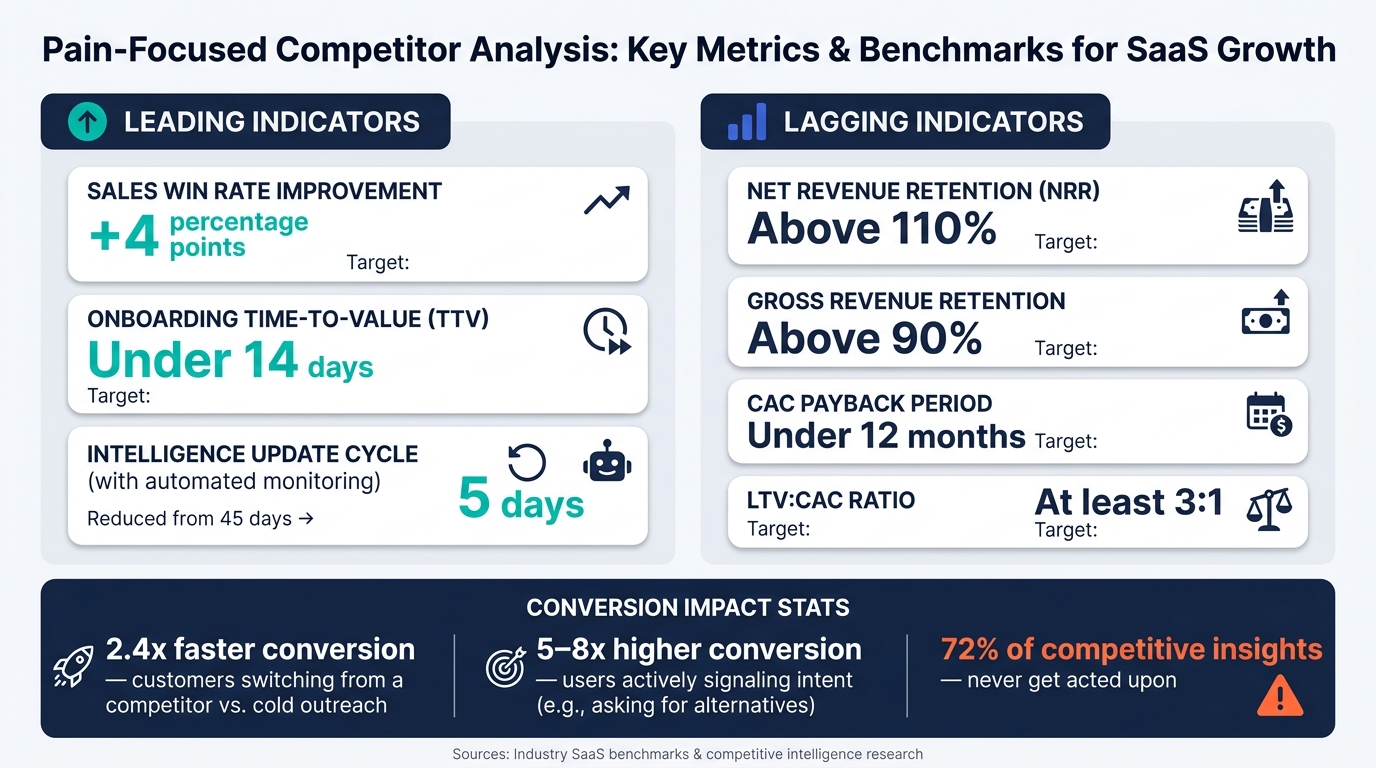
Pain-Focused Competitor Analysis: Key Metrics & Benchmarks for SaaS Growth
Implementing a pain-focused approach is a great start, but the real proof lies in tracking the right metrics to measure its impact.
Track Leading and Lagging Metrics
Metrics tell different parts of the story. Leading indicators give you early signs that your changes are working, while lagging indicators show the long-term financial benefits.
For leading metrics, keep an eye on your sales win rate, sales cycle length, and onboarding time-to-value (TTV). For example, a TTV of under 14 days means you've resolved onboarding challenges, helping customers achieve success faster. Studies show that automated competitive monitoring can boost sales win rates by an average of 4 percentage points. That kind of improvement is a clear sign of early success.
On the lagging side, focus on metrics like Net Revenue Retention (NRR) and the CAC payback period. High-growth SaaS companies typically aim for an NRR above 110% and gross revenue retention over 90%. A CAC payback period of less than 12 months ensures acquisition costs remain manageable, while an LTV:CAC ratio of at least 3:1 confirms that your pain-focused strategy is driving strong pricing power.
Here’s a quick breakdown of key metrics to track:
| Metric Type | KPI | Target Benchmark |
|---|---|---|
| Leading | Sales Win Rate Improvement | +4 percentage points |
| Leading | Onboarding Time-to-Value | Under 14 days |
| Lagging | Net Revenue Retention (NRR) | Above 110% |
| Lagging | Gross Revenue Retention | Above 90% |
| Lagging | CAC Payback Period | Under 12 months |
| Lagging | LTV:CAC Ratio | At least 3:1 |
Start by setting clear benchmarks, then compare these metrics before and after making changes to assess your progress.
Compare Results Before and After Implementation
To measure success, begin by documenting your baseline metrics - such as win rates, sales cycle length, and NRR - before making any changes. This "before" snapshot is critical for understanding the real impact of your efforts.
After rolling out your pain-focused workflow, track these metrics over a 90-day period. The results can be striking. For instance, TripMaster, a B2B SaaS company, generated $504,758 in Net New ARR within a year by adopting a structured competitive analysis and conquesting strategy. Similarly, TestGorilla slashed its CAC payback period to just 80 days - well below the 12-month benchmark - and used competitive intelligence to refine its positioning, which helped secure a $70M Series A funding round.
Operational efficiency also plays a big role. Automated competitive monitoring, for example, can reduce intelligence update cycles from 45 days to just 5 days. This speed advantage ensures your team works with up-to-date information, enabling quicker and more confident decisions across sales, marketing, and product teams.
"The biggest competitive advantage isn't knowing what competitors do - it's acting on accurate data faster than they do." - Prospero Team
These metrics highlight how focusing on buyer pain points can drive meaningful growth in the SaaS world.
Conclusion: Growing Your SaaS by Addressing Buyer Pain Points
Many SaaS teams focus their competitive analysis on features, traffic stats, or keyword rankings. But real growth comes from digging deeper - understanding the frustrations of your buyers and showing how your product solves their problems. A pain-focused strategy doesn’t just reveal what buyers need - it also sharpens your growth efforts.
Here’s the key takeaway: focusing on buyer pain points delivers far better results than just comparing features. For instance, customers who switch from a competitor convert 2.4 times faster than those reached through cold outreach. Even better, when users actively signal their intent - like publicly asking for alternatives - they convert 5 to 8 times higher than cold prospects. This approach can completely change your growth trajectory.
The tricky part? A staggering 72% of competitive analysis efforts generate insights that never get used. The problem isn’t gathering data; it’s creating a system that transforms those insights into decisions your product, marketing, and sales teams can act on.
The difference between generic feature lists and meaningful gap analysis is clear: actionable insights are what truly set you apart.
FAQs
How do I spot buyer pain points in competitor reviews fast?
One of the fastest ways to understand buyer frustrations is by diving into one- and two-star reviews on platforms like G2, Capterra, and Trustpilot. These reviews often highlight recurring problems users face.
To make sense of the data, create a spreadsheet and track how often specific issues come up. If a particular complaint is mentioned five or more times, you’ve likely identified a gap in the market.
For even more candid feedback, explore forums like Reddit. Search for terms like "workaround" or "frustrated" to find unfiltered conversations where users openly discuss their struggles. These insights can be goldmines for figuring out what your audience truly needs.
Which buyer-journey stage should I map each pain point to?
Mapping pain points to specific stages of the buyer journey can help identify where friction occurs and how to address it effectively. Let’s break it down into the four key stages:
- Acquisition: Problems here often stem from gaps in SEO or unclear messaging. If potential customers can't find you or don't fully understand what you offer, they might never enter your funnel.
- Conversion: Friction at this stage typically happens during demos or onboarding. Confusing product demonstrations or a difficult onboarding process can make potential buyers hesitate or abandon the process altogether.
- Expansion: Challenges here might include cross-sell opportunities that aren’t clear or packaging that doesn’t meet customer needs. If customers don’t see the value in upgrading or adding services, growth stalls.
- Retention: Issues with support or a lack of community engagement can lead to churn. When customers feel unsupported or disconnected, they’re more likely to leave.
By pinpointing these blockers and aligning them with the right stage, you can create a strategy that directly addresses the hurdles slowing growth.
What metrics prove a pain-focused strategy is working?
To gauge the effectiveness of a pain-focused strategy, start by tracking key metrics like the CAC-to-LTV ratio (Customer Acquisition Cost to Lifetime Value). Why? Because solving core pain points often leads to lower churn rates and a healthier financial outlook.
Keep an eye out for specific signals that show your strategy is hitting the mark:
- A noticeable "Wait, I need this!" reaction during sales calls - this reflects genuine interest and urgency from potential customers.
- Fewer resources spent on backfilling efforts, suggesting you're retaining more customers and addressing their needs effectively.
- Signs of growing product-market alignment, which could mean your total addressable market is expanding as your solution resonates with a broader audience.
These indicators can help confirm that you're on the right track and that your strategy is driving meaningful results.