
How to Prioritize SEO for SaaS Growth
A 4-step SaaS SEO plan to drive revenue: focus on BoFu pages, technical fixes, competitor gaps, and a 4‑hour weekly routine.

SEO is one of the most effective ways for SaaS companies to drive growth, offering high-quality leads and long-term cost efficiency. Organic search accounts for 44.6% of B2B revenue, with SEO leads converting at 14.6%, far surpassing outbound efforts. However, many SaaS founders struggle with SEO due to misaligned strategies, limited time, and the delayed ROI typical of search optimization.
Here’s a simple, four-step framework to prioritize SEO effectively, even with limited resources:
- Define Outcomes: Focus on metrics tied to revenue, like organic SQLs and demo requests, instead of vanity metrics like raw traffic.
- Prioritize Tasks: Use a lean system (like the ICE framework) to focus on high-impact efforts, such as building bottom-of-funnel pages and fixing technical issues.
- Leverage Competitor Insights: Analyze competitors to identify keyword gaps and content opportunities that align with your audience's search intent.
- Establish a Routine: Dedicate no more than 4 hours per week to SEO, focusing on tracking performance, updating content, and addressing technical issues.
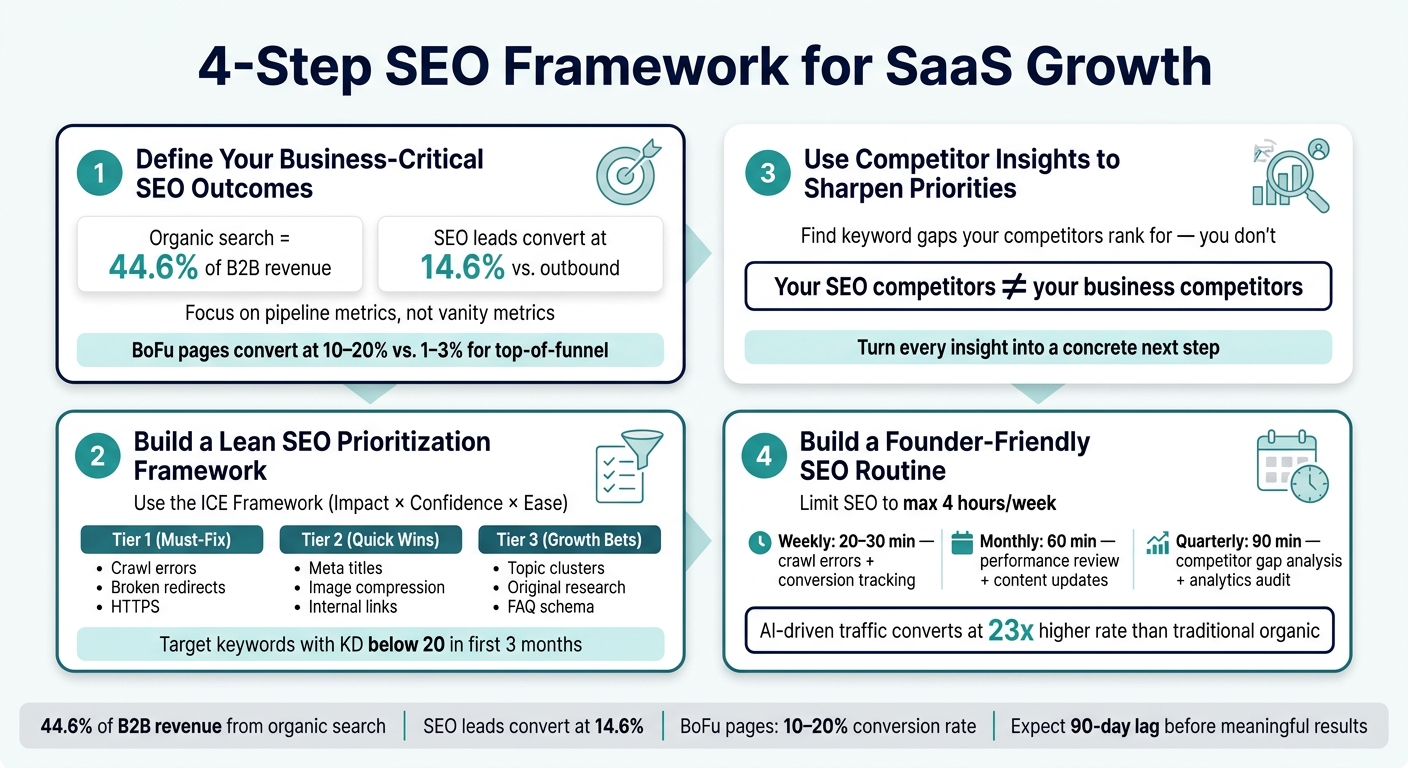
4-Step SEO Framework for SaaS Growth
Step 1: Define Your Business-Critical SEO Outcomes
Connecting Business Goals to SEO Metrics
A common pitfall for SaaS founders is focusing on vanity metrics like rankings or raw traffic instead of metrics that directly impact revenue. The key is to shift your focus to pipeline metrics - those that actually drive business growth.
"Most SaaS SEO programs do not generate pipeline is that they were never designed to. They were designed to generate traffic, and they succeed at exactly that." - PipeRocket Digital
To align SEO efforts with revenue, start with your revenue goal and reverse-engineer from there. For instance, if you need 30 organic SQLs (Sales Qualified Leads) this quarter, calculate the traffic required based on the conversion rates of your highest-intent pages. This approach ensures every SEO decision ties back to tangible business outcomes.
| Metric Category | Vanity Metric (Avoid) | Pipeline Metric (Prioritize) |
|---|---|---|
| Traffic | Raw traffic | Organic SQLs and demo requests |
| Rankings | Position 1 for zero-intent terms | Rankings for comparison and alternatives pages |
| Conversion | MQLs | Organic-to-SQL conversion rate by landing page |
| Cost | Total SEO spend | Organic CAC vs. paid CAC |
By focusing on metrics that directly influence revenue, you can build a content strategy that aligns with your buyer's journey.
Aligning SEO with Your SaaS Funnel
Not all content serves the same purpose, and understanding this is critical. For example, a search for "what is churn rate" reflects an early-stage interest, while a query like "[Your Product] vs. [Competitor]" shows a buyer closer to making a decision. Mapping your content to the buyer's journey ensures you're meeting prospects where they are.
Bottom-of-funnel (BoFu) pages - such as comparison, alternatives, and pricing pages - are especially powerful, converting at 10–20%, compared to the 1–3% conversion rates of top-of-funnel awareness content. Start by building BoFu content first, then expand to higher-funnel topics. Using a competitive analysis framework can help identify which high-intent pages your competitors are using to capture market share.
"SEO is not 'blog posts that rank.' It's a distribution system that captures intent at every stage of a multi-stakeholder buying journey." - Nirav Parmar, SEM Monks
Setting a 90-Day SEO Focus
Rather than spreading your efforts too thin, focus on one primary SEO goal for the next 90 days. This concentrated approach allows for faster, more impactful results.
Here’s a suggested structure for your 90-day plan:
- Days 1–30: Fix technical issues like crawlability, indexation, and page speed.
- Days 31–60: Create 5–10 high-intent BoFu pages.
- Days 61–90: Build authority with original research or unique data assets.
Before beginning, make sure your CRM is set up to track UTM parameters, demo requests, and trial signups. Having clear tracking in place will help you measure success and validate your SEO efforts.
sbb-itb-0a8c96a
Full SaaS SEO Marketing Strategy For 2025 (Build Pipeline in 90 Days)
Step 2: Build a Lean SEO Prioritization Framework
For busy founders, having a lean framework is a game-changer. It helps you focus your limited SEO time on tasks that truly make a difference.
Main SEO Task Categories for SaaS
Once you've identified your business goals, the next step is to structure your SEO efforts into clear, actionable categories. For SaaS founders, there are four key areas to concentrate on:
- Technical SEO: Address issues like crawl errors, broken links, and Core Web Vitals to ensure search engines can properly access and index your site.
- Core Pages (BoFu): Develop high-converting pages such as comparison, alternatives, and pricing pages, which can perform 10–20 times better than awareness-focused content.
- Search-Led Content: Create topic clusters centered around a main pillar page, with 5–10 supporting articles that build depth and relevance.
- Authority Building: Gain backlinks through strategies like publishing original research, conducting data studies, or offering free tools.
"A technically broken site is like a well-stocked store with a locked front door." - Deepanshu Udhwani, Founder, itsdeep
Technical SEO lays the groundwork for everything else. Once these categories are defined, the next step is to assess the potential impact of each task.
Scoring SEO Tasks by Impact, Effort, and Confidence
After categorizing your tasks, prioritize them using a straightforward scoring method. The ICE framework - Impact, Confidence, Ease - helps small SaaS teams make quick, informed decisions without drowning in analysis.
Rate each task on a scale of 1–10 for Impact, Confidence, and Ease, then multiply the scores. For example, a task scoring 8 for Impact, 7 for Confidence, and 9 for Ease would total 504 - a clear priority over a speculative link-building effort that might score 2 × 4 × 3 = 24. This approach quickly reveals which tasks are worth your time.
Confidence often gets overlooked but is crucial. If you're unsure about a task's potential, assign it a lower confidence score (e.g., 25–50%). This naturally pushes less certain tasks down the list until you have more data to back them up.
"The specific framework matters far less than using one consistently." - Stuart Brameld, Founder, Growth Method
Building Your SEO Roadmap
Once you've scored your tasks, group them into three tiers to create a practical roadmap:
| Tier | Label | Focus Areas |
|---|---|---|
| Tier 1 | Must-Fix | Crawl errors, broken redirects, missing sitemaps, HTTPS issues |
| Tier 2 | Quick Wins | Meta title optimization, image compression, internal link cleanup |
| Tier 3 | Growth Bets | Topic clusters, FAQ schema, original research, listicle link acquisition |
Start with Tier 1 tasks - these are your roadblocks. Once those are resolved, move on to Tier 2 for smaller fixes that can drive noticeable results. Finally, tackle Tier 3, which includes your long-term growth strategies.
"80% of SEO tasks produce 20% of the results. The other 20% - the stuff almost nobody talks about because it's boring - produces 80% of your organic visibility." - The Seoable Team
For new SaaS websites, focus on keywords with a Keyword Difficulty (KD) score below 20 during the first three months. Avoid targeting keywords with a KD above 35, as they are typically unattainable for domains less than six months old, regardless of content quality. This keeps your roadmap realistic and grounded in achievable goals.
Step 3: Use Competitor Insights to Sharpen Your Priorities
Why Competitor Analysis Speeds Up SEO Planning
Competitor analysis is like a shortcut for refining your SEO strategy. By studying what’s already ranking well, you can figure out which content and pages should take priority. Here’s the catch: your SEO competitors aren’t always the same as your business competitors. Sometimes, it’s platforms like G2, niche blogs, or even Reddit threads that dominate the keywords your audience is searching for. Bradford Rose of Keygrip sums it up perfectly:
"Every ranking position you want is already held by someone. Understanding who holds it and why is the fastest path to taking it."
Getting to page one is critical because it’s where most clicks happen. The difference between ranking on page one and page two isn’t just about visibility - it can be a major revenue driver. Competitor insights help you turn this data into actionable steps for your SEO strategy.
Prioritizing SEO with Competitor Findings
A competitor audit can uncover a "keyword gap" - those valuable terms your competitors rank for but you don’t. These gaps are golden opportunities to create content that aligns with what your audience is actively searching for.
But it’s not just about keywords. Look at the types of pages your competitors are building. Are they creating use case pages, industry-specific landing pages, or comparison pages that you’re missing? For example, in early 2026, PipeRocket Digital helped a SaaS client move a key page from page two to the second spot on page one by shifting from an academic "methodology" focus to a straightforward "Problem → Solution" structure. The result? A 30% boost in organic traffic within just a few days.
The key is to turn every insight into a concrete next step. Whether it’s rewriting a headline, adding FAQ schema, or creating a missing comparison page, ensure your analysis translates into specific actions. Using tools can help streamline this process, making it easier to go from data to action.
Using Competitor Analysis Tool to Get Actionable Insights
For many founders, especially those new to SEO, turning competitor data into clear priorities can feel overwhelming. That’s where tools like the Competitor Analysis Tool come in. Simply enter your URL and a competitor’s, and within two minutes, you’ll get actionable insights - no SEO expertise required.
Instead of drowning in raw data, this tool provides clear, actionable recommendations for your SEO strategy. It saves you from spending hours analyzing spreadsheets, so you can focus on the opportunities that will actually drive growth.
Step 4: Build a Founder-Friendly SEO Routine
With your SEO priorities in place and a clear roadmap to follow, the next step is to establish a routine that keeps you on track without overwhelming your schedule.
Setting a Weekly and Monthly SEO Cadence
The biggest obstacle for most founders isn’t a lack of SEO knowledge - it’s the absence of a consistent routine. The solution? Limit your SEO time to no more than 4 hours per week. This approach ensures steady progress without turning SEO into a time sink.
Here’s a breakdown of how to structure your time:
- Weekly (20–30 minutes): Use Google Search Console to check for crawl errors and monitor organic demo or trial starts.
- Monthly (60 minutes): Dedicate 10 minutes to reviewing performance in Google Search Console and GA4, and 50 minutes to either updating a top-performing article or preparing briefs for 2–4 new "answer-shaped" posts.
- Automation Tip: Add an IndexNow ping to your CI/CD pipeline to ensure new pages are indexed by Bing and ChatGPT search engines within 24 hours.
| Frequency | Task | Time Required |
|---|---|---|
| Weekly | Indexing & error check + conversion tracking | 20–30 mins |
| Monthly | Performance review + content updates | 60 mins |
| Quarterly | Competitor gap analysis + analytics audit | 90 mins |
Tracking the Right SEO Metrics
Focus on metrics that directly tie back to business outcomes, as identified in Step 1. Tracking too many metrics can be as ineffective as tracking none. The key indicators to watch include:
- Organic signups: Target 3–7% of traffic.
- Organic MQLs (Marketing Qualified Leads): Aim for 15–25% of those signups.
- Trial-to-paid conversion rates: Expect 8–15% for self-serve SaaS.
For early-stage progress, monitor non-branded organic impressions in Google Search Console. These impressions often appear before conversions and signal that your content is reaching new audiences. Expect a 90-day lag before seeing meaningful impressions and about 6 months to achieve 100+ organic clicks per week.
"Traffic without pipeline contribution is just a vanity metric." - Perry Steward, Founder, MADX Digital
Another emerging metric to watch is your AI citation rate. Each month, run 15–25 buyer queries through tools like ChatGPT and Perplexity to see how often your brand appears compared to competitors. Why does this matter? AI-driven traffic converts at a 23x higher rate than traditional organic traffic, making even a small share of this audience a valuable driver of signups.
Keeping Your SEO Backlog Focused
Maintaining a lean and actionable backlog is critical for momentum. As the Seoable team puts it:
"The brutal truth: 80% of SEO tasks produce 20% of the results. The other 20% - the stuff almost nobody talks about because it's boring and doesn't sell tools - produces 80% of your organic visibility."
Here’s how to keep your backlog effective:
- Cut low-impact tasks immediately. Skip backlink outreach, advanced schema markup, and title tag A/B testing if you’re in the early stages - they offer minimal returns compared to fixing technical issues and optimizing keywords already ranking in positions 4–10.
- Prune low-quality pages. Remove pages under 150 words from your sitemap to avoid signaling "low-quality site" to Google.
- Focus on high-ROI updates. Once you have 10 or more published posts, refreshing content that ranks in positions #3–5 often delivers better results than creating new articles.
A quick weekly review - spending 20 minutes on alerts and prioritizing tasks that require action within the next 2–4 weeks - keeps your SEO efforts streamlined and impactful.
Conclusion: Focus Your SEO to Drive SaaS Growth
SEO for SaaS doesn't have to feel overwhelming. The key is to tie every SEO decision directly to meaningful business outcomes - like trial starts, pipeline value, or the LTV:CAC ratio - rather than getting caught up in traffic metrics that don’t contribute to growth.
Set clear goals, create a streamlined framework, analyze competitors, and stick to a routine. These steps help ensure your SEO efforts lead to measurable results. When done right, SEO becomes more than just a long-term strategy - it turns into a dependable engine for growth.
As Angel Diaz, Founder of Growth Forensic, aptly states:
"Organic search for SaaS is not a content volume problem. It is an engine architecture problem."
Begin with a competitor gap analysis to identify where they rank and focus on high-intent keywords. Tools like the Competitor Analysis Tool can help you quickly uncover gaps in demand, messaging, and visibility.
Lastly, keep your efforts focused. Tackle one priority at a time - execute, measure, and then move to the next. This disciplined approach is how SaaS companies turn SEO into a reliable growth channel.
FAQs
Which SEO metric matters most for SaaS revenue?
For SaaS companies, the SEO metric that matters most is pipeline attribution from organic search. Why? SaaS revenue hinges on actions like trials, demos, and activations. That means your focus should be on metrics directly tied to these conversions, such as:
- Organic-attributed trials
- SQL (Sales Qualified Leads) volume
- LTV:CAC ratio (aim for a 3:1 target)
Steer clear of vanity metrics like traffic or pageviews - they might look impressive but don’t necessarily reflect business growth. Instead, track how your content contributes to closed-won deals. This approach provides solid proof of SEO’s role in driving revenue.
What SEO tasks should I prioritize with only 4 hours a week?
Begin with the essentials. Address technical SEO issues first: make sure Google Search Console is properly set up, submit an XML sitemap, and confirm your site aligns with Core Web Vitals standards (like keeping Largest Contentful Paint under 2.5 seconds).
Next, shift your attention to creating content that delivers quick results. Focus on bottom-funnel content targeting long-tail keywords with high intent and low difficulty (in the 0–20 range). Pages comparing products or offering alternatives to competitors can often rank quickly and generate conversions in a short timeframe.
Above all, aim for consistent, intent-driven content. It doesn’t have to be flawless - what matters most is delivering value that aligns with user needs.
How do I find the best BoFu keywords to target?
When you're looking for BoFu keywords for your SaaS business, focus on terms that show clear commercial intent. These are the kinds of searches people make when they're ready to buy or seriously considering their options. Examples include:
- Pricing-related terms (e.g., "SaaS pricing plans")
- Alternatives (e.g., "best alternatives to [competitor]")
- "Best of" lists (e.g., "best project management software")
- Direct comparisons (e.g., "[Product A] vs [Product B]")
To make the most of these keywords, prioritize them based on three factors: intent, competition, and search volume. Mid-tail queries - those that are longer than basic keywords but not overly specific - often strike the right balance. They tend to have actionable intent and aren't as fiercely competitive.
You can also use keyword research tools to identify gaps in your current visibility. Once you've gathered your keywords, organize them into clusters. This way, you can create targeted landing pages that directly address your audience's needs and help guide them through their final decision-making process.