
Competitor Gap Analysis for Indie Makers: Quick Guide
Find one actionable gap across demand, messaging, and visibility among 3–5 competitors and run a low-risk test to validate it.
If I only had 30 minutes, I’d do this: compare 3–5 close competitors, look for gaps in demand, messaging, and visibility, then pick one low-risk test to ship first.
This works because most small teams do not need a big research project. I just need one clear signal:
- What buyers keep asking for
- What rivals fail to say well
- Where rivals show up before I do
- Which gap I can test with the least time and cost
A tight review like this can help me avoid months of guesswork. For example, if I see the same complaint in reviews across 3 tools, that pattern matters more than one random comment. And if a rival has niche landing pages or pricing pages that I lack, I may be losing buyers before they even reach my site.
My goal is simple: turn scattered notes into one clear niche statement, then act on it.
| Area | What I check | What I’m looking for | First move |
|---|---|---|---|
| Demand | Reviews, Reddit, search terms | Repeated complaints, “alternative for [niche]” searches | Test a niche page or feature angle |
| Messaging | Homepages, pricing, hero copy | Vague copy, feature-first language, no clear audience | Rewrite headline or positioning |
| Visibility | Search results, use-case pages, comparison pages | Topics or pages rivals have and I do not | Publish the missing page type |
In short: I’m not trying to map the whole market. I’m trying to find one gap I can act on now.
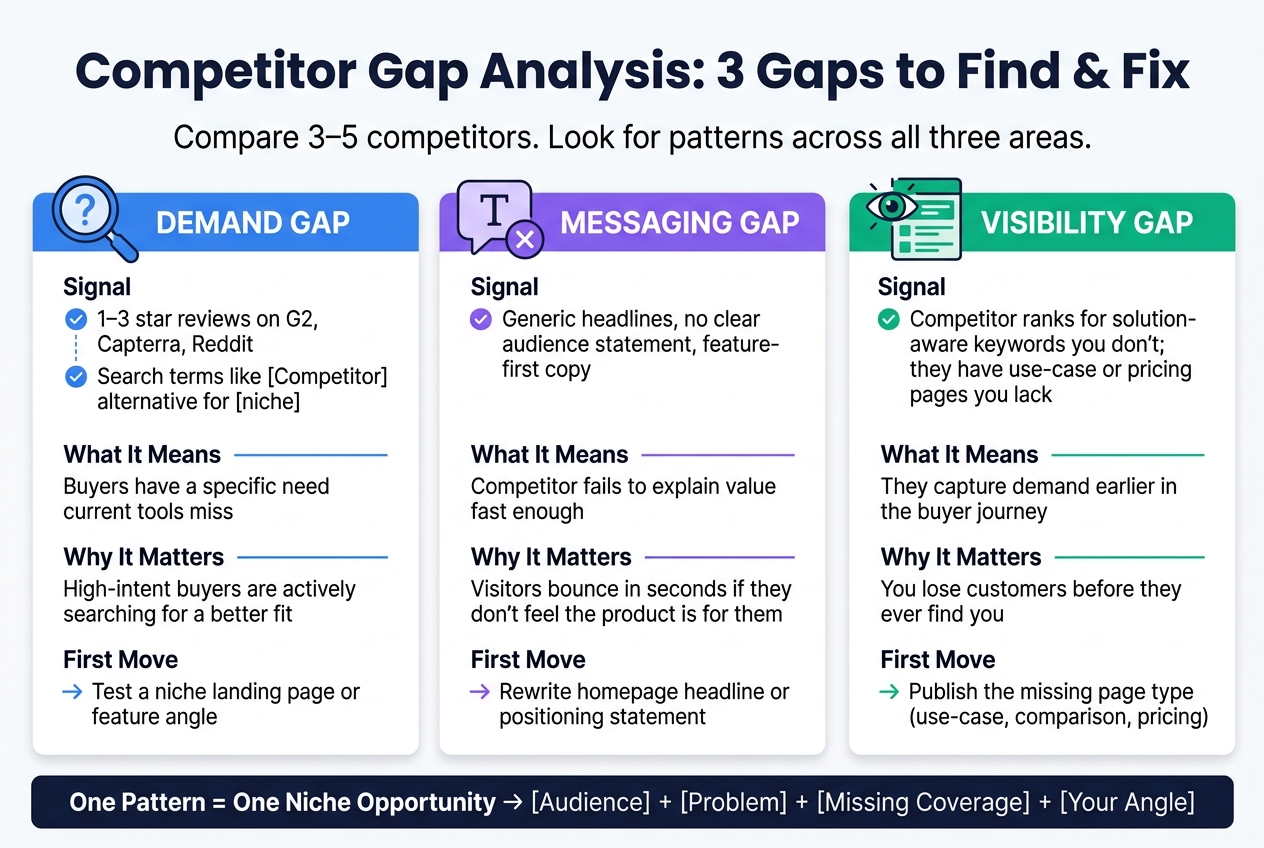
Competitor Gap Analysis Framework: Demand, Messaging & Visibility
SaaS AI Keyword Research To Do AI Competitor Analysis
sbb-itb-0a8c96a
2. Pick the Right Competitors to Compare
Your comparison set shows where buyers still feel friction. The key is simple: compare yourself to the options people already put side by side. That keeps your gap analysis tied to actual buying behavior, not guesswork.
Choose 3 to 5 direct and indirect competitors
Start with the tools or pages a buyer sees before they pick a product like yours. A direct competitor sells a similar product to the same audience. An indirect competitor works more like a discovery path - maybe a search result, directory listing, or community thread that appears before someone lands on your site.
A short list of 3 to 5 competitors is usually enough. It gives you a clean view without turning the analysis into a mess.
To build that list, search Google for "[your top competitor] alternative", then check niche communities and directories to confirm which tools buyers compare side by side.
It also helps to include one newer competitor that matches your stage, price point, or product scope. For a small team, that kind of benchmark is more useful because it's closer to what you can match.
Once your set is fixed, you can start looking for gaps in:
- Demand
- Messaging
- Visibility
Skip enterprise brands that do not match your stage
Big enterprise brands can throw off the whole picture. Their budgets, teams, and reach are on a different level, so the comparison doesn't tell you much you can act on.
Instead, compare yourself to businesses that match your current stage, price point, and product scope. Those are the gaps you can actually close as an indie maker.
With the right set in place, the next step is to map demand, messaging, and visibility gaps.
3. Find Demand, Messaging, and Visibility Gaps
Now that you’ve locked in your competitor set, look for gaps in three places: demand, messaging, and visibility. These aren’t separate issues. They’re three signs pointing to the same unmet need.
| Gap Type | Signal | What It Means | Why It Matters |
|---|---|---|---|
| Demand | Repeated feature requests in 1–3 star reviews; search terms like "[Competitor] alternative for [niche]" |
Buyers have a specific need that current tools miss | High-intent buyers are actively looking for a better fit |
| Messaging | Generic headlines; no clear "who it's for" statement; features instead of outcomes | The competitor does not explain value fast enough | Visitors bounce within seconds if they don't feel the product is for them |
| Visibility | Competitor ranks for solution-aware keywords you don't; they have use-case or pricing pages you lack | They capture demand earlier | You lose potential customers before they ever find you |
Demand gaps: what buyers want that competitors do not cover
Demand gaps show up when buyers keep running into the same wall. A simple place to spot this is in 1–3 star reviews on G2, Capterra, and Reddit. Look for repeated complaints from the same type of user. When that pattern keeps showing up, it usually means one audience segment isn’t being served well.
Search queries can tell you the same thing. A keyword like "[Competitor] alternative for [niche]" is a strong signal. That person isn’t browsing. They’re actively trying to find a better option.
Messaging gaps: where the value proposition is vague or missing
Messaging gaps are often easy to spot on a competitor’s homepage. If the page doesn’t clearly say who the product is for or what problem it solves, that’s a gap.
Products win when they explain value to the right buyer FAST.
Check the hero section, pricing page, and feature descriptions. If the copy leans on features instead of outcomes, or if it’s hard to tell which buyer they want, you have room to position your offer with more focus.
Visibility gaps: where discovery is weaker than it should be
Visibility gaps show up when buyers can’t find you, even though they’re looking. Or when a competitor appears in search and you don’t. Check whether competitors have use-case pages and pricing pages. If they do and you don’t, they’re picking up solution-aware traffic before your product even enters the picture.
Competitor Analysis Tool can help surface these gaps fast, so you can get straight to spotting patterns. Once you’ve gathered notes across all three areas, group the repeated themes into one niche opportunity.
4. Turn Repeated Gaps Into One Niche Opportunity
Now turn those gaps into a pattern you can use. One competitor without a pricing page might just be an odd miss. But if three competitors all skip it, that starts to look like a market blind spot worth going after.
Group findings into patterns worth acting on
Sort your raw notes into three buckets: demand (search terms or audience groups that no one serves well), messaging (vague copy or feature-heavy language that never says what result the buyer gets), and visibility (buyers don't see a clear path through the competitor's content).
Patterns matter more than one-off issues. If reviews for several competitors keep pointing to the same friction, and none of those companies speak to a certain stage of the buyer journey, that's not random. That's a gap. The same goes for messaging. If a few competitors open with a feature list instead of a clear outcome, you have room to say the thing buyers want to hear first.
Also look for missing buyer-journey pages, such as:
- Use cases
- Comparisons
- Pricing
Once the pattern is clear, boil it down to one sentence.
Write a one-sentence niche opportunity statement
Use this format: [Audience] + [problem] + [missing coverage] + [your angle].
Keep it tight. If it spills into a second sentence, it's probably too broad. A good niche statement should lead straight to one test you can run, like a landing page, a feature callout, or a messaging tweak, without needing a full product overhaul.
Then use that statement to score which gap to tackle first.
5. Choose the First Gap to Act On
Use your niche statement to rank the gaps, then pick one. Score each gap with the same criteria so you can spot the clearest win.
Score each gap by impact, effort, and team fit
Your first move should be the gap most likely to turn into a fast, low-risk niche test. Rate each gap across four criteria: impact (revenue or traffic upside), effort (time and cost to ship), demand signal (how strong the demand signal is), and founder fit (how well it lines up with your skills, roadmap, and distribution path). Set a hard cap on time and spend, and ask a simple question: will this gap still matter in 18 months?
Use the same four criteria for every gap. That keeps the process clean and stops you from talking yourself into a weak idea.
| Scoring Criteria | High | Medium | Low |
|---|---|---|---|
| Impact | Clear revenue upside or meaningful traffic from high-intent demand | Improves retention or conversion | Minor UX fix or vanity traffic |
| Effort | Quick win; low-cost change you can ship fast | 1–2 week sprint; moderate work | 1-month-plus project; needs new infrastructure |
| Demand Signal | Repeated deal-breaker complaints or strong search signal | Some search volume or mixed feedback | Based on one or two anecdotes |
| Founder Fit | Matches your expertise, roadmap, and distribution path | Requires learning new skills | Out of sync with product direction |
Favor structural gaps. They’re harder to copy than tactical fixes, which gives you more room if the test works.
Start with the gap that has the clearest demand and lowest risk
Use the top score as your first test. Put the gap first when demand is already proven and execution is within reach.
A messaging gap often does well here. Why? Because the work is usually light. A clearer headline or a homepage rewrite can be enough to test the idea, and the signal often shows up fast in bounce rates or repeated complaints in reviews and forums. A feature gap may look bigger on paper, but if it takes a month to build, it’s often the wrong first move for a solo team.
If you’re stuck on which gap has the strongest demand signal, Competitor Analysis Tool shows demand, messaging, and visibility gaps side by side, which makes scoring much faster.
Pick one gap and ship a small test.
FAQs
How do I know which gap matters most?
Prioritize gaps by potential impact, commercial intent, and ease of execution. The best opportunities are the ones that can drive business, match what buyers want, and don’t take forever to ship.
Focus on:
- Demand and buyer intent
- Meaningful upside, not vanity traffic
- Feasibility and quick wins
- Fit with your product messaging
What if I find several gaps at once?
Finding a few gaps at the same time is normal. The hard part is that a long list can get messy fast.
To keep things clear, rank each gap by significance and urgency. In plain English, look at two things: how much value the gap could bring, and how fast you can fix it.
Stick to 3 to 5 action items. Split them into:
- Quick wins you can ship today
- Bigger moves to handle later
If you want a simple way to sort those ideas, Competitor Analysis Tool can help you organize and rank them.
Can I do this without SEO experience?
Yes - you can run a competitor gap analysis even if you don’t have SEO experience.
The old-school way can eat up hours and usually calls for deep SEO know-how. But Competitor Analysis Tool makes the process much easier. It gives you plain-English insights, keeps jargon to a minimum, and shows priority-based recommendations so you can focus on what to ship next.