
How Competitor Analysis Shapes Messaging Frameworks
Competitor analysis reveals demand, messaging, and visibility gaps you can turn into a tested message map that boosts clarity and conversion.

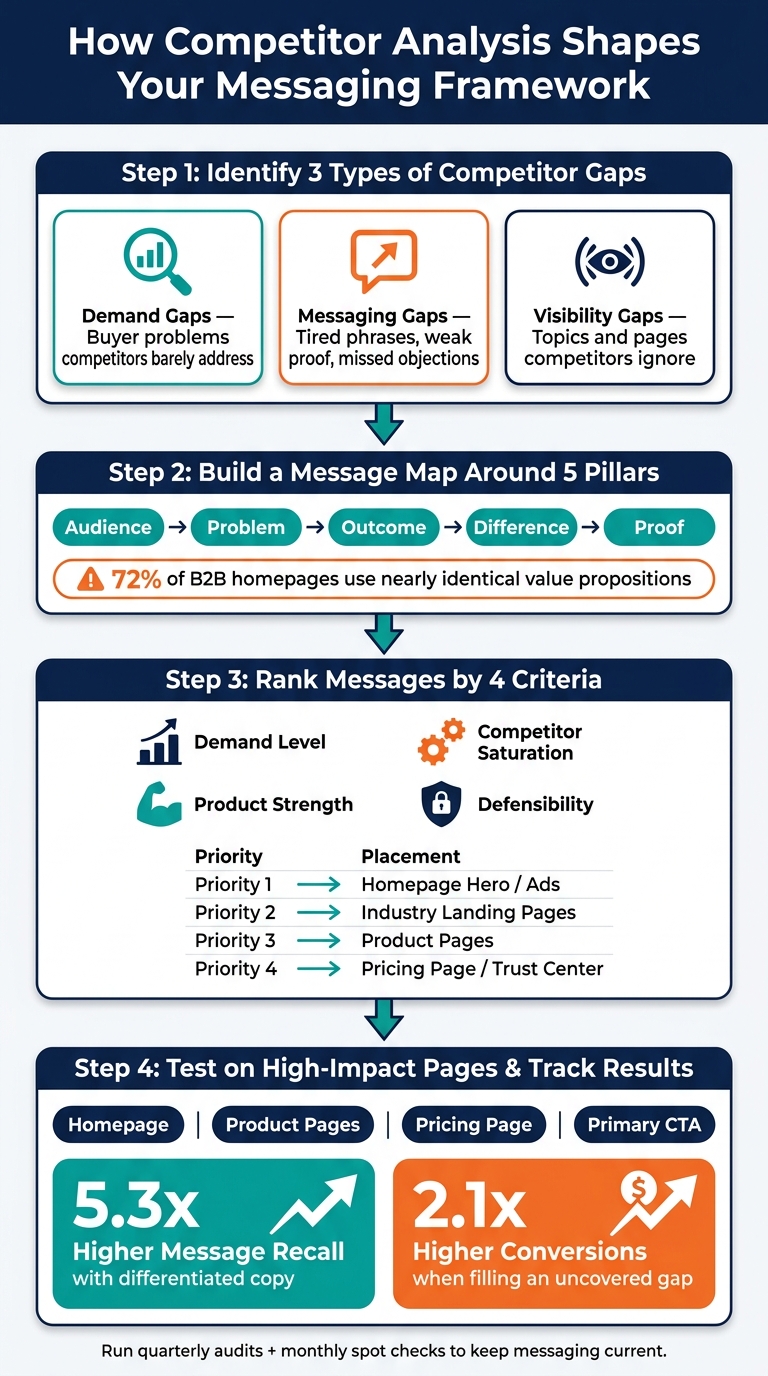
Most SaaS messaging blends in. In fact, 72% of B2B homepages use near-identical value props. My takeaway is simple: if I want messaging that gets attention, I need to analyze competitor websites to compare my copy to the market, find the gaps, and turn those gaps into clearer claims.
Here’s the short version:
- I look for demand gaps: buyer problems competitors barely address
- I look for messaging gaps: tired phrases, weak proof, and missed objections
- I look for visibility gaps: topics and pages competitors ignore
- Then I turn those findings into a message map built around:
- audience
- problem
- outcome
- difference
- proof
- Last, I test the top messages on pages that matter most, like the homepage, pricing page, and product pages
A few points stand out fast:
- Buyers respond better to clear outcomes like hours saved, lower risk, or $ savings
- Generic lines like “AI-powered” or “all-in-one platform” often blend into the same category noise
- Better message recall can be 5.3x higher when copy breaks from default category language
- Filling a clear market gap can lift conversions by 2.1x
The core idea: competitor analysis should shape what I say, where I say it, and what I should stop saying.
Competitor Analysis to Messaging Framework: A Step-by-Step Process
How To Do A Competitive Analysis [The Ninja 14-Step Framework]
sbb-itb-0a8c96a
How competitor analysis reveals demand, messaging, and visibility gaps
Competitor analysis shows how buyers are being talked to across the market. It looks at homepage copy, pricing, use cases, and proof points. When you do it well, messaging stops being a gut call and starts being based on evidence. In most cases, the patterns fall into three buckets: demand, messaging, and visibility.
Demand gaps: problems buyers care about that no one addresses clearly
A demand gap shows up when competitors are picking up search terms, customer questions, or market segments your team isn't going after. Common examples include operational risk, software spend, and time to value.
To find these gaps, compare competitor claims with the words customers use in customer questions, G2 reviews, and lost-deal interviews. When the same buyer language keeps showing up and competitor copy says nothing about it, you've likely found a value proposition gap.
Once you've mapped demand gaps, the next job is to see where competitor language starts to miss the mark.
Messaging gaps: overused claims, weak proof, and ignored objections
Messaging gaps appear when competitors lean on copy that sounds the same from one site to the next. A smart move here is to build a do-not-use list of phrases buyers have seen so many times they've stopped paying attention.
You should also look for credibility gaps. That's what happens when a company makes a claim but doesn't back it up. If a brand says it's the "easiest to implement", that claim needs setup data or customer proof. Without that, the line doesn't do much.
Then there's what competitors leave out. That's often where things get interesting. Migration effort, team adoption, and integration complexity are common objections, yet many SaaS homepages barely mention them. If your brand addresses those friction points head-on, the difference becomes much clearer.
The same review shouldn't stop at copy. It also needs to cover page coverage and topic selection.
Visibility gaps: topics and angles underused across key pages
Visibility gaps show up in the pages and topics competitors don't put much effort into. Check whether they give their best pages to roles, outcomes, and journey-stage topics, or if they stay broad and generic.
Content strategy often tells you a lot about messaging strategy. The topics competitors publish on show the conversations they want to own. The topics they avoid can turn into openings for your brand to claim, because page targeting and topic coverage shape which messages buyers actually see. Competitor Analysis Tool can speed this up by comparing your site with a competitor's and showing demand, messaging, and visibility gaps without SEO expertise.
How to turn competitor findings into a messaging framework
Competitor findings don't do much on their own. They start to matter when you turn them into a message map: what to say, where to say it, and how to stand apart. The gap types above give you the raw material for that map.
Map competitor claims against customer outcomes
Start by pulling the basics from competitor pages: homepage headlines, subheadlines, CTAs, proof points, and pricing language. Then translate each claim into the buyer, problem, mechanism, and outcome behind it. That makes it easier to spot where competitor copy is vague and where your product can be more specific.
Use this format to line up claims with demand signals:
| Competitor Claim | Customer Demand Signal | Your Current Messaging | Gap to Address |
|---|---|---|---|
| "AI-powered automation" | Need for specific time savings | "Automate your workflow" | Lack of concrete proof/metrics |
| "Enterprise-grade security" | Compliance and risk mitigation | "Secure data handling" | Missing SOC 2 or specific compliance proof |
| "All-in-one platform" | Desire for tool consolidation | "Integrated feature set" | Complexity vs. ease of use |
That last column gives you your next copy priorities. In plain English, it shows what your next draft needs to fix.
Build messages around problem, outcome, and differentiation
Once the gaps are clear, write each message around three things: the problem the buyer wants to solve, the outcome they want, and the point that makes your claim believable. That keeps your copy tied to what buyers care about instead of drifting into generic language they've seen a hundred times.
Use measurable wording when you can: hours saved per week, cost reduced by $X, or lower operational risk. In a crowded market, that kind of specificity helps. 72% of B2B homepages use nearly identical value propositions, and differentiated messaging achieves 5.3x higher recall compared to category defaults.
Here's a simple gut check: if you took your logo off your homepage right now, would a buyer still know it was your company?
Use tool-based analysis to speed up the process
Competitor Analysis Tool can speed up this work by comparing your site with a competitor's and surfacing demand, messaging, and visibility gaps in minutes. So your team spends less time stuck in analysis and more time deciding what to test next. From there, you can rank the messages that should go live first.
How to prioritize and test the right messages first
Once you’ve mapped the growth gaps, the next step is deciding what to test first. Not every message should live on the homepage, so rank each one by placement before you touch the copy.
Rank message opportunities by demand, saturation, and product strength
Start with demand, saturation, product proof, and defensibility. If the same phrase shows up across a bunch of competitor sites - lines like "all-in-one platform", "streamline workflows", or "AI-powered insights" - put it on your burn list, not your homepage.
That ranking tells you where each message should go.
| Problem Theme | Customer Demand Level | Competitor Saturation | Product Strength | Priority Rank | Recommended Placement |
|---|---|---|---|---|---|
| Outcome-based (ROI/Speed) | High | Low | High | 1 (Critical) | Homepage Hero / Ads |
| Segment-specific (Vertical) | Medium | Low | High | 2 (High) | Industry Landing Pages |
| Feature-specific (Technical) | High | High | Medium | 3 (Table Stakes) | Product Pages / Documentation |
| Trust/Security | Medium | High | High | 4 (Supportive) | Pricing Page / Trust Center |
Use Priority 1 in the homepage hero and ads. Put Priority 2 on industry landing pages and product pages. Lower-priority messages fit better on pricing pages and in sales enablement.
Test revised messaging on high-impact pages
Put your tests on the pages that shape buyer decisions most: the homepage, product pages, pricing page, and primary CTA. These are the best spots to test clearer outcome-led messaging, stronger proof points, direct objection handling, and audience-specific framing.
This can be pretty simple. Swap a vague headline for one tied to a clear outcome. Tighten the CTA around a concrete promise. Or rework the pricing page so it speaks to value first. When a message fills an uncovered gap, it can produce 2.1x higher conversion rates - but only if the test is isolated enough to show what changed.
Track demo requests, CTA clicks, pricing-page exits, and the quality of sales objections. In sales calls, look for fewer generic competitor-comparison objections and more buyer-specific objections. That shift often shows up before the conversion numbers do. Use those signals to decide what to test next.
Conclusion: Build an ongoing messaging framework, not a one-time rewrite
Once you’ve tested message priorities, keep a close eye on the market. Quarterly structured audits, with monthly spot checks in between, help teams catch major competitor moves before they turn into blind spots.
This isn’t about doing one big rewrite and calling it done. It’s about building a repeatable review cycle that keeps messaging in step with the market as it shifts. That matters in B2B, where 72% of homepages already use nearly identical generic category language. And differentiated messaging can drive 5.3x higher recall - but only if the framework stays current.
Competitor Analysis Tool can make quarterly reviews faster by surfacing demand, messaging, and visibility gaps in minutes. That makes review cycles feel routine instead of occasional. A living framework stays current because the market doesn’t stand still.
FAQs
How often should I review my messaging?
Review your messaging on a regular basis. This isn’t a one-and-done task.
Your competitors keep changing how they position themselves and what they say. If you don’t check in, your messaging can get stale without you noticing.
A quarterly messaging audit is a practical rhythm. It gives you enough time to spot shifts, track changes, and keep your analysis up to date.
If you want to move faster, the Competitor Analysis Tool can help. It lets you compare your website with competing sites and find messaging gaps fast.
What proof makes SaaS messaging credible?
SaaS messaging works better when you back up claims with proof people can check for themselves.
That proof can include customer logos, case studies, G2 badges, usage stats, and analyst recognition.
What matters most is which proof you put front and center. It should line up with what the buyer cares about most:
- ROI metrics for buyers focused on the business case
- Case studies for buyers who look to peer experience before they decide
And if competitors lean on vague promises without support, this is where you can pull ahead. Strong, verifiable evidence makes your message more convincing and a lot harder to ignore.
Which page should I test first?
Start with the homepage. It shapes the first impression and usually gives you the clearest, most stripped-down version of a brand’s message.
Because it’s the most visible page - and often the one a team polishes the most - it gives you a solid baseline for judging the rest of the site, plus other channels.