
Competitor Messaging: Emotional Gaps to Watch
Spot trust, urgency, and aspiration gaps in SaaS competitor copy and prioritize fixes that improve recall and conversions.

Most SaaS competitor pages don’t lose because of weak features. They lose because the message doesn’t make buyers feel safe, ready, or sure.
If I were reviewing competitor copy, I’d look for three gaps first:
- Trust gaps: big claims with thin proof
- Urgency gaps: weak pain, weak reason to act now
- Aspiration gaps: no clear picture of who the buyer becomes after using the product
That matters because 72% of B2B homepages use near-identical value props, and brands with sharper positioning can see 5.3x higher recall and 2.1x higher conversion rates. When copy sounds like everyone else, buyers often default to price, brand familiarity, or delay.
Here’s the short version:
- If a page says a lot but feels flat, the problem is often emotional, not factual
- If proof is thin, fix trust first
- If pain is vague, fix urgency and relief next
- If the message never answers “Is this for someone like me?”, fix aspiration
A simple test I use: remove the logo. If the page could belong to almost any SaaS company in that category, there’s probably a messaging gap worth noting.
This article breaks down how I’d spot those gaps, what they look like in competitor copy, and which one I’d fix first on high-traffic pages.
The B2B SaaS messaging sweet spot: How to stand out without confusing your market
sbb-itb-0a8c96a
How to spot emotionally weak competitor copy
A fast way to analyze a competitor's website for emotional pull is simple: remove the logo and brand name.
If the copy could fit almost any company in the same space, it's generic. And that's not rare. Research shows 72% of B2B homepages use nearly identical value propositions , making it easier to find growth gaps vs competitors. When everything sounds the same, there's usually an emotional gap underneath it.
Once a page starts to feel interchangeable, the job shifts. Now you need to spot the exact emotional signal it's missing.
Common signs of emotionally thin messaging
Weak copy usually follows the same script. Headlines lean on phrases like "streamline workflows", "all-in-one platform," or "AI-powered insights." That's category language. It tells you what kind of product it is, but not why this company matters.
You'll also see soft social proof: logo walls with no context, or testimonials like "trusted by leading brands" with no numbers, no segment, and no clear result. Proof without detail doesn't build much trust.
Another red flag is broad targeting. If the message is meant for everyone, it usually lands with no one. And when every page pushes "Book a Demo" no matter what's on the page, it ignores buyer intent and timing.
Each of these signals points to a missing emotional cue, usually around:
- trust
- urgency
- aspiration
The next step is figuring out which one is absent.
Feature-led vs. emotion-led language
The same point can sound flat or sharp depending on how it's framed. If the copy only names a feature, it often feels cold. If it links that feature to an outcome the buyer cares about, it starts to land.
| Feature-Led Language | Emotion-Led Language | Why It Works Better |
|---|---|---|
| "AI-powered automation" | "Handle 47 tasks while you sleep" | Turns a vague claim into concrete relief |
| "Enterprise-grade security" | "SOC 2 certified so you never worry about a breach" | Connects the feature to a fear buyers already have |
| "Leading CRM platform" | "It's possible to love your sales CRM" | Pushes back on the dread many buyers feel about CRM software |
| "Launch faster" | "Ship landing pages with pre-tested layouts and built-in analytics hooks" | Replaces a bland promise with a believable mechanism |
From here, the next move is to decide whether the gap is trust, urgency, or aspiration.
The main emotional gaps to watch in competitor messaging
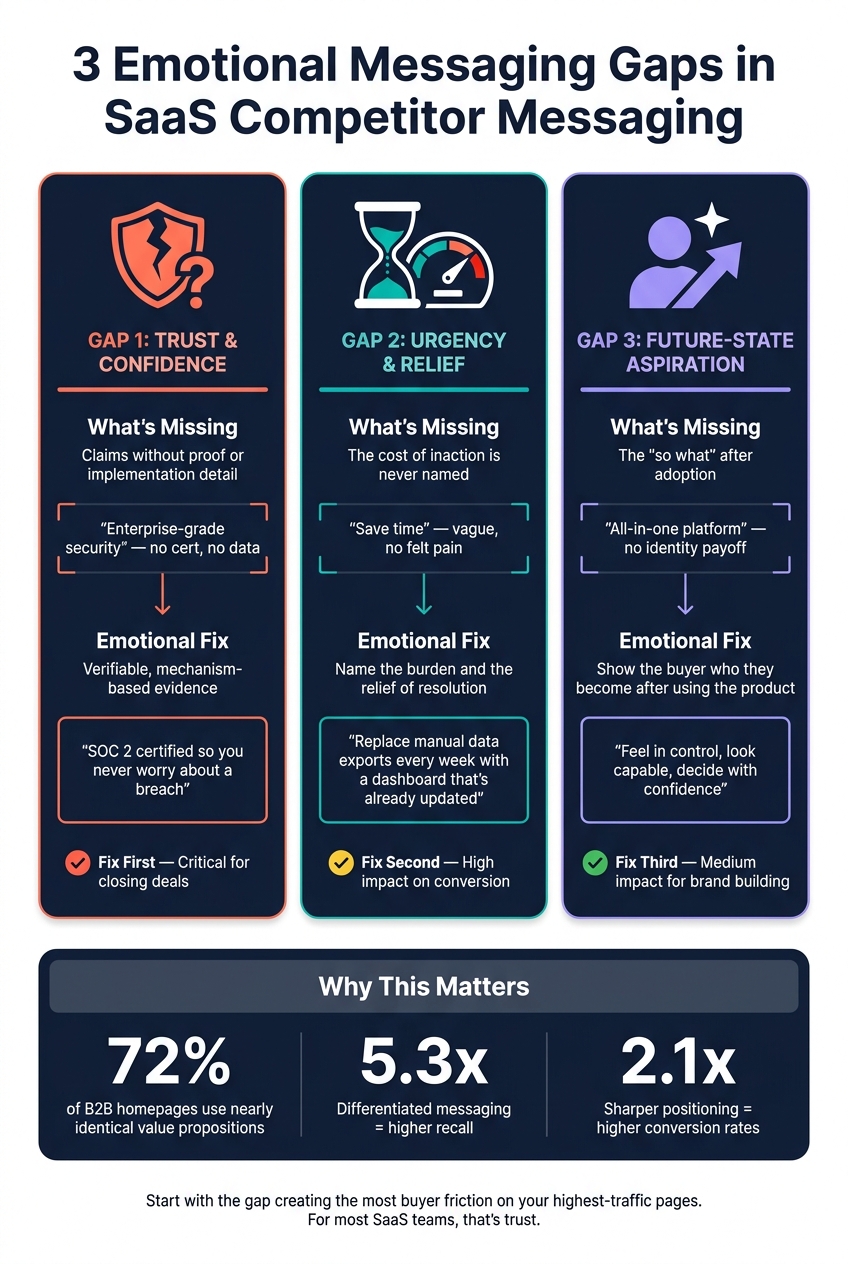
3 Emotional Messaging Gaps in SaaS: How to Spot & Fix Them
Once you know what thin, low-impact messaging looks like, the next move is to name the gap. In SaaS, most of these weak spots show up in three places. These are the ones to watch.
Use them to spot where a competitor sounds polished on the surface but still doesn’t give buyers enough to believe, feel, or act on.
Trust and confidence gaps
A trust gap shows up when a competitor makes a big claim and doesn’t back it up.
You see this all the time with lines like "enterprise-grade security" or "easy to use." Those phrases sound good. But without a SOC 2 certification, onboarding data, or customer testimonials, they fall flat. Buyers start to doubt the claim. The risk feels higher.
At the root of this is a proof gap. The competitor promises a result but never shows how the product gets there. Saying "increase conversions" is easy. Showing the system behind that result is much harder - and much more persuasive.
Without proof, the claim feels like a gamble, not a reason to buy.
Urgency and relief gaps
Most SaaS copy explains the product. It doesn’t bring the pain into focus.
"Competitive messaging starts in a spreadsheet before it ever lands on a website. The research phase is where the real positioning advantage is won or lost."
If a competitor only says "save time," it skips the part buyers actually feel day to day: the manual work stacking up, the small errors slipping through, and the mental drag that comes with both.
That leaves people with no clear sense that doing nothing has a cost. And if there’s no felt cost, there’s no reason to move now.
Future-State Aspiration gaps
This gap sits between the product and the identity the buyer wants after they adopt it.
Feature-heavy copy answers, What does this tool do? But buyers are often asking something deeper: Is this for someone like me?
The payoff they want usually isn’t abstract growth. It’s more concrete than that. They want to feel in control of a process, look capable in front of their team, or make decisions without second-guessing themselves.
When competitor copy stops at the feature and never gets to that payoff, it leaves room for a brand with sharper positioning to step in.
| Gap Type | What's Missing | Emotional Opportunity |
|---|---|---|
| Trust & Confidence | Claims without proof or implementation detail | Verifiable, mechanism-based evidence |
| Urgency & Relief | The cost of inaction | Naming the burden and the relief of resolution |
| Future-State Aspiration | The "so what" after adoption | Feeling in control, competent, and confident |
Once the gap is clear, the next step is to turn it into sharper claims, proof, and outcomes.
How to write SaaS messaging that closes emotional gaps
Use the gap you found earlier - trust, urgency, or aspiration - to guide the rewrite. Once you know the gap, reshape the copy around a real pain point and a payoff people can believe.
Use customer language and tie pain to outcome
Start with the words customers already use. Pull exact lines from reviews and call transcripts, like "I was frustrated by" or "I wish it could." Those phrases show what people felt before they bought, and they give you language you can mirror back. The goal isn't to slot in a feature. It's to speak to the feeling behind it - trust, urgency, or aspiration.
From there, connect the pain to the outcome. Not "save time," but "replace manual data exports every week with a dashboard that's already updated." That version does more work. It names the hassle and shows the relief.
Then turn that raw language into a clear before-and-after benefit.
Translate features into emotional benefits
Turn each feature into a before-and-after outcome. If a reporting feature cuts turnaround from 48 hours to 5 minutes, the shift isn't just about speed. It's the move from waiting on a report to getting answers almost right away.
Say how it works so the outcome feels believable. Vague claims like "get better insights" can make people doubt the promise. A plain-English mechanism, like "pre-tested layouts and built-in analytics hooks," gives the claim some weight.
Once the message is sharper, make sure the product can back it up.
Match your messaging promise to the real product experience
Big claims create a credibility gap when the message gets ahead of the product. Check that the promise stays steady from the homepage through onboarding. The emotional claim has to be something the product can deliver again and again, not just when everything goes right. That keeps the rewrite grounded before you choose which gap to fix first.
How to pick the right emotional gap to fix first
Once you've found the gap, sort it by one thing: how much it slows the next step.
Start with the gaps that get in the way of buying the fastest. In most cases, that means trust first, urgency and relief second, and aspiration last.
A simple messaging priority framework
The best gaps to fix are the ones with high impact and low effort. If your homepage headline creates doubt, a sharper message and a stronger proof point can often help fast. Aspiration is different. That usually takes steady brand work over time.
So the move is pretty simple: fix what's stopping buyers today before you spend time on what may inspire them later.
| Emotional Need | Buyer Pain | Emotional Intensity | Impact | Priority |
|---|---|---|---|---|
| Trust & Confidence | Skepticism, fear of wrong choice | High | Critical for closing deals | 1 - Fix first |
| Urgency & Relief | Overwhelm, manual work fatigue | High | High for conversion | 2 |
| Future-State Aspiration | Status, growth ambition | Medium | Medium for brand building | 3 |
Use Competitor Analysis Tool to find messaging gaps faster
If you want a faster read across several pages and competitors, use a comparison tool.
Competitor Analysis Tool compares your site with a competitor and surfaces demand, messaging, and visibility gaps fast. That lines up neatly with the priority order above, so you can spot what matters first instead of guessing.
Conclusion: What to fix first in competitor messaging reviews
Emotional gaps rarely look like obvious errors. More often, they hide in copy that sounds fine on the surface but doesn't push anyone to act.
A better way to review competitor messaging is to read each page through the buyer's emotional lens. Check the homepage, the product page, and the main conversion page. Then ask: What feeling does this page create? And just as important: Is that the feeling a buyer needs to take the next step?
With 72% of B2B homepages using nearly identical value propositions, standing out doesn't take much. Differentiated messaging produces 5.3x higher recall and can drive 2.1x higher conversion rates when it occupies an open market position. Start with the gap creating the most buyer friction on your highest-traffic pages. For most SaaS teams, that's trust.
FAQs
How do I tell which emotional gap matters most?
Look for places where competitor messaging doesn’t speak to your ideal customer profile. Focus on the gaps that line up with your core strengths and speak to buyer needs, pain points, or emotions that come up in actual conversations.
The biggest opportunities often show up when competitors make bold claims without proof, or when they ignore certain buyer groups and pain points. If it fits your process, Competitor Analysis Tool can help you spot and compare those messaging gaps.
What proof builds trust fastest on a SaaS homepage?
Show clear proof behind your claims: customer logos, case study headlines, G2 badges, usage stats, and analyst recognition.
Put the proof your buyers care about most near the top. ROI numbers speak to a commercial audience. Case studies work well for buyers who trust peer experience. And technical proof lands better when you tie it to something human, like lower risk or protecting your team’s reputation.
Can emotional messaging improve conversions without changing features?
Yes. Moving away from generic, feature-heavy copy and toward outcome-specific or emotion-driven messaging can improve conversions without changing the product itself.
When competitors all sound alike, buyers have a hard time telling one option from another. That’s where tone gaps come in. If your market leans on the same tired claims, speaking to trust, ambition, or ignored pain points can make your brand feel clearer, sharper, and easier to remember.