
Cross-Channel Experimentation Framework for SaaS Teams
Align paid, email, product, and sales around one funnel stage, one KPI, and one shared test plan for connected SaaS experiments.
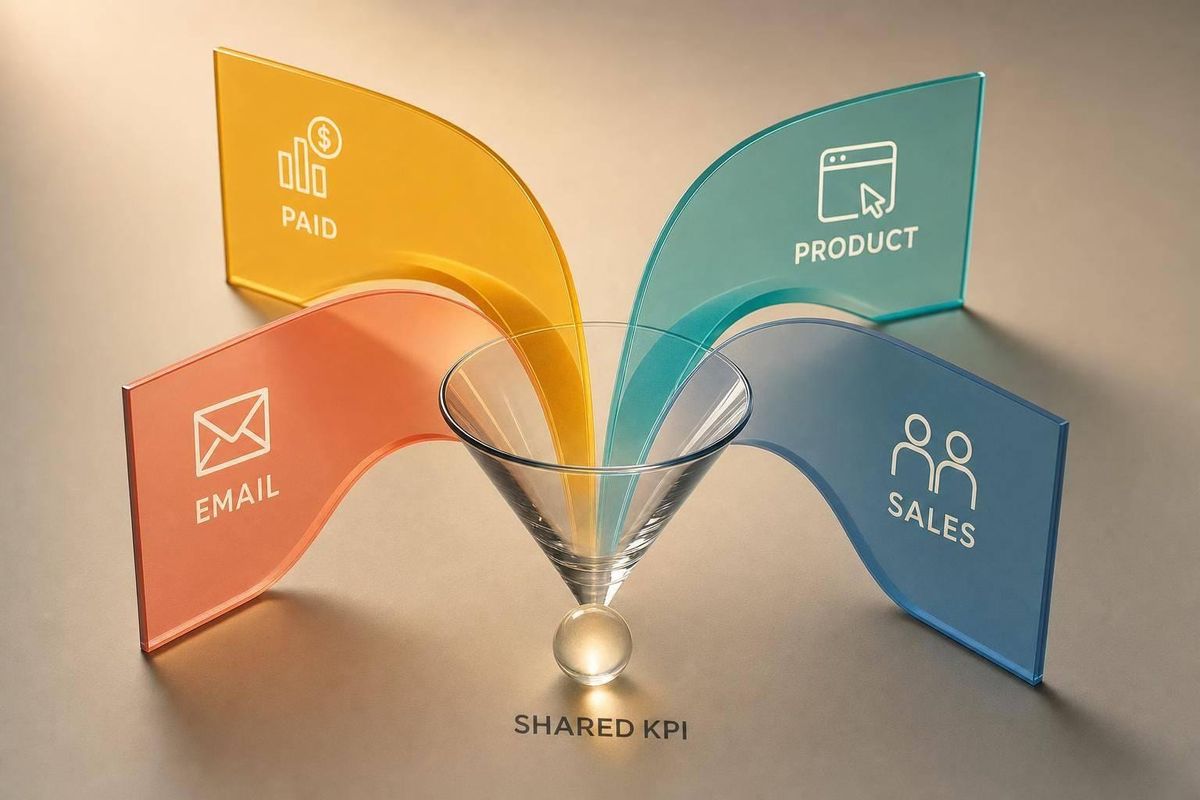
If your SaaS team tests paid ads, email, landing pages, product flows, and sales touches separately, you’re probably missing what actually drives growth. The fix is simple: I would line every team up around one business goal, one main KPI, and one shared test plan.
Here’s the short version:
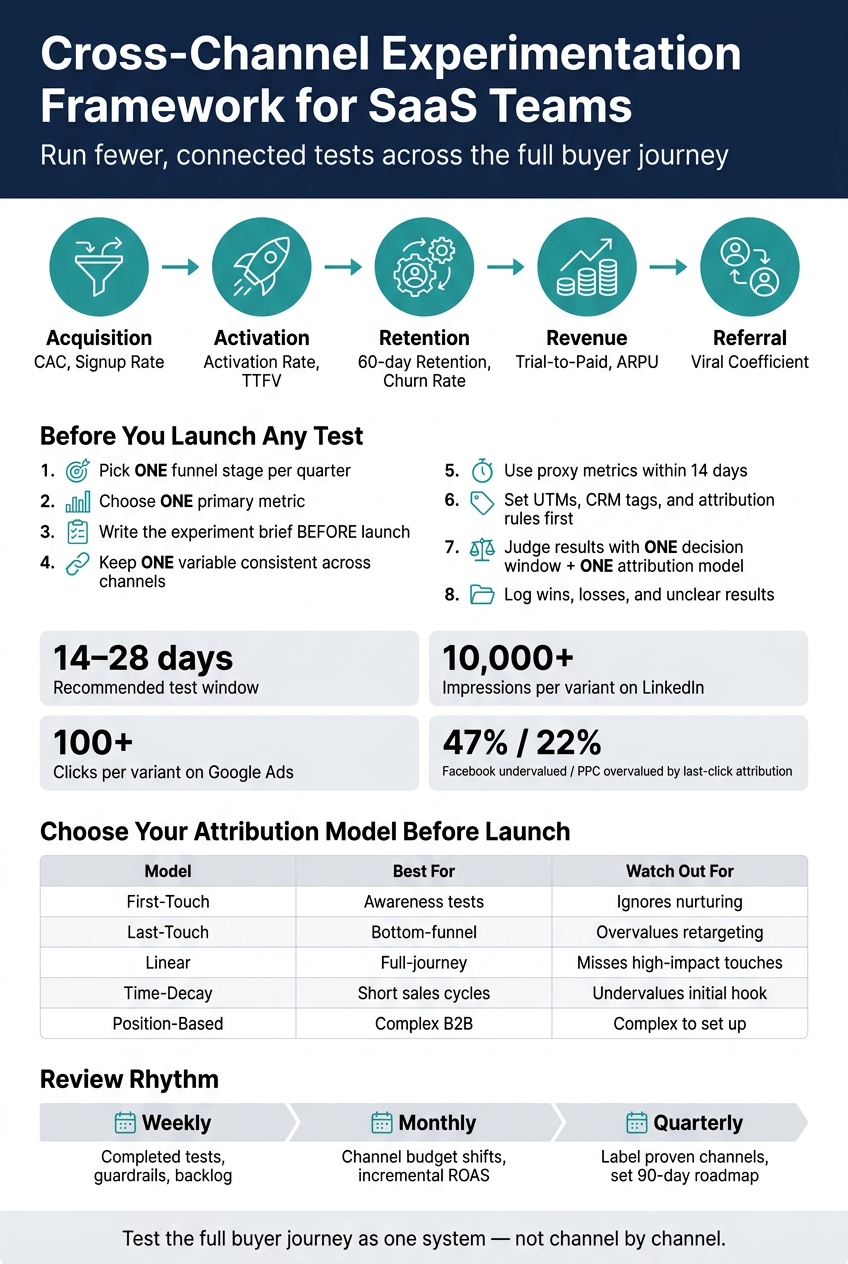
- I would pick one funnel stage per quarter: Acquisition, Activation, Retention, Revenue, or Referral.
- I would choose one primary metric tied to that stage, like trial starts, demo requests, activation rate, or trial-to-paid conversion.
- I would write the test brief before launch, including the hypothesis, audience, owner, timeline, expected lift, and stop rules.
- I would keep one variable consistent across channels, usually the message or offer.
- I would use proxy metrics within 14 days when revenue takes months to show up.
- I would set tracking first, including UTMs, CRM tags, and attribution rules.
- I would judge results with one decision window and one attribution model, not by whoever argues best after the test ends.
- I would log wins, losses, and unclear results so each test helps the next one.
A few numbers from the article stand out. Some teams use 14- to 28-day test windows. LinkedIn tests may need 10,000+ impressions per variant. Google Ads tests may need at least 100 clicks per variant. And last-click attribution can distort performance, with one cited example showing Facebook undervalued by 47% and PPC overvalued by 22%.
What this means for you: don’t run more tests. Run fewer, connected tests that follow the same idea from ad to page to email to product to sales follow-up.
Cross-Channel Experimentation Framework for SaaS Teams
How to build your cross channel marketing analytics platform within 30 minutes - NO SLIDES
sbb-itb-0a8c96a
Quick overview
| Area | What I’d do |
|---|---|
| Goal | Pick one growth outcome |
| KPI | Use one main metric |
| Scope | Focus on one funnel stage each quarter |
| Test setup | Write the brief before launch |
| Variables | Change one thing at a time |
| Channels | Keep message aligned across touchpoints |
| Measurement | Use proxy events when sales cycles are long |
| Attribution | Choose the model before launch |
| Reviews | Check weekly, monthly, and quarterly |
| Documentation | Store every result in one shared log |
In other words: this framework is less about testing tactics one by one, and more about testing the full buyer journey as one system.
Build the Foundation Before Running Tests
Before launch, lock in the rules of the game: one primary metric, guardrails, minimum expected lift, one owner, verified tracking, and stop/scale rules written in advance. That setup keeps paid, email, website, product, and sales tests pointed at the same outcome.
Choose Your Core Metrics and Funnel Stage
Start with your funnel diagnosis or find growth gaps vs competitors. Look for the biggest percentage drop across AARRR stages - Acquisition, Activation, Retention, Revenue, or Referral - and run your first experiment there.
Put simply: pick the stage where one cross-channel change can ease the biggest bottleneck.
| Funnel Stage | Practical SaaS Metrics | Focus Area |
|---|---|---|
| Acquisition | CAC, Signup Conversion Rate, Cost-per-qualified-opportunity | Traffic quality and ICP fit |
| Activation | Activation Rate, Time to First Value (TTFV), Step Completion | Reaching the "Aha Moment" |
| Retention | 60-day Retention, DAU/MAU Ratio, Churn Rate | Long-term product value |
| Revenue | Trial-to-Paid Conversion, Expansion Revenue, ARPU | Monetization efficiency |
| Referral | Viral Coefficient, Referral Participation Rate | Organic growth loops |
Stick to one funnel stage per quarter. If you're in B2B and sales cycles drag on, use proxy events like demo requests, trial activations, or MQLs to get directional signal within 14 days instead of waiting for 95% significance.
Once you've picked the stage and metric, write the experiment brief before you build any variations.
Create a Standard Experiment Brief and Growth Log
Put every experiment into one brief so the whole team can run, measure, and decide from the same record. It cuts out confusion about what you're testing, who owns it, and when the test ends.
Each brief should include these fields before launch:
- Experiment ID - a single reference for your growth log
- Hypothesis - use this format: "Because [data/observation], we believe [change] for [audience] will cause [metric] to move [direction + size] within [timeframe]"
- Channel Mix - which channels are part of the test
- Audience Segment - who is included
- Primary KPI - the one metric this test is meant to move
- Secondary KPIs - guardrails that must not slip
- Owner - one named person accountable for the full test
- Start/End Dates - use MM/DD/YYYY
- Expected Uplift - your minimum expected lift
- Stop/Scale Criteria - objective rules set before launch
Write stop and scale rules before you see a single data point. That's the part many teams skip, and it comes back to bite them.
A common kill rule is a fixed end date, often 14 to 28 days, or a guardrail breach, such as trial-to-paid conversion dropping by more than 2 percentage points for over 48 hours. A common scale rule is to make the test part of your standard play if the primary KPI hits the target uplift and all guardrails stay in range.
If the result is still unclear, log the learning and rerun only after you reach the minimum evidence threshold, such as 20 to 30 opportunities or 3 to 5 closed deals. Precommitment helps cut bias.
Use the growth log to show which tests improved one funnel metric in the last 60 days.
Do not launch until the required events and dashboards are live in production.
With the brief in place, you can build the test around a clear hypothesis.
How to Design Cross-Channel Experiments Step by Step
The next step is turning ideas into a test plan your team can actually run. That starts with the right problem, then a clear hypothesis, and then a tight setup around channels, variables, and timing. The best approach is simple: find the bottleneck first, then use market signals to figure out why it's there.
Find High-Impact Problems Using Funnel Data and Market Signals
Plan experiments based on your growth stage. Early-stage teams should focus on ICP fit and demo quality. Mid-stage teams should focus on MQL-to-SQL conversion and scoring. Late-stage teams should focus on time-to-close and net revenue retention.
Less than 30% of growth teams connect analytics data with billing or CRM data to measure LTV by acquisition channel. That leaves a big blind spot. Pull CRM and billing data together and calculate channel efficiency by dividing monthly revenue by fully loaded cost. Then look for segments where demo-to-opportunity conversion is weak.
Numbers tell you where the drop-off happens. Feedback helps explain it.
Review support tickets, sales win-loss notes, and direct customer feedback. Ask buyers what almost stopped them from signing up and what other options they looked at. When you combine funnel drop-offs with repeated objections, patterns start to show up fast. That’s usually where the best test ideas come from.
To prioritize, score each problem with the ICE framework - Impact, Confidence, and Ease - and start with the single top-priority test.
Turn Competitor Insights Into Testable Hypotheses
Once you've found the problem, competitor and market signals can help explain what's missing. Use Competitor Analysis Tool to compare your site with a competitor and spot gaps in demand, messaging, and visibility.
From there, write a tight hypothesis:
"If we [change one variable] for [specific ICP], then [proxy metric] will increase because [market insight]."
Keep one core variable the same across every channel in the test. In most cases, that's the messaging hook. If your ad says one thing, your landing page says another, and your follow-up email goes in a third direction, it becomes much harder to tell what worked.
Use the gap you found to shape one testable message or offer. After that, lock in the channels, timing, and sample targets.
Set Channels, Variables, Timing, and Sample Expectations
Keep each test clean. Change one variable at a time - audience or message, not both. That gives you a clearer read on what caused the result.
Start with channels that give you signal fast. Paid creative on LinkedIn or Google Ads, along with the landing page, usually moves faster than product-level changes. For concept-level tests, where you're comparing messaging hooks or value propositions, a 7- to 14-day window is often enough to get a reliable directional read in B2B SaaS.
For sample size, use these benchmarks:
- Aim for at least 100 clicks per variant on Google Ads
- Aim for 10,000+ impressions per variant on LinkedIn
- Those thresholds can help you reach 90%+ statistical significance
If volume is low, don't sit around waiting for closed revenue. Use proxy events like demo requests, trial starts, or MQLs as the main success metric. And tag every experiment participant in your CRM at the first touchpoint, so you can track performance across a 6- to 9-month sales cycle.
How to Execute Tests and Measure Results Correctly
Once your hypothesis, channels, and sample targets are set, execution comes down to control. You want the test to run with as few moving parts as possible. In practice, that means lining up assets across every channel before launch, not scrambling after the fact. The next three steps are the big launch calls: tracking, credit, and the line you'll use to make a decision.
Coordinate Execution Across Paid, Email, Website, and Product
Before launch, confirm that UTM parameters - utm_source, utm_medium, and utm_campaign - are captured on page load and persist through the session using sessionStorage or first-party cookies. That setup keeps the experiment visible across each touchpoint.
Your ad copy, email subject line, and landing page headline should all carry the same core message. If the promise shifts between the ad and the page, you've added a variable you never meant to test.
Set aside 15–20% of paid media spend for testing. Then use the experiment ID to connect channel data to downstream revenue.
Once everything is live, stick with one attribution lens and one decision window when you read the result.
Pick the Attribution Model That Matches the Test
The attribution model should match the question you're trying to answer. If you're testing awareness, one model makes sense. If you're testing conversion, another may fit better. That matters because last-click attribution has been found to undervalue Facebook by 47% and overvalue PPC by 22%.
| Attribution Model | When to Use | Advantages | Limitations |
|---|---|---|---|
| First-Touch | Awareness/top-of-funnel experiments | Credits the channel that created demand | Ignores all nurturing and conversion steps |
| Last-Touch | Landing page or bottom-funnel optimization | Simple; identifies the channel that drove the final converting visit | Overvalues branded search and retargeting |
| Linear | Full-journey budget analysis | Gives equal credit to every touchpoint | Rarely reflects the actual influence of high-impact touches |
| Time-Decay | Short sales cycles or promo periods | Weights recent interactions more heavily | Undervalues the initial hook that started the journey |
| Position-Based | Complex B2B sales cycles | Balances demand generation and conversion credit | Can be complex to set up and interpret correctly |
Choose the model before launch so the team doesn't end up debating credit after the test ends.
Handle Small Sample Sizes With Directional Confidence
If volume is too low for a clean split, stop chasing precision and move to a predefined directional read. Use directional confidence with a 14-day decision window, lean on proxy events like form fills, demo requests, or free trial activations, and decide whether the result clearly favors one version.
If the audience is too small for a clean A/B split, use sequential testing instead. Run one variant at a time against a steady baseline over matched time windows. That won't give you the same kind of read as a larger split test, but it does help you spot which version is pulling ahead without muddying the picture.
Turn Results Into a Repeatable Growth System
Convert Findings Into Channel and Funnel Playbooks
Once a test has a readout, turn the result into a rule your team can use again.
After launch, keep one readout per test with the same fields every time: hypothesis, variant, sample, results, guardrails, segment, and decision. That gives you one searchable record for each experiment, which makes reuse much faster. It also helps to log the losses. Failed tests stored in a shared library stop other teams from repeating the same dead end months later.
Then group your wins by funnel stage. That’s how single test results become playbooks instead of one-time lessons.
| SaaS Funnel Stage | Reusable Pattern |
|---|---|
| Acquisition | Pain-led headlines outperform outcome-led headlines for cold ICP audiences |
| Activation | Reducing activation friction increases time-to-first-value |
| Retention | Early intervention on declining engagement signals reduces churn |
| Revenue | Pricing model and upsell trigger timing affect trial-to-paid conversion |
| Referral | Both-sides rewards outperform one-sided incentives in referral participation |
Once the pattern is documented, use a fixed review rhythm to decide what ships, what scales, and what gets archived.
Run Weekly, Monthly, and Quarterly Review Cadences
Weekly, monthly, and quarterly reviews help teams turn isolated test wins into changes in budget, roadmap, and playbooks.
Use reports for context. Use readouts for decisions.
Weekly reviews should cover completed tests, in-flight guardrails, launches, and backlog priorities. Monthly reviews should move up a level and look at channel budget shifts based on incremental ROAS and lift. Quarterly reviews are the point where teams label channels as proven, update budget or rollout plans, and set the next 90-day testing roadmap.
| Feature | One-Off Cross-Channel Tests | Programmatic Experimentation System |
|---|---|---|
| Planning | Ad-hoc, gut-feel brainstorming | Structured backlog scored by ICE/RICE |
| Documentation | Scattered in Slack or individual docs | Single searchable library with standardized readouts |
| Data Integration | Siloed by channel | Cross-channel attribution with CRM tagging |
| Decision Cadence | Whenever someone checks the numbers | Weekly, monthly, and quarterly fixed reviews |
| Impact on ARR | Temporary lifts; inconsistent results | Compounding growth through repeatable playbooks |
Archive any unscored idea after 90 days.
Conclusion: A Simple Framework SaaS Teams Can Start Using Now
The framework comes down to a few habits that shouldn’t be skipped. Start with one clear business problem. Get the team aligned on one primary KPI before the test goes live. Document every experiment - wins, losses, and inconclusive results - in one central library. Use the attribution model that fits the goal of the experiment, not the one that’s easiest to pull. And treat each result as an input for the next cycle, not as a final answer.
Most experiments won’t win. That’s normal. The edge comes from speed, documentation, and cadence. Teams compound growth when they work from a shared metric, a standard readout, and a fixed review rhythm, then keep running that loop.
FAQs
How do we choose the right funnel stage first?
Start with the biggest percentage drop between two steps in your AARRR funnel. That’s the stage to tackle first.
Why? Because your weakest stage is usually the main bottleneck. Not the part that feels most fun. Not the part your team knows best. The biggest leak.
If you’re still not sure where to focus, use your company stage as a simple guide.
- Early-stage teams should focus on ICP and messaging fit
- Mid-stage teams should focus on throughput and efficiency
Then track progress with one primary metric for that stage. That keeps the team focused and makes it easier to tell if things are moving in the right direction.
What if our team doesn’t have enough test volume?
If your team doesn’t have enough traffic to get a clear result, change the plan. The goal is to avoid tests that drag on and tell you nothing.
A simple fix is to aim for bigger wins. In practice, that means increasing your Minimum Detectable Effect so the test looks for a larger lift.
You can also shift the experiment to a page or channel with more traffic. That gives you a better shot at hitting the sample size you need within four weeks.
If you still can’t reach statistical significance in that window, don’t run the test.
Which attribution model should we use?
There’s no single perfect attribution model. Every model has limits, and most of them flatten the messy, multi-channel path people take before they buy.
A better move is to put incrementality testing first, especially geo-holdout testing. For day-to-day work, connect your campaigns to your CRM so you can track full-funnel impact and measure revenue instead of stopping at clicks.
You can also use the Competitor Analysis Tool to spot growth gaps and decide which tests to run first.