
How To Validate SaaS Value Propositions With Data
Test measurable SaaS value propositions with experiments, analytics, and customer feedback to refine messaging and increase revenue.

Most SaaS companies fail to validate their value propositions with data - and it’s costing them. With customer acquisition costs rising and 58% of B2B buyers saying vendor claims are indistinguishable from competitors, relying on assumptions can hurt both messaging and revenue.
Here’s the solution: test your value proposition systematically. Start with a clear, measurable statement. Use data to validate claims through experiments, customer feedback, and analytics. Then refine and scale what works.
Key Takeaways:
- Testable Value Proposition: Focus on measurable outcomes, not vague claims.
- Metrics Matter: Tie your claims to specific data points like trial-to-activation rates or CAC payback.
- Run Experiments: Use A/B tests and paid traffic to validate messaging.
- Customer Feedback: Conduct interviews and surveys to uncover insights.
- Refine Messaging: Focus on what resonates most and differentiate from competitors.
This process ensures your SaaS product stands out, resonates with customers, and drives measurable results.
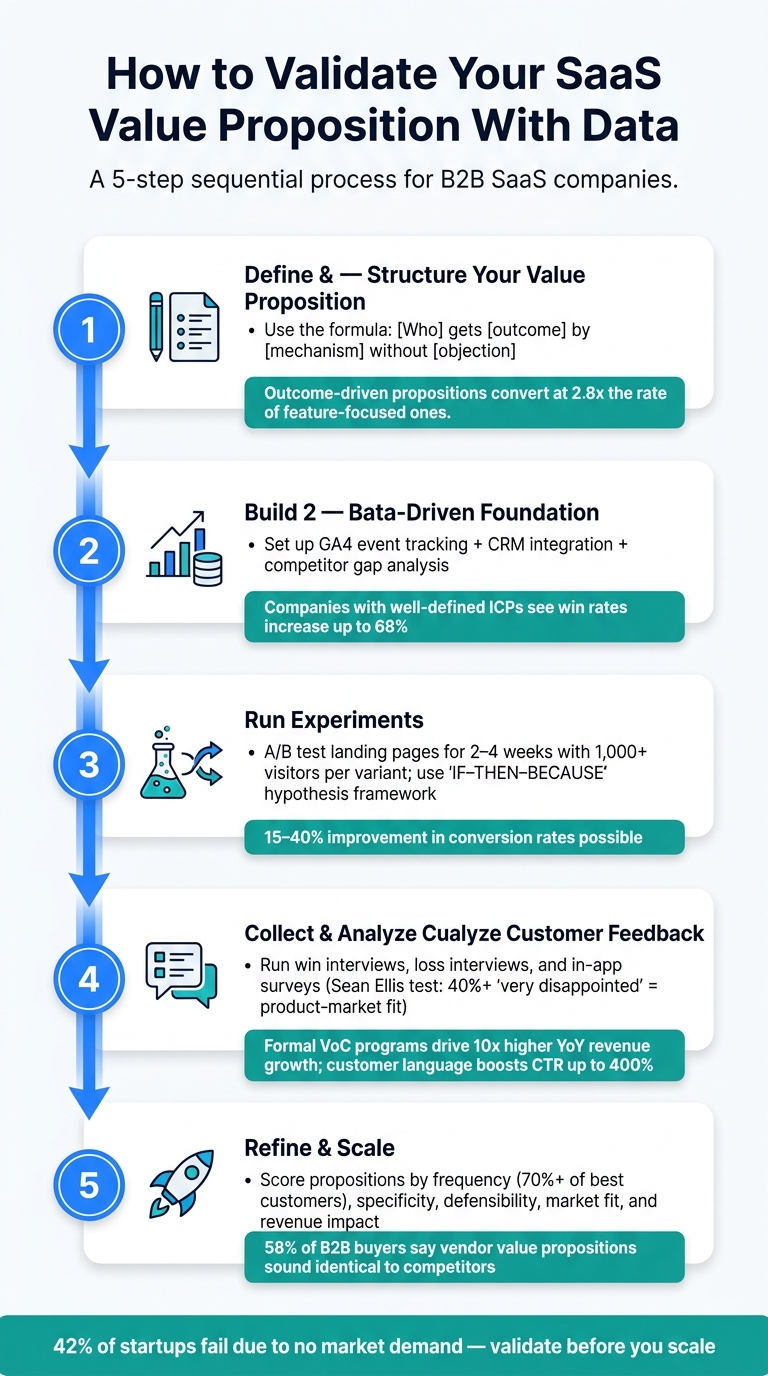
How to Validate Your SaaS Value Proposition With Data: 5-Step Framework
How to improve your value proposition with message testing
sbb-itb-0a8c96a
Step 1: Define and Structure Your SaaS Value Proposition
Start by validating a clearly defined value proposition. This begins with crafting a clear, measurable statement. Let’s break down what your SaaS value proposition should include.
What Is a SaaS Value Proposition?
A SaaS value proposition answers one critical question: why should a buyer choose your product to achieve a specific outcome instead of any other option? This serves as the backbone for all your product messaging and ensures internal alignment.
Here’s a practical way to test it. As the team at Tracsio explains:
"The best value proposition is not the one that sounds polished in the founder's head. It is the one the buyer can repeat without you in the room."
If your message becomes unclear when a buyer tries to share it with others, it’s too complicated. A strong value proposition includes these core elements: a well-defined Ideal Customer Profile, a pressing problem, a measurable outcome, a distinct mechanism, a removed tradeoff, and a timely trigger.
Once you’ve outlined your proposition, the next step is making it measurable.
How To Make Your Value Proposition Testable
For a value proposition to be testable, vague claims must be replaced with specific, measurable outcomes. Words like "faster" lack meaning unless backed by specifics. For instance, saying "40% faster" or "in one session instead of a week" gives you something concrete to validate.
Here’s a formula to guide you: "[Who] gets [outcome] by [mechanism] without [objection]."
For example, instead of saying "AI-powered workflow automation", try this: "Your support team resolves tickets 40% faster without increasing headcount." This version identifies the buyer, promises a measurable improvement, and addresses a common concern - all in one sentence. Outcome-driven propositions like these convert at 2.8 times the rate of feature-focused ones.
A quick gut-check: read your value proposition as if you were your closest competitor. If it still applies to them, you’ve created a category claim - not a differentiator.
Choosing Key Metrics for Validation
Tie your measurable claims to specific data by selecting metrics that align with your promises. If your value proposition highlights faster time-to-value, focus on metrics like trial-to-activation rate. If it promises cost savings, track metrics such as CAC payback periods and LTV:CAC ratios.
| Metric Category | Specific Examples | Validation Focus |
|---|---|---|
| Financial | Net New ARR, CAC Payback, LTV:CAC | ROI and business impact |
| Operational | Time-to-value, error reduction | Workflow efficiency claims |
| Engagement | CTR, reply rate, demo acceptance | Message clarity and resonance |
| Product | Activation rate, feature adoption | Product promise delivery |
Here’s a real-world example. In April 2026, a B2B SaaS client working with daydream built their entire Unique Value Proposition (UVP) around "time-to-first-value in under 48 hours." After just one week of testing landing page messaging and updating product copy, their trial-to-activation rate improved by 28%.
The takeaway? Pick a single key metric that directly supports your main claim, run a short 2–4 week experiment, and let the results show whether your proposition resonates.
Step 2: Build a Data-Driven Foundation
Once you’ve established a testable value proposition with clear metrics, the next step is to implement a tracking system that validates your claims. Without the right tools to collect and analyze data, you're left making assumptions instead of confirming results.
Set Up Analytics for Behavior Tracking
For SaaS teams, Google Analytics 4 (GA4) is an essential starting point. Unlike older versions that focused on session volume, GA4 emphasizes event-based tracking. This means you can monitor specific user actions - like form submissions, button clicks, or trial signups - ensuring your value proposition is driving meaningful engagement, not just traffic.
To make the most of GA4, configure custom conversions tied to key SaaS milestones. For example, track events like "Trial Signup Completed", "Activation Milestone Reached", or "Upgrade Event." These metrics reveal whether your messaging is effectively guiding users through the funnel. SaaS teams that implement disciplined GA4 setups often achieve trial-to-paid conversion rates between 15% and 25%.
However, relying solely on client-side tracking can lead to underreported events. To ensure precision, integrate server-side tracking. Additionally, connecting GA4 to your CRM (such as Salesforce or HubSpot) allows you to link anonymous web behavior to specific accounts and actual revenue outcomes. Once your tracking system is in place, you can dive deeper into the data to uncover audience-specific insights.
Segment and Analyze Audience Data
Raw data is only useful when you break it down into actionable segments. Create dashboards that analyze engagement based on factors like industry, company size, or job title. This segmentation helps identify which messaging resonates most and informs the development of your Ideal Customer Profile (ICP).
Why does this matter? Companies with well-defined ICPs see account win rates increase by up to 68%. To build a strong ICP, pull insights from multiple sources: use CRM data for firmographics, conduct customer interviews to gather technographics, and review support tickets or online feedback to spot recurring pain points. This multi-source approach highlights which audience segments are most likely to activate and which are at risk of churn before realizing your product’s value. These insights allow you to refine your value proposition and confirm which messaging drives the outcomes you’ve promised. Once you’ve fine-tuned your internal data, it’s time to evaluate your position within the competitive landscape.
Using Competitor Analysis Tool to Find Messaging Gaps
Understanding how your messaging stacks up against competitors is crucial. Tools like Competitor Analysis Tool let you directly compare your website to others, highlighting demand gaps, messaging gaps, and visibility gaps. In just a couple of minutes, you can uncover actionable insights.
Why is this important? A positioning gap - when no competitor effectively addresses a specific buyer segment - can be a major opportunity. As one framework explains:
"A feature checklist tells you to copy what competitors have. A real gap analysis tells you to build what the market wants but nobody is delivering. One leads to parity. The other leads to differentiation." - Compttr
Step 3: Run Experiments To Test Your Value Proposition
Now that you've built a solid foundation with data and identified growth gaps, it’s time to test your value proposition with real users. This step is all about running targeted experiments to find out what truly connects with your audience.
Design A/B and Landing Page Tests
When running A/B tests, focus on changing just one variable at a time. For example, keep the visuals, layout, and call-to-action (CTA) the same, but test different copy. This way, you can pinpoint whether the messaging is driving the results rather than a design tweak.
A helpful framework for structuring your tests is the "IF–THEN–BECAUSE" hypothesis. For example: IF we change the headline to emphasize ROI, THEN sign-ups will increase BECAUSE it speaks to the audience's financial concerns.
When deciding what to test, try comparing outcome-focused messaging (e.g., "Increase revenue by 30% faster") to problem-focused messaging (e.g., "Stop losing leads with manual follow-ups"). Outcome-focused messages often resonate with high-intent buyers, while problem-focused ones appeal to those frustrated with their current solutions. To avoid bias, segment your tests to target new visitors only.
Run these experiments for 2–4 weeks, ensuring each variant gets at least 1,000 visitors. This approach can lead to a 15–40% improvement in conversion rates and a 25–40% reduction in bounce rates.
Run Paid Traffic Experiments
Paid ads are a quick way to test messaging and gather feedback in just a few days, without requiring extensive engineering work. However, keep your testing budget separate from performance campaigns. Mixing the two can create pressure to focus on immediate Return on Ad Spend (ROAS), which can interfere with your learning process. Leading B2B teams typically allocate 15–20% of their paid media budget specifically for testing.
To make the most of these experiments, define your Ideal Customer Profile (ICP) clusters and analyze competitor websites and tailor messages to each segment. One effective strategy is the "3x3" framework - test three ICPs with three distinct hooks each. For example, you might compare pain-based hooks (e.g., "Still spending six figures on untraceable channels?") with aspiration-based ones to see which drives more qualified clicks.
One critical detail often overlooked is ensuring your ad and landing page messaging align. If your landing page headline doesn’t deliver on the promise made in the ad, users may bounce. For instance, Campaign Monitor saw a 31.4% increase in trial conversions when they used dynamic text replacement to match their landing page headlines with their ad copy. Fixing mismatched headlines is one of the easiest ways to improve experiment success.
"Within two weeks, you should probably know if you set this up right." - Sam McLellan, VP of Growth, MAVAN
Finally, connect the insights from these experiments to revenue outcomes for a clearer picture of their impact.
Analyze Experiment Results
Testing isn’t just about collecting data - it’s about finding actionable insights. After running your experiments, declare a winner only when both conversion rates and secondary metrics support the result. Don’t rely solely on click-through rates; use conversion rates as your primary metric and validate findings with secondary indicators like bounce rates, time on page, and lead quality scores. Make sure your results reach a 95% confidence level (p-value < 0.05) before making decisions.
The real payoff comes when you tie test results to revenue. Link your experiment data to your CRM to track downstream outcomes like Net New ARR, pipeline value, and sales-qualified leads (SQLs). For example, TripMaster’s systematic testing in 2025–2026 added $504,758 in Net New ARR within a year. Similarly, Playvox achieved a 10x reduction in Cost Per Lead (CPL) by focusing on revenue-driven experiments.
To build a strong business case, calculate the financial impact of your winning variant. For instance, if your conversion rate improves from 2.5% to 3.5% on 50,000 monthly visitors, estimate the projected annual revenue increase. This data can justify scaling the successful messaging across your key assets.
| Metric Type | Metric | Target Benchmark |
|---|---|---|
| Primary | Conversion Rate | 15–40% improvement over baseline |
| Secondary | Bounce Rate | 15–30% reduction |
| Secondary | Time on Page | 30–50% increase |
| Quality | Lead Quality Score | 10–15% improvement |
| Statistical | Confidence Level | 95% (p-value < 0.05) |
Step 4: Collect and Analyze Customer Feedback
Experiments can show you what’s working, but they rarely explain why. That’s where customer feedback comes in. When customers share their experiences in their own words, it provides context to the numbers - often uncovering insights you might otherwise miss. This qualitative feedback works hand-in-hand with the quantitative data from your experiments.
Conduct Customer Interviews and Surveys
Organize your interviews into three key types to better understand your value proposition’s strengths and weaknesses:
- Win interviews: Focus on why new customers chose your product and what almost stopped them.
- Switch risk interviews: Talk to long-term customers to identify potential reasons they might leave.
- Loss interviews: Dive into why prospects chose a competitor by performing a competitive analysis or stuck with the status quo.
During these interviews, avoid asking for opinions. Instead, use behavioral questions like, “Walk me through your evaluation process.” This approach gets to the heart of their decision-making. A helpful follow-up is the "So What?" test. Keep digging deeper into feature mentions to uncover the real benefit. For instance: “Automated invoicing” → “Get paid faster” → “Better cash flow” → “Never worry about payroll”.
This method can deliver big results. Companies with formal Voice of Customer (VoC) programs report 10x higher year-over-year revenue growth. Plus, incorporating customer language directly into your marketing copy can boost click-through rates by up to 400%.
Use In-App Surveys for Real-Time Feedback
In-app surveys are a great way to capture feedback while users are actively engaging with your product. Timing is crucial - send surveys only after users have had at least two weeks of active use or completed a core workflow twice. Asking too early risks getting feedback from users who haven’t fully experienced the product yet.
Keep surveys short and focused, with 8–12 targeted questions. A standout question is the Sean Ellis test: “How would you feel if you could no longer use this product?” If 40% or more say “very disappointed,” it’s a strong sign of product-market fit. Pair this with an open-ended question like, “How would you describe this product to a colleague?” to capture the exact words users naturally use.
In-app surveys tend to outperform email surveys, with response rates averaging 25–30% compared to the 15–25% typical for email. Segmenting survey results by user role, company size, or acquisition channel can help you pinpoint which groups your value proposition resonates with most.
“The words your best users choose to describe your benefit should become your marketing copy.” - Johannes, CEO & Co-Founder, Formbricks
These insights can help refine your earlier hypotheses and guide your next steps.
Identify Trends in Feedback
Organize recurring themes from interviews, surveys, and reviews into actionable insights. Tag patterns like “approval bottleneck,” “manual workaround,” or “EHR integration,” and note both their frequency and intensity. For example, a pain point mentioned by 30% of respondents with high intensity is more critical than a minor annoyance that’s widely mentioned.
Next, compare these themes with your experimental data. When qualitative feedback aligns with quantitative results, you have strong validation. When they don’t match, you’ve likely found an area worth exploring further. Jake McMahon, Founder of ProductQuant, puts it this way:
“because that’s where the assumptions are hiding.” - Jake McMahon, Founder of ProductQuant
For instance, in early 2026, ProductQuant analyzed 60 sales call transcripts for a healthcare SaaS product. They discovered that a feature thought to be an 88% priority - EHR integration - was actually a deal-breaker for just 13% of prospects. Meanwhile, “paper digitization,” which came up in 57% of conversations, wasn’t even on the product roadmap. This insight led the team to shift 23 percentage points of their go-to-market budget.
When you treat feedback as structured data rather than anecdotal stories, you uncover insights that can reshape your strategy. Combine these findings with your experimental data to refine your value proposition and make smarter decisions.
Step 5: Refine and Scale Your Best Value Propositions
Now that you've gathered insights from experiments and customer feedback, it’s time to fine-tune and expand the value propositions that show the most promise. Use the validated data and feedback to decide which ideas deserve further investment and roll them out across all customer touchpoints.
Prioritize High-Impact Value Propositions
Focus on scaling value propositions that have the potential to make a lasting impact. These should meet three key criteria: they’re frequently mentioned by your top customers, they deliver measurable outcomes, and they highlight something your competitors can’t claim. If your message could easily fit on a competitor’s homepage, it’s not a differentiator - it’s just a generic category description.
"The strongest SaaS differentiators in crowded markets aren't features - they're structural. A different data model, a different pricing structure, a different target workflow." - ValidateThat Guide
Here’s a scoring framework to help rank your options:
| Metric | High Potential Signal | Data Source |
|---|---|---|
| Frequency | Mentioned by 70%+ of best customers | Win interviews |
| Specificity | Can be quantified (e.g., "Reduce costs by 40%") | Customer data |
| Defensibility | Structural or architectural difference, unclaimed | Competitor analysis |
| Market Fit | 40%+ cluster around a switching trigger | User surveys |
| Revenue Impact | High correlation with Net New ARR | CRM data |
Also, create a "Burn List" - a collection of overused phrases like "streamline workflows" or "all-in-one platform" that competitors frequently use. If three or more competitors already rely on the same phrase, eliminate it from your messaging.
Update Core Assets with Validated Messaging
Once you’ve identified your strongest value propositions, start applying them consistently across your organization. Begin internally, ensuring alignment among your team. As Kassandra Rodriguez, Founder and Brand Strategist at 1st House Branding, explains:
"If you proceed with a value proposition before you're aligned in the conference room, you're far more likely to fail once you're outside the conference room."
After internal alignment, update your external materials using a structured approach. Tailor messaging for each stage of the funnel:
- Awareness-stage content (e.g., blog posts, social ads): Focus on the problem your product solves.
- Consideration-stage content (e.g., case studies, webinars): Highlight measurable results.
- Decision-stage content (e.g., pricing pages, demos): Emphasize what sets you apart and address perceived risks.
Before publishing, test your messaging. Show it to someone unfamiliar with your product for five seconds. If they can’t quickly understand what you do and who it’s for, simplify the message. A strong value proposition should also be easy to repeat - if a champion within a target account can’t explain it clearly to a decision-maker, it needs refining.
Benchmark Competitor Messaging Over Time
Refining your messaging isn’t a one-and-done task. Competitor positioning evolves quickly, and what differentiates you today could become standard in just a few months. Since messaging shifts faster than product updates, regular benchmarking is crucial.
Conduct a competitive review every 90 days to stay ahead. Tools like Competitor Analysis Tool can help by directly comparing your website to competitors. These tools highlight gaps in messaging, demand, and visibility - revealing where rivals are gaining ground and where you can carve out a unique narrative.
Set a 6-month review cadence to reassess whether your main claims are still unique. If competitors start using your language, it’s a sign to dig deeper into what makes your offering structurally different and find new ways to stand out. By continuously refining your messaging with data-driven practices, you can ensure your SaaS value proposition remains a standout in the market.
Conclusion: Using Data To Build a Stronger SaaS Value Proposition
Building and validating a SaaS value proposition isn’t something you do once and forget. It’s an ongoing process that requires constant attention. This guide walks you through the essentials - from crafting a testable proposition to fine-tuning your messaging based on real-world data. Each step connects to the next, forming a feedback loop that strengthens your messaging and improves your results.
Here’s something to think about: 58% of B2B buyers believe vendor value propositions sound identical to their competitors’, and 42% of startups fail because there’s no market demand. These numbers show how crucial it is to stand out with a value proposition that truly resonates.
One key idea to keep in mind is positioning debt - the gap between what your team says about your product and what your customers actually believe. If left unchecked, this gap can grow quickly and hurt your ability to connect with your market. To avoid this, make regular use of tools like win/loss interviews, competitor benchmarking (try tools like Competitor Analysis Tool), and real-time review monitoring. Together, these steps help ensure your message stays aligned with what your audience values.
"The version [of a value proposition] that survives contact with actual buyers is the version that ships." - Stratridge
FAQs
What’s the fastest way to turn my value proposition into a measurable claim?
The fastest approach is to run a "pain math" exercise - this means translating customer frustrations into tangible numbers, like wasted time, increased errors, or lost revenue. Pinpoint a key metric and establish a clear benchmark for success, such as reduced costs or improved efficiency. Capture these details in an experiment brief, then test your value proposition through focused landing pages or outreach campaigns.
What is the first metric I should use to validate my value proposition?
When validating your idea, behavioral commitment should be your go-to metric. This means looking for tangible actions from your audience, like joining a paid waitlist, making a $1 pre-payment, or signing a letter of intent. These actions reflect genuine interest and intent, giving you a clear signal of demand.
Here’s how to approach it:
- Willingness to pay: Track conversion rates for offers such as early access programs or paid pilot opportunities. If people are willing to spend money upfront, it’s a strong indicator of interest.
- Targeted traffic conversion: Aim for a conversion rate between 5–15%. This range suggests that your messaging is resonating with the right audience.
- Pain frequency: Make sure your target users experience the problem often enough that they’ve already resorted to workarounds. A frequent pain point means they’re more likely to seek and pay for a solution.
These steps help you gauge whether your idea addresses a real problem and if users are ready to act on it.
How do I know if test results are real or just noise?
When evaluating interest, actions speak louder than words. Look for behavioral signals that demonstrate real commitment, such as:
- $1 pre-payments: Even a small financial commitment shows genuine intent.
- Signed Letters of Intent (LOIs): These indicate a willingness to formalize interest.
- Paid pilots: Nothing validates interest like someone paying to try your solution.
Set Clear Criteria Before Testing
Before diving into any test, clearly define your pass/fail criteria. This ensures you can evaluate results objectively and avoid being swayed by ambiguous outcomes.
Use "Fake Door" Tests to Measure Interest
A "Fake Door" test can be a powerful way to gauge real interest. For example, you might create a landing page for a product or feature that doesn’t exist yet. By tracking how many people click or sign up, you can measure actual demand without building anything upfront.
Avoid Hypotheticals - Focus on Real Actions
Rather than asking hypothetical questions about what someone might do, dig into their past behavior. Ask questions like:
- "Have you ever tried solving this problem before?"
- "What workarounds have you used in the past?"
These kinds of questions provide far more reliable insights than guesses about future actions.
Ensure a Sufficient Sample Size
To draw meaningful conclusions, you need enough data. For example, aim for at least 200 visitors to a test page or experiment. A larger sample size reduces the risk of basing decisions on outliers or random noise.
By focusing on actions over words and using structured, data-driven approaches, you can make more informed decisions about product validation and interest levels.