
How Keyword Gap Analysis Boosts SaaS Growth
Identify competitor keywords you miss, prioritize high-intent opportunities, and map content to buyer stages to drive SaaS growth.

Keyword gap analysis helps SaaS companies grow by identifying search terms competitors rank for that you don't. This process reveals missed opportunities to attract potential customers, especially those searching for solutions to specific problems. Many SaaS businesses focus on broad, high-volume keywords but overlook high-intent queries like "why is my churn rate increasing", which are more likely to convert.
Key takeaways:
- 91% of web content gets zero organic traffic, often due to poor keyword targeting.
- SaaS websites typically cover only 10–15 pages on 2–3 topics, leaving gaps in the buyer journey.
- Competitors dominate high-intent queries, capturing traffic and demand you miss.
By analyzing competitors' keyword rankings, you can:
- Find gaps where they rank, and you don't.
- Prioritize high-ROI keywords based on search volume, ranking difficulty, and intent.
- Align content with buyer needs at every stage of the funnel (awareness, consideration, decision).
This approach isn't just about SEO; it aligns your content with how buyers search, turning missed keywords into growth opportunities.
SaaS Growth Problems Caused by Keyword Gaps
Low Visibility on High-Intent Keywords
Many SaaS companies focus on high-volume, broad keywords like "project management software" or "CRM platform." While these terms may seem appealing, they often fail to convert effectively. Meanwhile, competitors often dominate lower-volume, high-intent queries - searches made by buyers actively seeking solutions to specific frustrations.
The difference in click-through rates (CTR) between ranking positions is massive. For example, CTRs can be 10× higher between position 10 and position 3, and 5× higher between position 3 and position 1. If your competitors are ranking at the top for queries that your potential buyers are using, your visibility drops significantly - right when those buyers are ready to act.
Another issue? Format mismatches. Even if you’ve covered a topic thoroughly in a blog post, it won’t rank if Google prefers a different format, like a comparison table or checklist. These gaps in visibility often translate into broader challenges with capturing demand.
Missed Demand Opportunities
When your keywords don’t rank, you’re not just missing traffic - you’re losing out on validated demand.
Competitors that consistently rank for keywords you overlook are capturing more than clicks; they’re securing a proven source of interest. The most damaging gaps often occur during the "problem stage." For instance, a prospect searching for "why is my churn rate increasing" isn’t casually browsing - they’re actively seeking a solution and may be days away from making a purchase. If your content isn’t there to meet them, competitors will step in, leading to stagnant growth and greater dependence on paid advertising.
"Keyword gap analysis is the single highest-ROI exercise I run on every new project. Before you write a single article, you should know exactly which queries your top 3 competitors rank for that you don't. Anything else is guessing." - Younes Lamnabhi, Founder of Ranki.io
Messaging That Does Not Match How Buyers Search
Even when SaaS companies produce plenty of content, they often miss the mark by focusing on how they describe their product rather than how buyers describe their problems. This disconnect can lead to high bounce rates and low conversions. Visitors land on your page, realize it doesn’t address their needs, and leave.
This issue is especially common when companies prioritize solution-aware terms like "best email automation tool" while neglecting problem-aware queries such as "why are my emails going to spam". Another common oversight? Comparison content. Without pages like "X vs. Y" or "alternatives to X", SaaS companies fail to engage prospects in the critical final evaluation stage.
"If you're not in that conversation [comparison and benchmark content], you don't exist to them." - GetContentGap
Fixing these gaps isn’t just about improving SEO - it’s about aligning your messaging with the buyer’s journey. By understanding where your audience is in their decision-making process, you can create content that resonates and drives results.
How to Find Keywords That Actually Convert: Keyword Research for SaaS
How Keyword Gap Analysis Works for SaaS Companies
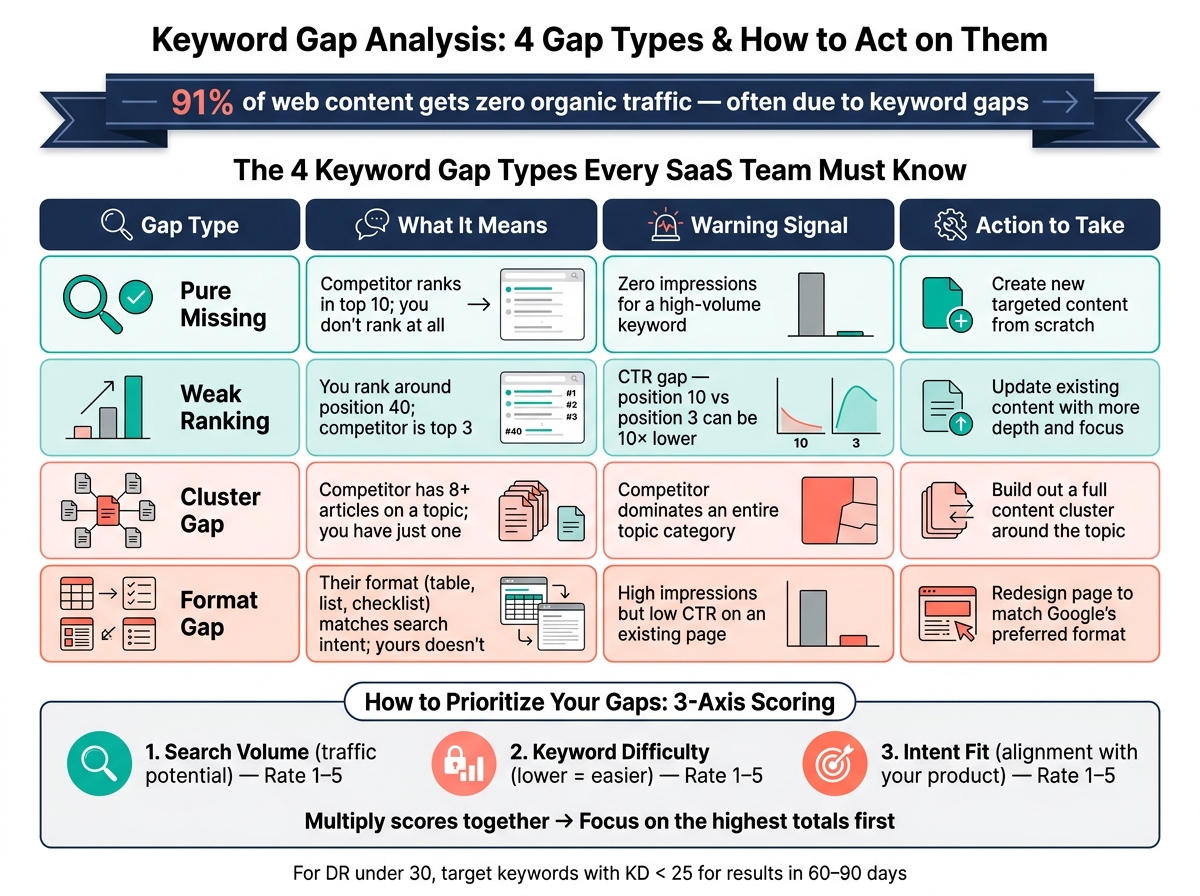
Keyword Gap Analysis: Types, Signals & Content Actions for SaaS Growth
Choosing the Right Competitors to Analyze
When SaaS teams start analyzing competitors, they often aim straight for the industry giants - names like HubSpot or Salesforce. But this approach can lead to skewed results. Instead, focus on competitors with similar levels of authority. Start by creating two lists:
- 3–5 direct competitors (the ones you actually lose deals to).
- 3–5 content or SERP competitors (sites ranking for your target keywords, even if they’re not direct business rivals - think G2, Reddit, or niche blogs).
To keep comparisons meaningful, stick to competitors with a Domain Rating within ±20 points of your own.
"Your real search competitors are rarely who you think they are." - Ramona Sukhraj, HubSpot
An efficient way to identify SERP competitors is by searching your top 10 target keywords in an incognito browser window. Look for domains that repeatedly show up. Often, you’ll find unexpected players quietly attracting the traffic you want. Once you have a well-rounded competitor list, you can dive into comparing keyword performance.
Running a Keyword Gap Comparison
With your list of competitors ready, the next step is to compare keyword rankings to uncover gaps. Focus on keywords where competitors rank in the top 10–20, but your site is either absent or ranks poorly.
Organize these findings into clear categories:
| Gap Type | What It Means | What to Do |
|---|---|---|
| Pure Missing | Competitor ranks in the top 10; you don’t rank at all | Create new targeted content |
| Weak Ranking | You rank poorly (e.g., position 40), competitor is top 3 | Update your content with more depth and focus |
| Cluster Gap | Competitor has 8+ articles on a topic; you have just one | Build out a full content cluster |
| Format Gap | Their format (e.g., table, list) aligns with search intent; yours doesn’t | Redesign your page to match what Google favors |
Beyond traditional rankings, also check where competitors show up in AI-generated answers on platforms like ChatGPT or Perplexity. By early 2026, only 38% of AI Overview citations came from Google’s top 10 results - down from 76% previously. This shift highlights the growing importance of visibility in AI answers, which is becoming increasingly independent of organic rankings.
Filtering and Prioritizing Keyword Opportunities
Once you’ve categorized your keyword gaps, the next challenge is prioritizing them. A raw keyword gap list can include hundreds of terms, but not all are worth pursuing. Focus on those with the highest potential for growth. Use a 3-axis scoring system to evaluate each keyword on a scale of 1–5:
- Search volume: How much traffic the keyword could bring.
- Keyword difficulty: Lower scores mean easier to rank for.
- Intent fit: How well the keyword aligns with your product.
Multiply these scores together and focus on the highest-ranking opportunities.
Keywords with commercial or transactional intent should top your list. Phrases like “vs,” “alternatives,” or “pricing” often signal that a buyer is close to making a decision. These gaps are more likely to translate directly into leads or sales. Considering that over 90% of web pages get zero organic traffic from Google, being selective isn’t just practical - it’s essential. By following this structured approach, you can turn raw keyword data into a focused plan for growth.
sbb-itb-0a8c96a
Turning Keyword Gaps into a Growth Plan
Prioritizing Keywords for Maximum Impact
After analyzing your competitors' keywords, zero in on the gaps that promise the highest return on investment (ROI). To do this, use a 3-axis scoring system: evaluate search volume, ranking difficulty, and intent fit - each rated on a 1–5 scale - and multiply the scores together. This method helps pinpoint your top 30 high-ROI keyword opportunities.
"The opportunities that move the business are usually mid-tail queries with clear commercial intent (comparison, alternative, 'vs,' pricing, 'for [vertical]')." - Seeto
For websites with a Domain Rating (DR) below 30, focus on keywords with a Keyword Difficulty (KD) under 25. These terms typically yield results within 60–90 days, allowing you to build momentum while working toward ranking for more competitive keywords.
Once scored, categorize your keyword gaps into three groups:
- Quick wins: High impact with minimal effort.
- Long-term clusters: High impact but require more effort.
- Noise: Low impact - skip these entirely.
With these priorities in place, the next step is matching each keyword to the right content type and buyer journey stage.
Mapping Keywords to Content and Funnel Stages
Understanding keyword intent helps you determine where a buyer is in their journey and what type of content will resonate most.
| Funnel Stage | Intent Type | Example Query | Recommended Content Format |
|---|---|---|---|
| TOFU | Awareness | "How to reduce churn" | Educational guides / Blog posts |
| MOFU | Consideration | "Best CRM for startups" | Listicles / Comparison tables |
| BOFU | Decision | "[Competitor] alternatives" | Comparison landing pages |
| BOFU | Transactional | "[Product] pricing" | Pricing page optimization |
Each keyword should be tied to a dedicated page that aligns with its funnel stage. This approach prevents internal competition and avoids the "consideration chasm", where buyers lack the detailed resources they need to confidently choose your product.
Keyword mapping isn't just about content - it also provides insights to fine-tune your product, pricing, and overall positioning.
Using Keyword Gaps to Refine Product, Pricing, and Positioning
Keyword gaps can highlight unmet market needs. For example, if competitors rank for phrases like "project management tool for construction teams" or "CRM with per-project pricing", this signals demand that your product might not yet address.
Pricing-related queries are particularly revealing. If search terms or competitor reviews frequently mention frustrations with per-seat fees or hidden costs, it could point to an opportunity to adjust your positioning. Sometimes, you don’t need to overhaul your product - simply clarifying your messaging can bridge the gap.
"A feature checklist tells you to copy what competitors have. A real gap analysis tells you to build what the market wants but nobody is delivering." - Compttr
When competitors dominate niche searches like "[your category] for healthcare", it suggests both a content gap and a potential market expansion opportunity. At their core, keyword gaps serve as a real-time roadmap of unmet demand, offering insights far more reliable than internal assumptions about buyer priorities.
Using Competitor Analysis Tool to Simplify Keyword Gap Analysis
Keyword gap analysis plays a crucial role in addressing SaaS growth challenges, but doing it manually can feel like an uphill battle. That’s where the Competitor Analysis Tool steps in. Designed specifically for SaaS founders, this tool transforms complex keyword data into clear, actionable insights. It doesn’t just help you identify gaps - it helps you act on them.
Finding Keyword Gaps Quickly
This tool compares your website with a competitor’s in less than two minutes, highlighting visibility, demand, and messaging gaps. Forget juggling spreadsheets; instead, you get a prioritized list of missed opportunities, complete with context on why they matter. It’s a smarter, faster way to uncover areas where your strategy might be falling short.
Turning Insights into Growth Actions
Spotting keyword gaps is only part of the equation. The real value lies in what comes next: actionable recommendations tailored to your findings. Whether it’s identifying the best keywords to target, refining your messaging, or addressing a positioning gap, the tool helps you focus on what will deliver the biggest impact.
For SaaS founders juggling countless priorities, this approach can be the difference between a growth plan that takes off and one that never moves past the planning stage.
Conclusion: Growing Your SaaS with Keyword Gap Analysis
SaaS growth often stalls when your target audience struggles to find your product. A keyword gap analysis helps bridge that gap by pinpointing where your visibility is lacking and offering actionable insights to address it. Your competitors' rankings highlight queries with proven demand and conversion potential. By identifying where they succeed and you don’t, you can replace guesswork with a clear, data-driven strategy.
This strategy isn’t set in stone - markets shift, new search queries arise, and the way buyers describe their needs evolves. To stay ahead, it’s essential to revisit your gap analysis every quarter. This ensures your content and messaging stay in tune with what your audience is searching for right now.
FAQs
Which competitors should I analyze for keyword gaps?
When analyzing competitors, it’s essential to zero in on 2 to 5 that are closely aligned with your niche and audience. These should include direct competitors - businesses with comparable domain authority and a similar number of indexed pages. Additionally, consider industry blogs or content hubs that rank for the keywords you’re targeting.
Why avoid sites like Wikipedia or massive e-commerce platforms? Their overwhelming authority can distort your analysis and make it harder to extract meaningful insights. By focusing on the right competitors, you’ll gain actionable data that can directly contribute to SaaS growth.
How do I score and pick the best keywords to target first?
When assessing keywords, focus on three key factors: search volume, keyword difficulty, and search intent. By scoring each of these on a 1-5 scale, you can create a simple system to prioritize keywords that offer the best opportunities. Here's how it works:
- Search Volume: Look for keywords with a healthy number of searches per month. Higher volume indicates more potential traffic.
- Keyword Difficulty: This measures how competitive a keyword is. Aim for keywords with a manageable difficulty score - ones where you have a realistic chance of ranking.
- Search Intent: Make sure the keyword aligns with what your target audience is actually looking for. Intent matters more than volume if the keyword doesn’t match user needs.
Once you score each factor, multiply the scores together to rank keywords. This method helps you focus on high-volume keywords that are relevant to your audience and not overly competitive.
Look for Gaps in Competitor Rankings
A great way to uncover opportunities is by analyzing your competitors. Identify keywords where they rank in top positions, but the difficulty score is relatively low. These represent "low-hanging fruit" where you can compete effectively.
Group Keywords for Efficiency
To streamline your content creation, organize keywords by shared intent or topic. This approach allows you to create clusters of related content, improving your site’s authority on specific subjects and boosting growth potential. By grouping keywords, you not only save time but also create a more cohesive content strategy.
How often should I rerun keyword gap analysis?
For industries that evolve quickly, such as SaaS, it's a good idea to perform keyword gap analysis every quarter. Additionally, check monthly for "Striking Distance" keywords - those that are just shy of ranking on the first page. If you're in a more stable niche, conducting this analysis every six months should suffice. Keeping up with regular updates ensures you can stay ahead of the competition and seize fresh opportunities as they arise.