
Long-Tail Keywords for Niche SaaS Markets
How niche SaaS can use long-tail keywords to target buyer intent, lower competition, and boost conversions with focused content clusters.

Long-tail keywords are specific, multi-word search phrases like "CRM for small law firms with built-in billing" that help niche SaaS companies attract high-intent customers. These keywords account for over 91% of all web searches and convert 2.5x higher than broad terms. For smaller SaaS businesses, focusing on long-tail keywords offers less competition, better targeting, and higher conversions without requiring massive budgets.
Key Takeaways:
- Why They Work: Long-tail keywords target users with clear intent, ready to convert.
- Benefits: Lower competition, higher conversion rates, and reduced reliance on high-traffic pages.
- How to Use Them: Identify customer pain points, use tools like Semrush or Ahrefs, and create content clusters to rank effectively.
- Success Metrics: Focus on search volume (50–500), keyword difficulty (under 30), and high CPC values (>$5.00).
This guide walks you through identifying and implementing long-tail keywords to drive targeted traffic and conversions for your SaaS business.
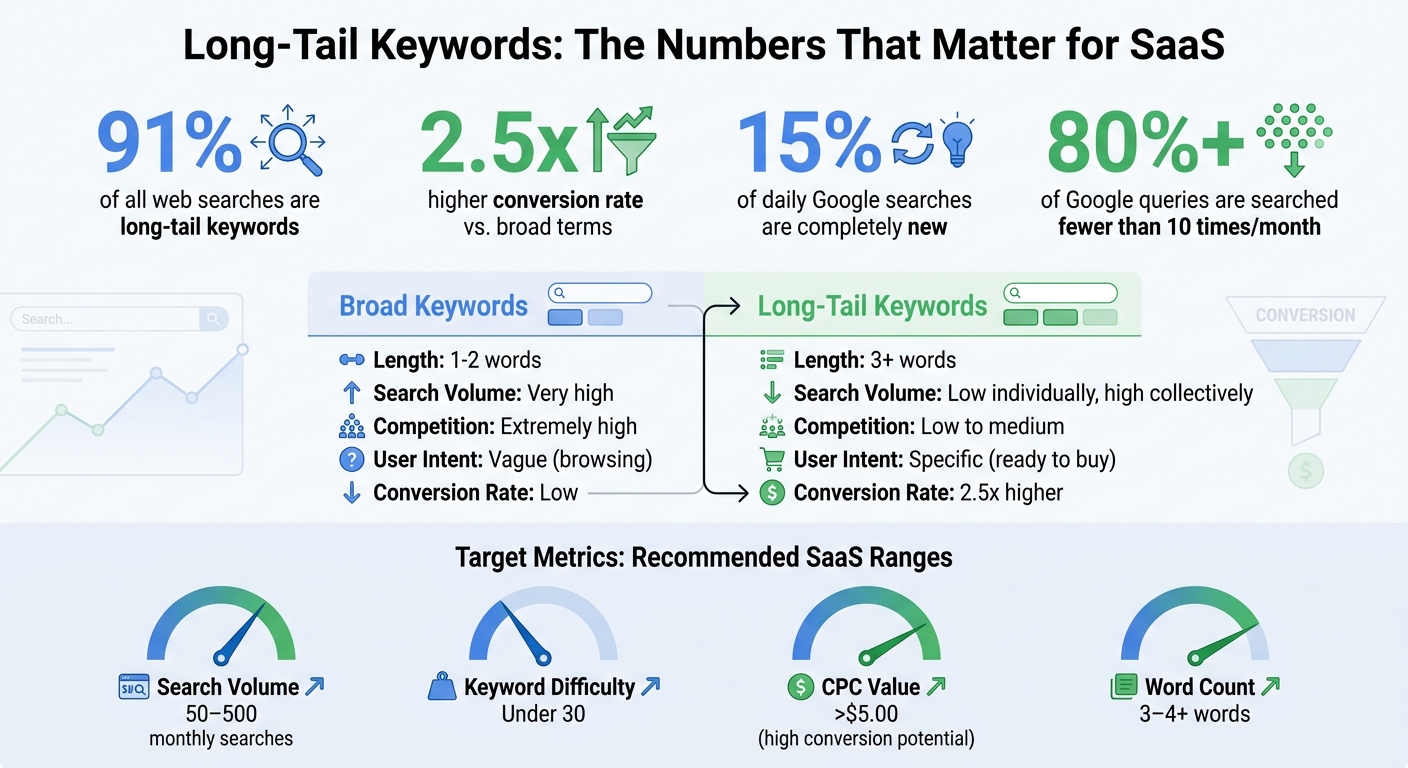
Long-Tail Keywords Statistics and Metrics for SaaS Success
What Long-Tail Keywords Are and Why They Matter
What Are Long-Tail Keywords?
Long-tail keywords are specific, multi-word phrases that pinpoint a user’s exact intent when searching online. Instead of a broad search like "accounting software", someone might type "free accounting software for nonprofits." These keywords are called "long-tail" because they sit at the less-trafficked end of the search demand curve. While each phrase may only attract a small number of searches per month, together, they account for the majority of online queries. In fact, about 15% of Google searches made daily are completely new.
What makes long-tail keywords so effective is their ability to capture intent. As Amit Bachbut, Director of Growth Marketing at Yotpo, explains:
"The shift to long-tail is a shift to intent. You aren't just capturing traffic; you're capturing a mindset. When a customer searches with specificity, they are telling you exactly what they need to convert."
This focus on intent is particularly useful for niche SaaS businesses, which thrive on addressing specific customer needs.
Why Long-Tail Keywords Work for Niche SaaS
For niche SaaS companies, long-tail keywords are a natural fit. These businesses cater to specialized audiences, providing solutions to highly specific problems. Instead of trying to appeal to everyone, they target a well-defined group of users.
Take Wave, for example. They created landing pages tailored to distinct segments of their audience. By July 2025, their page optimized for "free accounting software for nonprofits" ranked in the top three results for 25 different keywords. This effort brought in organic traffic valued at around $2,600 for the month. This example highlights how targeting specific, low-competition keywords can yield strong results without requiring a massive budget.
Main Benefits: Less Competition and Better Conversions
Long-tail keywords offer two standout advantages: lower competition and higher conversion rates.
Broad keywords like "CRM software" are highly competitive, often dominated by companies with deep pockets and extensive marketing strategies. In contrast, long-tail keywords often lead to results filled with outdated content or forum discussions, making them easier for a well-optimized SaaS page to rank. This process often begins when you analyze a competitor's website to identify which specific terms they are neglecting. Interestingly, over 80% of all Google queries are searched fewer than 10 times per month, which means most advertisers don’t even target them.
Even more compelling is their impact on conversions. Long-tail keywords convert at a rate 2.5 times higher than broad terms. For instance, if someone searches for "project management software for remote designers under $50/month", they’ve already narrowed down their options. They know their budget, team structure, and specific needs. All they’re looking for is the right match. If your SaaS fits their criteria, you’re one step closer to gaining a customer.
Here’s a quick look at how broad and long-tail keywords stack up:
| Feature | Broad Keywords | Long-Tail Keywords |
|---|---|---|
| Length | 1–2 words | 3+ words |
| Search Volume | Very high | Low individually, high collectively |
| Competition | Extremely high | Low to medium |
| User Intent | Vague (browsing) | Specific (ready to buy) |
| Conversion Rate | Low | 2.5x higher |
Another benefit of focusing on long-tail keywords is risk management. Instead of relying on a few high-ranking pages, you spread your traffic across many targeted pages. This diversification makes your site less vulnerable to sudden changes in search engine algorithms.
sbb-itb-0a8c96a
Step 1: Define Your Customer Profile and Starting Keywords
Identify Your Ideal Customer Profile
Before diving into keyword research, take a step back and define your target customer. This step is essential - without it, you risk wasting time on broad keywords that attract the wrong audience.
Start by analyzing your internal data. Sales call recordings, support tickets, and onboarding sessions are goldmines for understanding how your customers talk about their needs. Sales calls can reveal early concerns and pain points, while support tickets highlight recurring issues. Pay close attention to the exact language customers use when describing their challenges - it’s the key to creating keywords that resonate.
Also, remember that within your target organizations, there are often multiple stakeholders with different priorities. For instance, a CTO might focus on security and compliance, a manager might prioritize improving workflows, and an end user could be searching for integrations or tutorials. Tailor your keyword lists to reflect these distinct roles.
To get started, create a pain point list with 5–7 specific challenges your customers face. Use their words, not your product’s feature names. For example, instead of "automated reconciliation", think about how they might phrase it, like "how to stop manually matching invoices." You can also pull insights from cancellation reasons or reviews on platforms like G2 to uncover recurring frustrations.
Here’s an example of how different stakeholders might search for similar tools:
| Stakeholder Role | Typical Challenges | Example Keywords |
|---|---|---|
| Engineering Manager | Agile tracking, sprint planning | "Agile project tracking", "Sprint planning software" |
| Product Owner | Roadmapping, feature prioritization | "Product roadmap tool", "Feature prioritization software" |
| CTO / Executive | Security compliance, enterprise scaling | "Project management security compliance", "ROI of [tool]" |
| End User | Tutorials, specific features, integrations | "How to use [feature]", "[Product] templates" |
Once you’ve nailed down your customer profile, you’ll be ready to turn these insights into specific keyword strategies. For SaaS founders, this process is the first step in building a sustainable growth engine.
Create Starting Keywords for Your SaaS Niche
The language your customers use is the foundation of effective keyword strategies. Take the challenges they describe and transform them into targeted search queries. For example, if a customer says, "I need something that automates invoicing for construction projects", you could create keywords like "invoice automation for construction companies" or "how to automate invoicing for contractors."
Instead of targeting broad terms like "HR software", drill down into micro-niches. Focus on specific queries such as "HR onboarding tool for construction companies" or "HR software for hospitals in the U.S.". These narrower terms often face less competition and yield higher conversion rates.
To build your keyword list, break down your product’s features and use cases. Each feature can inspire multiple long-tail keywords. For example, if your product supports "workflow automation", you could target phrases like "workflow automation for remote teams", "workflow automation under $50/month", or "workflow automation for design agencies."
If you’re running paid ads, don’t overlook your paid search data. Your "Search Terms" report can uncover phrases that are already driving conversions. These can become seed keywords for your organic strategy. Google Search Console is another powerful tool - use a regex pattern like .{25,} to filter for long-tail queries (25+ characters) that are already generating impressions.
Finally, organize your keywords by intent. Group them into categories such as:
- Problem Aware: Customers know they have an issue but aren’t sure what solutions exist.
- Solution Aware: Customers are exploring different types of tools.
- Product Aware: Customers are ready to buy and comparing specific products.
This approach ensures your content aligns with where your audience is in their decision-making process, making it more relevant and impactful.
Step 2: Find Long-Tail Keyword Opportunities with Tools
Use Keyword Research Tools
After defining your customer profile and identifying your starting keywords, it's time to expand your list using keyword research tools. Platforms like Semrush, Ahrefs, and KWFinder are great for pinpointing long-tail keywords that align with your niche SaaS audience.
When using these tools, apply filters to find the right keywords. For example, set search volumes between 0–1,000, keyword difficulty (KD) below 30, and word counts of 3+ or 4+ to focus on genuine long-tail opportunities.
To uncover conversational queries, use the "Questions" filter in tools like Semrush's Keyword Magic Tool. These question-based keywords are perfect for creating help documentation, blog posts, or FAQ sections. Tools like AlsoAsked, AnswerThePublic, and Answer Socrates specialize in pulling "People Also Ask" (PAA) data, revealing high-intent and problem-solving queries.
Pay attention to commercial intent. Even low-volume keywords with high CPC values can indicate strong conversion potential.
"A keyword with 40 monthly searches that converts at 8% is worth more than one with 2,000 searches that converts at 0.3%", says The SEO Engine Editorial Team.
When evaluating keywords, look for these signals:
| Signal | What to Look For | Why It Matters for SaaS |
|---|---|---|
| High CPC | $5.00+ in B2B niches | Suggests profitable traffic with strong conversion potential. |
| Low KD | Score under 20–25 | Indicates you can rank without needing a large backlink profile. |
| Buyer Intent | Keywords like "vs", "alternative", "pricing" | Shows searchers are in the decision-making stage. |
| Weak SERP | Forums (e.g., Reddit/Quora) in Top 10 | Signals a lack of high-quality content, creating an opportunity. |
Once you’ve identified these opportunities, dive into competitor data to find additional gaps.
Use Competitor Analysis Tools for Gap Analysis
Competitor analysis is essential for uncovering keywords where your competitors rank but you don’t. Tools can identify "Missing" keywords (those your competitors rank for, but you don’t) and "Weak" keywords (where both rank, but your competitor holds a stronger position).
Platforms like Competitor Analysis Tool make this process simple. In just a couple of minutes, you can compare your site to a competitor’s and pinpoint gaps in demand, messaging, and visibility. These tools also help prioritize which keywords to target based on growth potential.
Focus on "Keywords to Improve" - terms where your site already ranks in the top 20 but is outranked by competitors. These are often easier to optimize than entirely new keywords. If your SaaS caters to multiple verticals, analyze by subfolder to ensure you're comparing specific product sections rather than irrelevant data.
Don't rely solely on keyword difficulty scores. Check manually if the top results feature thin content, outdated material, or forums like Reddit or Quora. These gaps often indicate opportunities for higher-quality content. A study shows that about 81.80% of low-competition SaaS keywords lack forums on Google’s first page, presenting a clear chance to create better content.
Check PAA, Autocomplete, and Forums
To refine your keyword list further, tap into real-user language from search suggestions and forums. These sources often reveal long-tail keywords that traditional tools might miss. Google's "People Also Ask" (PAA) boxes, autocomplete suggestions, and industry forums are excellent for finding the exact phrases users type when searching for solutions.
Start with autocomplete tools like Soovle, which aggregate suggestions from search engines like Google, Bing, and Amazon. Enter your seed keyword and note the variations - it’s a direct reflection of how people search.
Forums and community platforms like Reddit (e.g., r/saas, r/startups), Quora, and Indie Hackers are goldmines for understanding the language your audience uses when discussing their challenges or looking for alternatives.
Don’t overlook your internal data. Google Search Console queries, sales call transcripts, and support tickets often highlight recurring phrases or specific "how-to" questions that may not show up in traditional keyword tools.
"The best long tail keywords aren't discovered in keyword tools - they're excavated from your own conversion data, sales transcripts, and competitor content gaps", says The SEO Engine Editorial Team.
Finally, look for keywords where the top 10 results include forums, outdated blog posts, or low-authority sites. These are green flags for ranking potential. When using tools like Semrush or Ahrefs, apply filters for KD below 20 and CPC above $5 to zero in on high-intent, low-competition opportunities.
Step 3: Evaluate and Organize Your Keywords
Check Keyword Metrics for Relevance
Once you’ve compiled a list of long-tail keywords, it’s time to refine it by analyzing key metrics. Focus on keywords with monthly search volumes between 50–500. Also, consider the keyword difficulty (KD) score - keywords with a KD below 30 are typically easier to rank for. But numbers alone aren’t enough. Take a closer look at the top 10 search results for each keyword. If you notice content that’s thin (under 500 words), outdated (older than two years), or dominated by forum threads, you’ve likely found an opportunity.
Don’t overlook cost-per-click (CPC) values either. A CPC of $5.00 or more often signals that a keyword attracts valuable, high-converting traffic. For example, research into "alternatives" keywords in the SaaS industry revealed an average KD of just 17.1 but a CPC of $14.70 - proving that low competition doesn’t always mean low value.
To streamline your prioritization, use a 3-signal scoring matrix. Rate each keyword from 1 to 5 based on these factors:
- Conversion proximity: How close the searcher is to making a purchase.
- Competitive gap: Your realistic chances of ranking.
- Content advantage: Your ability to create better content than existing results.
Focus on keywords with the highest combined scores. Additionally, check Google Search Console for keywords where you already rank in positions 8–20. These "low-hanging fruit" terms may require only slight optimization to boost their performance.
By evaluating these metrics, you’ll not only identify keywords with ranking potential but also find SEO gaps vs competitors to craft content that converts. Once your keywords are sorted, the next step is to organize them into structured content clusters.
Group Keywords into Content Clusters
After narrowing down your keywords, arrange them into content clusters using a hub-and-spoke model. This approach involves creating a central "pillar" page that covers a broad topic comprehensively, supported by 6–8 "spoke" articles that delve into specific subtopics or long-tail variations. For instance, a pillar page titled "Customer Onboarding for SaaS" could link to supporting articles such as "How to Automate Customer Onboarding Emails" or "Top Onboarding Checklists for B2B SaaS."
Organize keywords based on search intent, not just topic similarity. For example, if searches like "CRM for freelancers" and "freelance consultant CRM" yield similar results, it’s a sign that they share the same intent and should be addressed on a single page to avoid internal competition. Assign one primary keyword to each page and map related keywords to prevent cannibalization and maintain clarity. Ensure that every supporting article links back to the pillar page, and vice versa, to evenly distribute authority across the cluster.
This strategy has delivered impressive results. Between March 2021 and March 2023, Aura increased its blog traffic to 319,000 monthly visitors by building authority through structured clusters - 202 pages on "scams" and 149 pages on "hacks". Similarly, ClickHouse achieved a 40% boost in organic sessions and a 37% rise in sign-ups after adopting a pillar-cluster framework. These examples highlight how well-organized keyword clusters can lead to measurable business growth.
Lastly, align your content clusters with the buyer’s journey. Use informational keywords for awareness-stage content (e.g., "how to reduce churn in SaaS"), commercial keywords for consideration-stage content (e.g., "best CRM for startups vs Salesforce"), and transactional keywords for decision-stage content (e.g., "Salesforce pricing for small business"). This ensures you connect with your audience at every stage of their search journey, guiding them toward conversion effectively.
Long Tail Keywords: More Traffic + Less Competition
Step 4: Add Keywords to Your Content and Track Results
Now that you’ve researched and organized your keywords, it’s time to weave them into your content and keep an eye on how they perform.
Add Keywords Naturally to SaaS Content
The key to effective keyword integration is to make it feel natural. Place your primary long-tail keyword in strategic spots like the page title, H1 tag, the first 100 words, one H2 tag, and image alt text. But don’t overdo it - forcing exact matches can make your content clunky and unappealing to readers. Search engines are smart enough to understand the intent behind your content, even if the keywords aren’t an exact match.
Each long-tail keyword should guide the focus of your content. For instance, if your target phrase is "Agile project management for remote teams", create a landing page that directly addresses this topic. A general page won’t deliver the same tailored experience your audience is looking for. To build authority, cover related subtopics and variations naturally. A single, well-crafted page can rank for multiple related phrases without resorting to keyword stuffing.
You can also refine your content by analyzing customer interactions. Take cues from support tickets and sales emails to fine-tune the language and messaging on your landing pages. Map your keywords to different stages of the buyer’s journey: use "how-to" queries for top-of-funnel content, comparisons for mid-funnel, and "alternative to" searches for bottom-of-funnel prospects ready to make a decision. Don’t dismiss zero-volume keywords outright - check if they signal high buyer intent before deciding to ignore them.
Once your keywords are thoughtfully integrated, it’s time to measure their impact.
Track Performance and Adjust Your Approach
After adding keywords, regular performance tracking is essential. Use tools like Google Search Console to monitor metrics such as indexing, rankings, and click-through rates (CTR) on a weekly basis. For indexing, you can use the site:yourdomain.com/page-url command or the URL Inspection tool. If a new page doesn’t break into the top 50 rankings within 60 days, revisit its content and internal linking strategy.
Instead of focusing solely on traffic volume, prioritize revenue per keyword. For example, a keyword with just 40 monthly searches but an 8% conversion rate can outperform one with 2,000 searches and a 0.3% conversion rate. Pages ranking in the top three positions should ideally achieve a CTR between 15% and 35%. If your CTR is below 10% despite strong rankings, consider rewriting your title tags and meta descriptions. Use Google Search Console to export queries where you’re getting impressions but few clicks - these are prime opportunities for optimization.
Diversify your traffic across long-tail pages to protect against sudden ranking drops caused by algorithm updates. Tools like the Competitor Analysis Tool can help you spot gaps in your messaging and visibility, allowing you to prioritize which pages need attention first. Ultimately, success isn’t just about traffic - it’s about linking your long-tail page performance to tangible outcomes like demo sign-ups, qualified leads, and sales velocity.
Conclusion
Focusing on long-tail keywords can elevate your strategy from simply being seen to actually acquiring customers.
These keywords aren't just a tactic; they're a game-changer for niche SaaS businesses. While a single long-tail keyword might only attract 30–50 visitors per month, scaling up with 100–500 well-optimized pages creates a traffic engine that's hard for competitors to replicate. Plus, this diversified approach minimizes the risk of being impacted by algorithm updates that target high-volume keywords.
The payoff is clear. Long-tail keywords often convert at much higher rates because they attract users who already know what they need. This precision leads to better-quality leads and shorter sales cycles, aligning perfectly with earlier steps in identifying and organizing keywords for maximum results.
"Big keywords give you visibility. Long-tail keywords give you customers." - Nazish Marvi, Business, Tech & Finance Writer
As buyers increasingly search for niche solutions, your ideal customers are looking for specialized answers, not generic options. Use the exact language from support tickets, sales conversations, and community discussions to position your SaaS as the perfect fit. Tools like Competitor Analysis Tool can help pinpoint gaps in your competitors' strategies, revealing untapped long-tail opportunities.
FAQs
How many long-tail pages do I need to see meaningful results?
Targeting 30 to 50 long-tail pages is often sufficient to see solid SEO results in niche SaaS markets. This approach allows you to tap into a mix of high-intent, low-competition keywords, which can bring in more focused traffic and boost conversions. The key is to craft content that matches what users are actively searching for, ensuring it aligns perfectly with their needs and expectations.
How do I pick long-tail keywords that actually drive demos or sales?
To select long-tail keywords that lead to demos or sales, concentrate on precise, intent-focused phrases that align with what your customers are searching for at different stages of the buying process. Look for low-competition keywords with strong intent, such as phrases related to competitor alternatives or specific problems your product solves. It's also helpful to connect keywords to different funnel stages - top, middle, or bottom - so you can effectively target prospects who are closer to making a purchase. Using tools like competitor analysis can help you discover niche, high-converting keywords that others might be overlooking.
How do I avoid keyword cannibalization when building content clusters?
To prevent keyword cannibalization within content clusters, it's essential to assign each piece of content a unique long-tail keyword that targets a specific buyer stage or intent. By doing this, you ensure that every page serves a distinct purpose and avoids competing with others on your site. Developing a clear keyword mapping strategy can help you organize these keywords effectively, ensuring there's no overlap between pages. This method allows your content to work together harmoniously, boosting SEO performance while aligning perfectly with user intent.