
How Market Segmentation Boosts SaaS Positioning
Segmentation is the foundation of SaaS positioning—target customer slices to sharpen messaging, cut CAC, and boost retention.

Market segmentation is the key to improving SaaS product positioning. By dividing your audience into smaller, well-defined groups, you can create messaging and strategies that connect directly with their needs. This approach solves common SaaS challenges like unclear messaging, high acquisition costs, and difficulty standing out from competitors.
Here’s what segmentation does:
- Clarifies Messaging: Tailor your value proposition to resonate with specific groups.
- Reduces Costs: Avoid wasting resources on unqualified leads.
- Improves Differentiation: Focus on gaps competitors overlook.
- Boosts Retention: Address customer needs more effectively.
Top segmentation models include:
- Firmographic: Groups based on company size, industry, or revenue.
- Behavioral: Focuses on product usage and engagement patterns.
- Job-to-Be-Done (JTBD): Centers on the outcomes customers want to achieve.
4 Main Types of Market Segmentation & Their Benefits
sbb-itb-0a8c96a
Positioning Problems That Come From Poor Segmentation
Poor segmentation can derail your entire go-to-market strategy. By understanding the challenges it causes, it becomes clear why tailoring strategies to specific segments is non-negotiable.
Vague Value Propositions and Messaging
When messaging is too broad, it fails to communicate any clear value. This kind of generic language, often referred to as "adjective soup", may sound polished but lacks substance for any specific audience. It doesn’t clarify your product’s unique benefits, and worse, your competitors are likely using the same tired phrases.
Here’s the reality: buyers need to feel like your product addresses their specific needs, or they’ll move on. Research shows that B2B buyers spend just 6.5 seconds evaluating a vendor before deciding whether to engage further. If your homepage copy could easily fit any competitor by swapping out the logo, your positioning isn’t resonating. As April Dunford, an expert in positioning, explains:
"Positioning is the process of deliberately defining how your product is the best in the world at delivering something a well-defined set of customers cares a lot about."
High Acquisition Costs and Low Conversion Rates
Unclear messaging isn’t the only issue. Broad targeting also drives up costs. When you try to market to everyone, you end up wasting money on people who aren’t ready to buy, don’t need your product, or are already committed to a competitor. This bloats your Customer Acquisition Cost (CAC) without delivering meaningful results.
The problem doesn’t stop there. Sales teams often waste time and resources pursuing accounts that are stuck in internal bottlenecks, such as complex procurement processes or lengthy approval chains.
"Every time your team engages an account trapped in procurement lockdown, your acquisition costs skyrocket... Your SDRs stop selling and transform into unpaid IT consultants." - Ciente Editorial Team
The data underscores the importance of alignment: misalignment between sales and marketing on segmentation definitions can slash win rates by up to 68%. On the flip side, segmented email campaigns can generate 760% more revenue than their non-segmented counterparts.
Difficulty Standing Out From Competitors
Without strong segmentation, it’s almost impossible to differentiate yourself. If you’re chasing the same broad audience and using the same generic language as your competitors, buyers won’t see a reason to choose your product over others. Poor segmentation also stifles the creation of distinct market categories that could set you apart.
Companies that successfully define a clear market category and focus on a specific audience often see 2–3x higher win rates compared to competitors stuck in commoditized markets. Take Gong, for example: by shifting from "sales coaching tools" to creating the "revenue intelligence" category, they expanded their audience from sales managers to entire revenue teams, including executives like CEOs and CFOs. This strategic move helped them achieve $200M ARR by 2021.
Common Failure Modes of Poor Segmentation
The table below highlights the typical symptoms and root causes of segmentation issues:
| Failure Mode | Symptom | Root Cause |
|---|---|---|
| Adjective Soup | Homepage uses vague terms like "powerful" or "intuitive" | No unique attributes identified; team uses fillers |
| Overly Broad ICP | Messaging targets "any B2B company" | Fear of narrowing the TAM in the founder's mind |
| Positioning Drift | Every sales rep tells a different story | No central, codified positioning canvas |
| Wrong Reference Frame | Sales positions against enterprise rivals while buyers use spreadsheets | Failure to conduct win/loss interviews |
| Category Confusion | Buyers don’t know which "mental bucket" to put the tool in | Attempting to be three categories simultaneously |
These challenges highlight the need for a targeted segmentation strategy to strengthen your positioning and messaging.
Market Segmentation Models SaaS Companies Can Use
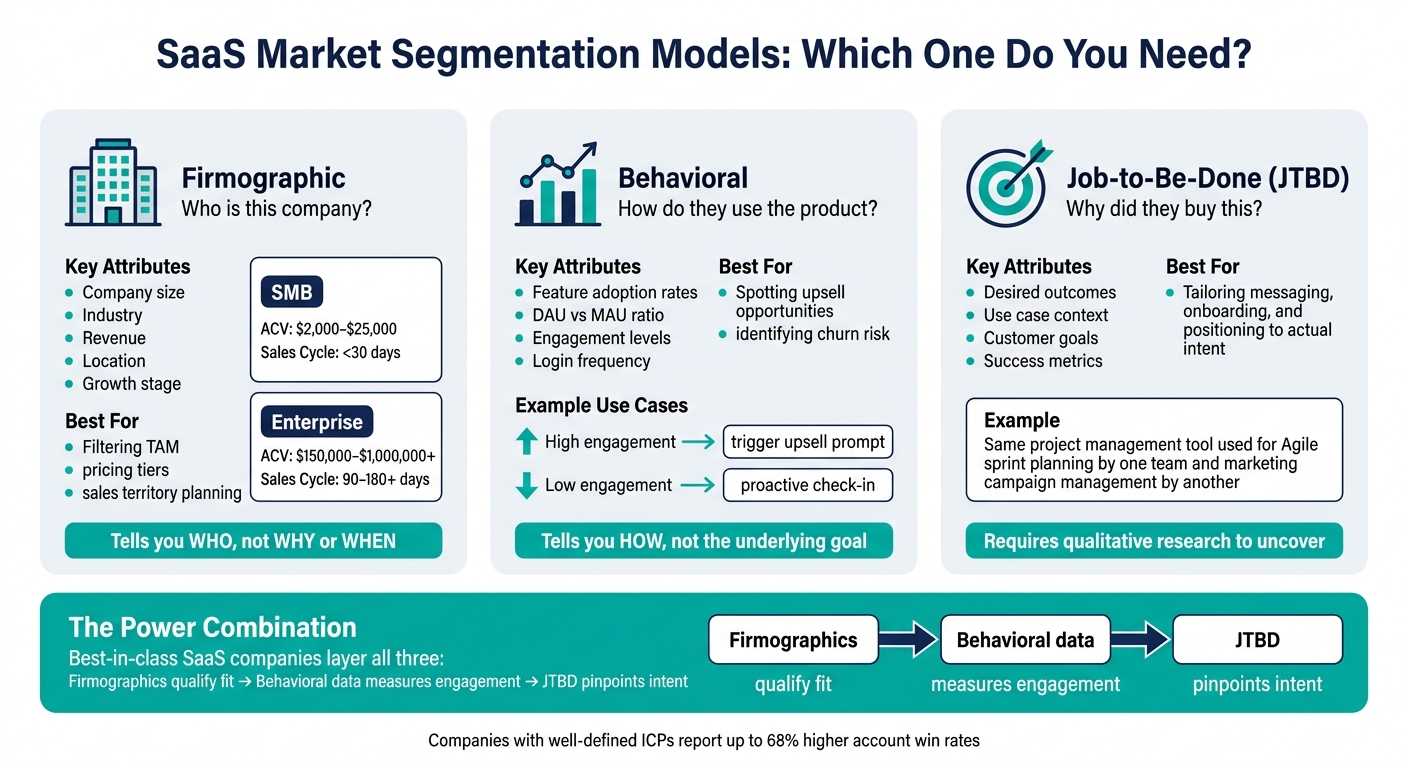
SaaS Market Segmentation Models: Firmographic vs Behavioral vs JTBD
Segmentation models help SaaS companies address specific customer challenges. Three key frameworks stand out for positioning: firmographic, behavioral, and job-to-be-done (JTBD) segmentation. Each tackles a different aspect of understanding your customers.
Firmographic Segmentation
Firmographic segmentation categorizes companies based on measurable traits like company size, industry, revenue, location, and growth stage. It answers the question, "Who is this company?" and is useful for tasks like filtering your total addressable market (TAM), setting pricing tiers, or planning sales territories.
For example, the economics of selling to a small business (SMB) versus an enterprise are worlds apart. SMB deals often range between $2,000 and $25,000 in annual contract value (ACV), with short sales cycles of under 30 days. In contrast, enterprise accounts can bring $150,000 to over $1,000,000 ACV, but the sales process may stretch 90–180 days or more. Treating these segments the same way can waste resources and derail your sales approach.
However, firmographics have their limits. While they tell you who the buyer is, they don’t reveal whether they’re ready to purchase or what they actually need. It’s a good starting point, but not a complete solution.
Behavioral and Usage-Based Segmentation
Behavioral segmentation focuses on how customers interact with your product. Key metrics include feature adoption rates, daily active users (DAU) versus monthly active users (MAU), and overall engagement levels. This approach is particularly effective for spotting upsell opportunities or identifying accounts at risk of churn.
As Vrushti Oza, Content Marketer at Factors.ai, explains:
"If the segment doesn't change the playbook, it lacks distinct strategic impact."
Consider two accounts: one with daily users adopting multiple features versus another with sporadic logins and limited usage. These two scenarios call for different strategies. Behavioral data lets you act at the right moment - whether that’s triggering automated upsell prompts when a team nears its seat limit or scheduling a proactive check-in when engagement drops.
Job-to-Be-Done Segmentation
Job-to-be-done (JTBD) segmentation groups customers based on the specific outcomes they aim to achieve - essentially, the "job" they hired your product to perform. It answers the question, "Why did they buy this?"
The same tool can solve entirely different problems for different users. For example, a project management platform might support Agile sprint planning for one team while another uses it to manage marketing campaigns. These distinct use cases require tailored messaging, onboarding experiences, and success metrics. JTBD segmentation uncovers these differences so you can align your positioning with actual customer goals rather than relying on assumptions.
Bringing It All Together
The most effective SaaS companies combine all three models. Firmographics qualify initial fit, behavioral data measures engagement, and JTBD pinpoints customer intent. By layering these approaches, you create a more precise and effective segmentation strategy.
How Segmentation Improves SaaS Positioning in Practice
Once you've defined your segmentation models, the next step is applying them to refine your product positioning. This means aligning your value propositions, customer profiles, and competitive strategies with the right audience. The key difference between a SaaS company that struggles and one that consistently closes deals often lies in how well their messaging resonates with their target segments. Let’s break down how segmentation sharpens these critical areas.
Building Segment-Specific Value Propositions
One of the biggest challenges SaaS companies face is vague messaging. Segmentation solves this by enabling you to deliver value with precision. Broad, generic messaging can stall growth, while tailored positioning grabs the attention of the right audience.
A simple yet effective formula for crafting segment-specific messaging is: "We help [ICP] achieve [benefit] so they [outcome]." This approach keeps your message focused on customer goals rather than drowning in feature lists. For example:
- An SMB-focused segment might value speed and simplicity, like offering a "free tier for bootstrapped teams."
- Enterprise customers may prioritize consolidation and governance, such as "replacing six tools with one platform ready for compliance."
Your messaging should also align with the buyer's journey. At the top of the funnel, educate potential customers about the category. Mid-funnel content should address specific pain points, while bottom-funnel messaging highlights your unique value and reduces perceived risks. Segmentation ensures each stage of the journey feels relevant and targeted.
But segmentation isn’t just about messaging - it also helps you define exactly who your ideal customers are.
Refining Ideal Customer Profiles (ICPs)
Segmentation data provides a solid foundation for developing a sharp Ideal Customer Profile (ICP). Instead of guessing who your best customers might be, analyze past successful deals to uncover patterns. Look at your last 20–30 high-value, fast-closing accounts to identify common firmographic, behavioral, and technographic traits.
This data-driven approach can significantly improve outcomes. Companies with well-defined ICPs report up to 68% higher account win rates. To ensure your segments are actionable, verify that they can be targeted through your CRM, ad platforms, or sales channels. A good rule of thumb is to focus on 4–6 clearly defined segments. Any more, and you risk spreading your resources too thin.
A strong ICP not only clarifies your audience but also helps you uncover competitive advantages.
Getting a Clearer Edge Over Competitors
Segmentation doesn’t just improve messaging - it also highlights areas where you can outperform competitors. By understanding the specific needs, frustrations, and tech environments of your target segments, you can identify gaps that broader competitors might miss.
One effective tool is a 2x2 matrix. Use it to map competitors along two customer-relevant attributes that are both defensible and meaningful. This exercise can reveal positioning opportunities that set you apart. For instance, if your segment values deep integrations with a specific tech stack and your competitor doesn’t prioritize this, you’ve found a clear advantage.
"Positioning is the architectural decision that determines what every other marketing and sales asset says, because it answers the prior question: best at what, for whom, against which alternatives?" - Peter Vogel, Founder, peppereffect
Tools like Competitor Analysis Tool can speed up this process by highlighting messaging gaps and visibility differences between your website and a competitor’s. When combined with segmentation insights, these tools enable you to make deliberate, informed choices about how to position your product effectively. Instead of guessing, you’ll know exactly where and how to compete.
A Step-by-Step Guide to Market Segmentation for SaaS
Knowing which segmentation models to use is just the beginning. The real challenge lies in turning that knowledge into a practical and repeatable strategy. Here's how to go from theory to action.
Start With a Data Audit
Before defining your segments, take a close look at your data. Pull information from key sources like your CRM (e.g., HubSpot, Salesforce), product analytics tools (e.g., Amplitude, Pendo), billing systems (e.g., Stripe, Chargebee), and support platforms (e.g., Zendesk). Each of these sheds light on different aspects of your customers - like firmographics, usage patterns, expansion trends, and recurring issues.
"A marketing audit is not a creative exercise. It is a diagnostic exercise. You are not looking for inspiration - you are looking for what is broken, what is underperforming, and where the highest-leverage improvements exist." - Alexander Chua, Co-Founder, Growigami
Focus on a 12-month data window to capture seasonal trends. Start by identifying your highest-LTV customers. Export CRM and product analytics data to spot patterns among accounts with the highest Annual Recurring Revenue (ARR) and lowest churn rates. Pay attention to any gaps in your data - if you're missing behavioral or technographic insights, it could limit how accurately you can group customers. Once you've got a clear picture of your data, you're ready to define meaningful segments. This process often involves learning how to analyze competitor website data to identify where they are winning and where you can differentiate.
Define and Prioritize Your Segments
After cleaning up your data, narrow your focus to segments where your message has the most impact.
"The goal of segmentation is not to find every possible slice of your market. The goal is to find the slices where your message lands with enough force to change behavior." - Samim Safaei, Founder, siift.ai
Evaluate potential segments based on their revenue potential, how well they align with your strategy, and how easily you can reach them through your current sales and marketing efforts. Look for opportunities where bigger competitors fall short - whether it’s due to their broad customer focus, outdated systems, or organizational inertia. Create separate segments only when buyers have distinct processes, needs, or value drivers. Aim for 4–6 well-defined segments - any more, and your resources could get stretched too thin, making execution harder.
Here’s a breakdown of how typical segment types align with deal size and sales approaches:
| Segment | ACV Range | Sales Cycle | Sales Model |
|---|---|---|---|
| SMB | $2K–$25K | 0–30 days | Self-serve / Product-led |
| Mid-Market | $25K–$150K | 30–90 days | Inside Sales / Hybrid |
| Enterprise | $150K–$1M+ | 90–180+ days | Field Sales / ABM |
(Source:)
Once you’ve defined your segments, the next step is to test and refine your strategy.
Test and Refine Positioning by Segment
With your segments in place, it’s time to validate your positioning. Run targeted campaigns - think paid ads, cold outreach, or custom landing pages - that address the specific needs and pain points of each segment. Measure results by segment, not as a whole, to see what’s working.
Early metrics like outbound reply rates and demo requests (within 30 days) can give you quick feedback. Over time (60–180 days), track metrics like sales cycle length, win rates, and ACV to assess the impact. For instance, fine-tuned segment-specific messaging can boost cold outbound reply rates by 30%–80% within the first month.
Keep refining your approach. Conduct deep audits annually and adjust your segment criteria every quarter to stay in sync with market changes. Use a structured 90-day rollout plan: spend 30 days aligning internal teams, 30 days deploying updated messaging, and 30 days amplifying and measuring the results.
Conclusion: Why Segmentation Is the Foundation of SaaS Growth
After diving into practical segmentation strategies, it’s easy to see why they’re so crucial for SaaS growth. Many SaaS positioning problems boil down to weak segmentation. By focusing on specific customer needs, segmentation solves issues like unclear messaging, high acquisition costs, and blending in with competitors. It helps refine your targeting, clarify your value proposition, and attract the right audience.
The numbers back this up. Companies using advanced segmentation strategies experience up to 10% faster annual growth, 20–30% higher retention rates, and 14% higher revenues compared to those sticking with generic approaches.
"Positioning is the most leveraged asset a $10M–$40M ARR SaaS company owns. AI has commoditized features. The only durable moat is a documented answer to... who you serve." - Peter Vogel, Founder, peppereffect
The competitive benefits are undeniable. Take Drift, for example. By restructuring its go-to-market efforts into three clear segments - Enterprise, Mid-market, and SMB - the company saw 35% higher win rates in enterprise accounts and 41% faster sales cycles in the mid-market. These results didn’t come from tweaking the product; they came from a laser-sharp focus on segmentation.
To anchor your strategy in actual market insights, tools like the Competitor Analysis Tool can help you spot messaging gaps and opportunities. Use it to uncover areas for improvement before diving into a segmentation revamp.
FAQs
How do I choose the right SaaS segments to focus on first?
The first step is to pinpoint the group that aligns most naturally with your product. Use firmographic filters like company size and industry, along with behavioral data, to carve out well-defined segments.
To ensure these segments are actionable, check that they are:
- Measurable: Can you track and quantify them?
- Reachable: Are they accessible through your marketing efforts?
- Substantial: Is the segment large enough to justify your focus?
By narrowing your focus, you can improve both clarity and efficiency in your strategy. Keep a close eye on high-value customer segments, and only consider expanding once you’ve achieved strong retention rates and a solid market share within your initial target group.
What data do I need to build accurate segments?
To build precise audience segments, blend various data types to get a comprehensive picture. Begin with firmographic data, such as company size, industry, and revenue. Layer in technographic data, like the technologies they use. Then, incorporate behavioral and intent data to understand their engagement levels and buying stage. To round it all out, use qualitative insights from customer interviews to confirm your segments align with actual behaviors and needs.
How can I test if my positioning works for each segment?
To fine-tune your positioning, follow a structured process that works across three layers: Ideal Customer Profile (ICP), problem framing, and differentiation. Start by conducting 8–10 interviews with two key groups: recent customers and lost prospects. These conversations will help you validate your assumptions and adjust your approach.
During the interviews, focus on understanding your buyers’ challenges. This will help you refine how you frame the problem your product or service solves. To evaluate differentiation, dig into what factors influenced their decisions - both for and against your offering.
Once you've gathered insights, run small tests targeting different segments. Track metrics like deal velocity and conversion rates to see which groups respond most positively. This approach will help you uncover the segments where your positioning resonates best.